Biometric Key Rotation: Securing Tunnels with Real-Time Wearable Entropy
IT
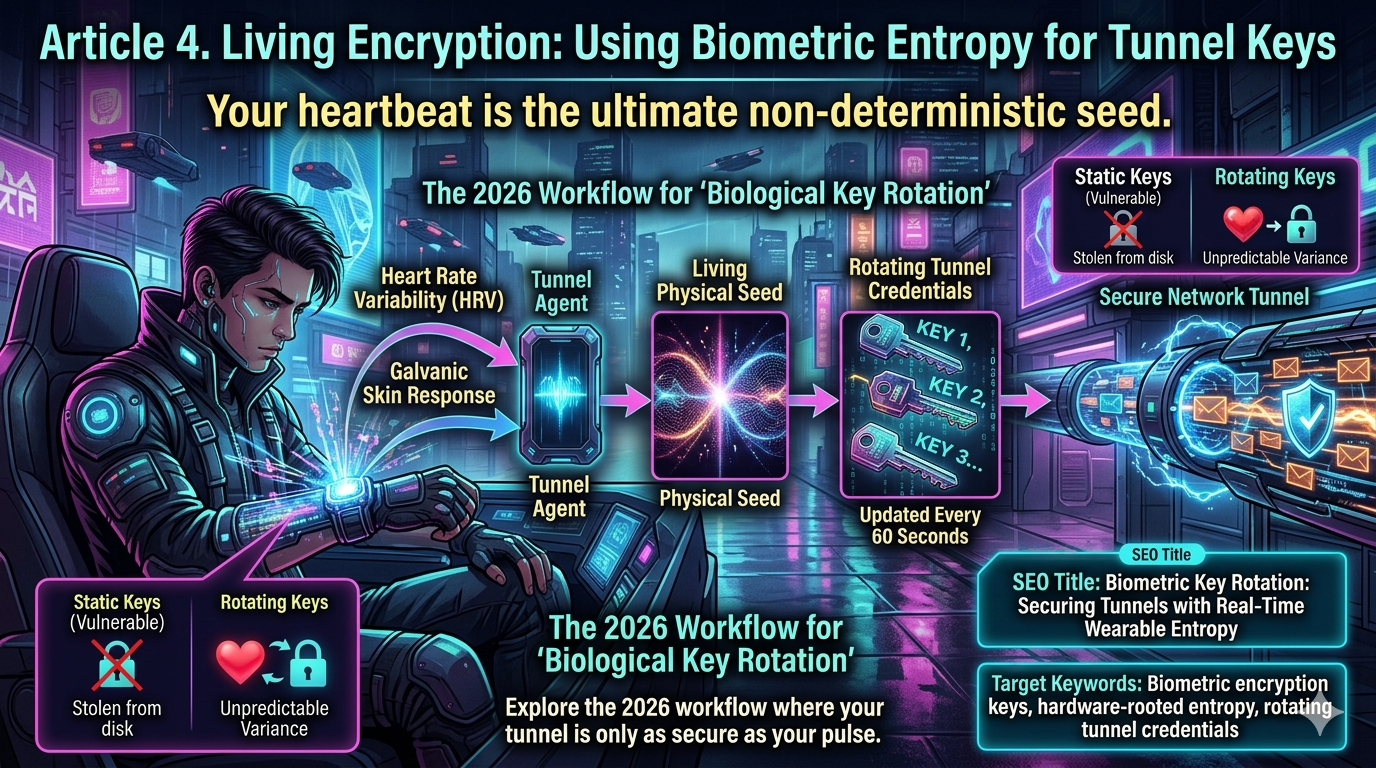
Biometric Key Rotation: Securing Tunnels with Real-Time Wearable Entropy
Your heartbeat is the ultimate non-deterministic seed. Here is how the emerging 2026 workflow of biological key rotation is transforming tunnel security — and why your pulse may be the strongest lock you have.
The Fragility of Static Cryptographic Material
For decades, the security of encrypted tunnels — VPNs, SSH sessions, TLS API pipes — has rested on a single fragile foundation: static cryptographic keys stored on physical disks. Even when wrapped within robust architectures like Public Key Infrastructure (PKI) or backed by Hardware Security Modules (HSMs) and Trusted Platform Modules (TPMs), these static keys represent a permanent, high-value target.
Sophisticated threat actors in 2026 employ advanced memory-dumping techniques, hypervisor-level introspection, and cold-boot attacks to intercept keys at the moment they are loaded into volatile memory for cryptographic processing. Technologies like Apple’s Secure Enclave Processor (SEP) and Windows DPAPI (Data Protection API) create meaningful barriers, but they are not infallible.
The problem compounds at the entropy layer. Pseudo-random number generators (PRNGs) running on traditional silicon — even those leveraging hardware True Random Number Generators (TRNGs) like Intel’s RDRAND instruction — are subject to deterministic vulnerabilities if the underlying hardware design is compromised or if an attacker can manipulate environmental conditions such as voltage or temperature at the CPU level.
When an encryption key remains static for hours, days, or months, an attacker has an extended window to capture, analyze, and exploit the credential. The industry responded with ephemeral key exchanges such as Perfect Forward Secrecy via Diffie-Hellman, but even these systems rely on a static primary identity key to authenticate the initial handshake. If that key is stolen from disk, a Man-in-the-Middle (MitM) attacker has enduring leverage.
The “Harvest Now, Decrypt Later” Threat Is Already Active
Before exploring solutions, it is important to understand the threat landscape that makes this work urgent.
“Harvest Now, Decrypt Later” (HNDL) is not a theoretical future risk — it is an active, ongoing attack strategy. State-sponsored actors are intercepting and storing encrypted enterprise traffic today, banking on future quantum computing capability to decrypt it. The FBI, CISA, and NIST have all publicly acknowledged HNDL as a present-day threat, and the U.S. Department of Homeland Security, the UK National Cyber Security Centre, the European Union Agency for Cybersecurity, and the Australian Cyber Security Centre all base their official post-quantum guidance on the premise that adversaries are already collecting and storing sensitive long-lived data.
The quantum timeline is compressing faster than expected. Three research papers published between May 2025 and March 2026 progressively reduced the estimated qubit count needed to break RSA-2048 encryption — from roughly 20 million qubits (a 2019 estimate) down to under one million in a 2025 Google paper, and then further to potentially under 100,000 physical qubits in a February 2026 preprint. These figures are directional, not definitive — but they move in one direction only, and consistently faster than most enterprise security timelines anticipated.
NIST finalized its first three post-quantum cryptography standards in August 2024 — ML-KEM (FIPS 203), ML-DSA (FIPS 204), and SLH-DSA (FIPS 205) — and HQC was selected as an additional code-based KEM backup in 2025. The NSA’s CNSA 2.0 roadmap mandates PQC deployment for new classified systems by 2027 and full migration by 2035. For enterprises in financial services, healthcare, and defense, the window for “harvest now, decrypt later” attacks has very likely already crossed a critical threshold.
An ISACA survey of over 2,600 security professionals in 2025 found that 62% are concerned quantum computing will compromise today’s encryption — but only 5% have a defined quantum strategy in place. That gap is precisely where HNDL exposure accumulates.
The Paradigm Shift: Living Encryption
Against this backdrop, forward-thinking security architectures are shifting away from static, long-lived credentials toward dynamic, ephemeral environments. The most significant evolution of this trend is what is now being called Living Encryption — tying the generation of cryptographic material directly to the real-time physiological telemetry of a human operator.
Instead of a permanent private identity key stored on an SSD or in a TPM, a tunneling agent running under this architecture generates short-lived, ephemeral rotating tunnel credentials every 60 seconds. The cryptographic seed — the foundational number used to generate each key pair — is pulled dynamically from the genuine, chaotic, and non-deterministic physiological variations of the human user at the terminal.
Commercial and enterprise-grade wearables serve as the entropy source: Apple Watch Ultra, Whoop, Oura Ring, and purpose-built biometric identity bands. The human body becomes a continuous, living stream of high-quality cryptographic entropy.
Why Human Biology Is Cryptographically Valuable
Traditional biometric authentication — fingerprints, facial geometry — is fundamentally static. A fingerprint does not change. If a fingerprint database is breached or a high-resolution mold is created, that biometric marker is compromised permanently.
Living Encryption uses dynamic biometric telemetry, not static identifiers. Specifically:
Heart Rate Variability (HRV): The precise, millisecond-level variation in time intervals between consecutive heartbeats — the Inter-Beat Interval (IBI). HRV is regulated by the autonomic nervous system and fluctuates continuously based on microscopic physiological changes: stress levels, respiration, cognitive load, and even temperature. Research published in PMC (March 2024) and ScienceDirect (2024–2025) has validated the use of PPG-derived HRV as a viable, high-entropy continuous authentication signal.
Galvanic Skin Response (GSR) / Electrodermal Activity (EDA): Continuous changes in skin electrical characteristics caused by microscopic sweat gland activity, reflecting real-time sympathetic nervous system arousal.
These fluctuations are governed by a massive array of interdependent biological feedback loops. An attacker sitting across a network — or a piece of malware monitoring a device — cannot predict whether a user’s next inter-beat interval will be 742 milliseconds or 748 milliseconds. That micro-variance is precisely what makes biological signals valuable as a cryptographic entropy source.
This has been validated in peer-reviewed research. A prototype chip developed at Arizona State University combined three entropy sources — ECG features, HRV, and an SRAM-based Physical Unclonable Function (PUF) — to perform real-time authentication and generate 256-bit random numbers. The system was tested against 741 subjects and fully passed NIST statistical randomness tests, achieving an equal error rate eight times better than ECG-only schemes. The chip operated at just 8.013 μW at 0.6V, demonstrating practical feasibility on embedded hardware.
Separately, a peer-reviewed study published in Sensors (August 2025) by researchers at the Faculty of Electrical Engineering, Osijek, demonstrated that entropy generated from Samsung Galaxy Watch sensors in shake mode reached a Shannon entropy of 0.997 and a min-entropy of 0.918 — approaching levels of software-based random number generators. The study confirmed that smartwatches can serve as practical, user-controlled entropy sources for local cryptographic key generation on commercial Wear OS devices using only standard APIs.
Technical Architecture: The 60-Second Rotation Workflow
Implementing Living Encryption requires a tightly integrated ecosystem: a biometric wearable, a secure local transit channel, a host-side tunneling agent, and a zero-trust network gateway. The conversion of a heartbeat into a verified, post-quantum secure tunnel key occurs across five distinct layers.
+------------------+      Encrypted BLE/UWB      +-------------------+
|  Wearable Device | --------------------------> | Local Host Device |
| (HRV / GSR Data) |                             |  (Tunnel Agent)   |
+------------------+                             +-------------------+
                                                           |
                                                           | Entropy Extraction
                                                           v
+------------------+       Validates Key         +-------------------+
| Remote Gateway   | <-------------------------- | Cryptographic KDF |
| (Zero-Trust Node)|    WireGuard / Noise Proto  | (HKDF-SHA256 Seed)|
+------------------+                             +-------------------+
Step 1 — Physiological Telemetry Capture
Specialized photoplethysmography (PPG) sensors emit light into the user’s skin to measure blood flow volume changes, capturing the exact timestamp of each cardiac contraction at sub-millisecond resolution. Concurrently, EDA sensors measure skin conductance. This raw, unformatted time-series data forms the baseline input.
Step 2 — Secure Local Transit
The wearable transmits raw telemetry to the local workstation over Bluetooth Low Energy (BLE) 5.4 or Ultra-Wideband (UWB) channels secured via Out-of-Band (OOB) pairing. The data payload is encrypted using a local session key established when the user initially authenticated via traditional means — typically a hardware security key such as a YubiKey combined with a local PIN.
Step 3 — Entropy Extraction and Quantization
Raw biological metrics cannot be used directly as cryptographic seeds because they do not have a uniform distribution — human heart rates naturally cluster within predictable ranges. To resolve this, the tunneling agent processes raw Inter-Beat Intervals (IBIs) through a Fuzzy Extractor or an Extract-and-Expand Key Derivation Function such as HKDF-SHA256.
The extractor stage harvests pure cryptographic randomness — the unpredictable micro-variances — from the biased biological input, outputting a highly random, uniform bitstring. The expand stage combines this bitstring with a local hardware-rooted entropy source (the computer’s TPM 2.0 TRNG) and a rotating cryptographic salt, producing a 256-bit or 512-bit seed. Research on ECG-based bio-crypto key generation (published in PMC, 2024) achieved a maximum entropy of 0.99 using this approach, with an authentication accuracy of 95%.
Step 4 — Ephemeral Key Generation
Using the biologically-derived seed, the tunneling agent constructs a brand-new cryptographic key pair. In 2026 architectures this typically means generating an ephemeral keypair optimized for WireGuard (Noise Protocol Framework) with a hybrid ML-KEM-768 component for post-quantum resilience — aligning with the NIST FIPS 203 standard finalized in August 2024.
As Cloudflare noted in their March 2025 post-quantum deployment report, as of that date well over a third of human web traffic reaching their network was already protected by TLS 1.3 with hybrid ML-KEM key exchange. The infrastructure for PQC-hybrid tunneling is no longer experimental.
Immediately upon generating the new keypair, the previous private key is overwritten in volatile memory using secure zeroization functions (memset_s), ensuring it leaves no digital footprint.
Step 5 — The Tunnel Handshake and Re-Keying
The tunneling agent initiates a non-disruptive re-keying handshake with the remote Zero-Trust Network Access (ZTNA) gateway. The agent sends its new public key, authenticated by a short cryptographic token indicating it was derived from a valid, active biometric stream. A modified Diffie-Hellman exchange establishes a new symmetric session key for packet encryption. This entire transition occurs in milliseconds without dropping active TCP packets. Exactly 60 seconds later, the cycle repeats.
Security Analysis: What Living Encryption Actually Solves
Crushing the HNDL Attack Window
Under traditional VPN or TLS architectures, a state-sponsored actor executing an HNDL campaign captures encrypted traffic and stores it, gambling on a future quantum breakthrough or key exfiltration. With Living Encryption executing 60-second biological key rotations, the maximum window of vulnerability for any captured traffic is compressed to a single one-minute slice. Even if a quantum algorithm or an exfiltrated disk key eventually compromises a session key, that key provides access to precisely 60 seconds of data — with no mathematical leverage over the preceding or succeeding minutes. This achieves near-flawless forward and backward secrecy simultaneously.
Defeating Memory Scraping
Under a Living Encryption framework, a scraped key is an expired key. By the time malware extracts memory structures, packages the data, and exfiltrates it to a command-and-control server, the 60-second epoch has already rolled over. The tunneling agent has zeroed out the used key material and generated a new key based on the user’s latest cardiovascular metrics. The stolen data is mathematically useless.
Eliminating Ghost Sessions
Because the tunnel is physically impossible to maintain without the authorized human operator’s active biometric stream, it completely eliminates the risk of “ghost sessions” — secure connections left open on unattended laptops that get hijacked by someone physically nearby. The moment biological telemetry drops, the tunnel enters degradation mode; if it is not restored, the tunnel shuts down entirely.
Comparison: Traditional VPN vs. Living Encryption
| Metric | Traditional VPN / Tunnel | Living Encryption Tunnel |
|---|---|---|
| Key lifespan | Months to years | 60 seconds (hard-capped) |
| Entropy source | Software PRNG / OS /dev/urandom | Human physiological chaos + hardware TRNG |
| Storage location | SSD / registry / TPM | Transient volatile memory (instantly zeroed) |
| Exfiltration risk | High (root access, disk cloning) | Near-zero (key expires before attacker can use it) |
| Physical presence requirement | None | Continuous (active pulse + wearable sync) |
| HNDL resistance | Low (static material exists to harvest) | Very high (60s window maximum) |
Engineering Challenges: When Biology Gets Messy
Anchoring digital security to human biology introduces real-world engineering problems. Networks demand absolute reliability. Human bodies do not behave uniformly.
The Exercise and High-Stress Edge Case
When a user experiences a panic attack, intense physical exertion, or sustained aerobic exercise, their Heart Rate Variability drops precipitously. In extreme exertion, inter-beat intervals become highly regularized — temporarily reducing the entropy available from HRV alone.
The 2026 solution uses a multi-source entropy blending matrix. The system continuously measures the min-entropy of the biometric input stream. When the available randomness from HRV falls below a safety threshold, the agent dynamically increases the weighting of secondary biological inputs — Galvanic Skin Response, micro-tremor acceleration data from the wearable’s accelerometer — and blends in a higher ratio of local hardware-rooted entropy from the machine’s TRNG. The key generation pipeline is never starved for randomness.
Wearable Disconnection and Skin-Contact Loss
If the user removes their wearable to wash their hands, or the device’s battery dies mid-session, the biometric stream abruptly halts. A hard immediate shutdown would cause catastrophic disruptions in enterprise environments. But an automatic fallback to weaker static authentication creates a vulnerability that an attacker could exploit by deliberately jamming the Bluetooth signal.
The architecture resolves this with a tiered Cryptographic Cooldown protocol. When the biometric stream breaks, the tunneling agent enters a secure isolation mode: the key rotation interval drops from 60 seconds to 15 seconds, keys are generated from a localized mathematical model backed by strict multi-factor challenges, and the user is granted a grace period — typically 5 to 10 minutes — to re-establish skin contact or complete an alternate biometric check such as an on-device facial scan. If the grace period expires without biological telemetry being restored, the tunnel executes a hard shutdown, wiping all session data from memory.
Intra-User Biological Variability
A genuine technical challenge in bio-crypto key research is that biological signals from the same individual vary over time — across days, health states, and environmental conditions. This means the “fuzzy extractor” layer must be robust enough to tolerate intra-user variation while remaining sufficiently sensitive to reject inter-user similarities. A 2024 study on ECG-based bio-crypto key generation using clustering-based binarization and the fuzzy extractor method achieved a maximum entropy of 0.99 and authentication accuracy of 95%, suggesting this challenge is solvable at production quality — but implementations must be individually validated before deployment at scale.
Post-Quantum Context: Why This Architecture Matters Now
Living Encryption does not exist in isolation. It is designed to complement, not replace, the post-quantum cryptography migration that enterprises are already undertaking.
As of 2026, the transition is real and accelerating. Akamai began deploying hybrid ML-KEM + X25519 key exchange for browser connections in September 2025, with plans to make it the default for all customers in early 2026. Cloudflare enabled post-quantum encrypted IPsec with hybrid ML-KEM in general availability, confirmed as interoperable with Cisco and Fortinet infrastructure. As of March 2025, more than a third of human web traffic reaching the Cloudflare network was already protected against HNDL attacks via TLS 1.3 with hybrid ML-KEM key exchange.
The NSA CNSA 2.0 roadmap mandates quantum-safe firmware signing by 2025 and requires all new systems to use ML-KEM for key establishment by January 2027. The EU’s ETSI quantum-safe cryptography roadmap projects hybrid deployment in 5G networks by 2026–2028. These timelines are no longer academic projections — they are compliance deadlines.
Living Encryption adds a complementary layer to this landscape: rather than only replacing the algorithm, it eliminates the window during which any algorithm’s key material can be compromised, by ensuring that the key is ephemeral, biological in origin, and expired before an attacker can act on it.
Regulatory Alignment
The use of continuous, hardware-rooted biometric key rotation is beginning to align with regulatory compliance frameworks:
CMMC (Cybersecurity Maturity Model Certification): Defense contractors face increasing pressure to demonstrate continuous authentication, not just point-in-time access control.
PCI-DSS: The card payments industry demands tight cryptographic hygiene and minimization of static credential exposure.
HIPAA (Healthcare): Long-lived session credentials over which sensitive health data transits are an ongoing liability; short-lived biometric sessions remove that liability.
DORA (EU Digital Operational Resilience Act): Active monitoring of quantum risk has been required for all EU financial entities since January 2025.
Because biological key rotation provides continuous authentication (you must be the authorized person at every moment, not just at login), it satisfies the most stringent requirements for cryptographic separation and identity assurance.
The Philosophical Shift: Encryption as a Living Process
The development of Living Encryption represents a fundamental change in how we conceptualize a cryptographic key. For decades, a key was an object — a digital artifact that could be stored, stolen, duplicated, or analyzed. Its existence on a disk or in memory was a permanent risk.
Through the combination of wearable biometric sensing, fuzzy extractor mathematics, HKDF-based key derivation, and high-frequency rotation frameworks, encryption is becoming a dynamic process. It is a living shield that continuously reshapes itself around the chaotic, inimitable rhythm of human physiology.
In an era where state-sponsored actors are hoarding today’s encrypted communications in anticipation of tomorrow’s quantum computers, and where an ISACA survey finds that 62% of security professionals are concerned but only 5% have a quantum strategy, the pressure to move beyond static credentials is no longer theoretical. The physics of human biology — the millisecond irregularities of a heartbeat, the subtle conductance changes across skin — may turn out to be one of the most robust entropy sources available.
Your tunnel is only as secure as your pulse. In 2026, that is beginning to mean something.
Further Reading
- Švarcmajer et al., “Entropy Extraction from Wearable Sensors for Secure Cryptographic Key Generation in Blockchain and IoT Systems”, Sensors 25, no. 17 (August 2025) — PMC Full Text
- Arizona State University / Skysong Innovations, “Authentication and Secret Key Generation Using ECG, HRV, and SRAM-Based PUFs” (February 2025)
- Dodis et al., “Fuzzy Extractors: How to Generate Strong Keys from Biometrics and Other Noisy Data”, SIAM Journal on Computing
- NIST FIPS 203 — ML-KEM Standard (August 2024)
- ISACA, “Post-Quantum Cryptography: A 12-Month Playbook for Digital Trust Professionals” (January 2026)
- Cloudflare, “Post-Quantum Zero Trust” (March 2025)
- The Quantum Insider, “Harvest Now, Decrypt Later — Why Should You Care?” (May 2026)


Comments
Post a Comment