Hybrid Sovereignty: Building Split-Brain Databases via Secure Tunnels
IT
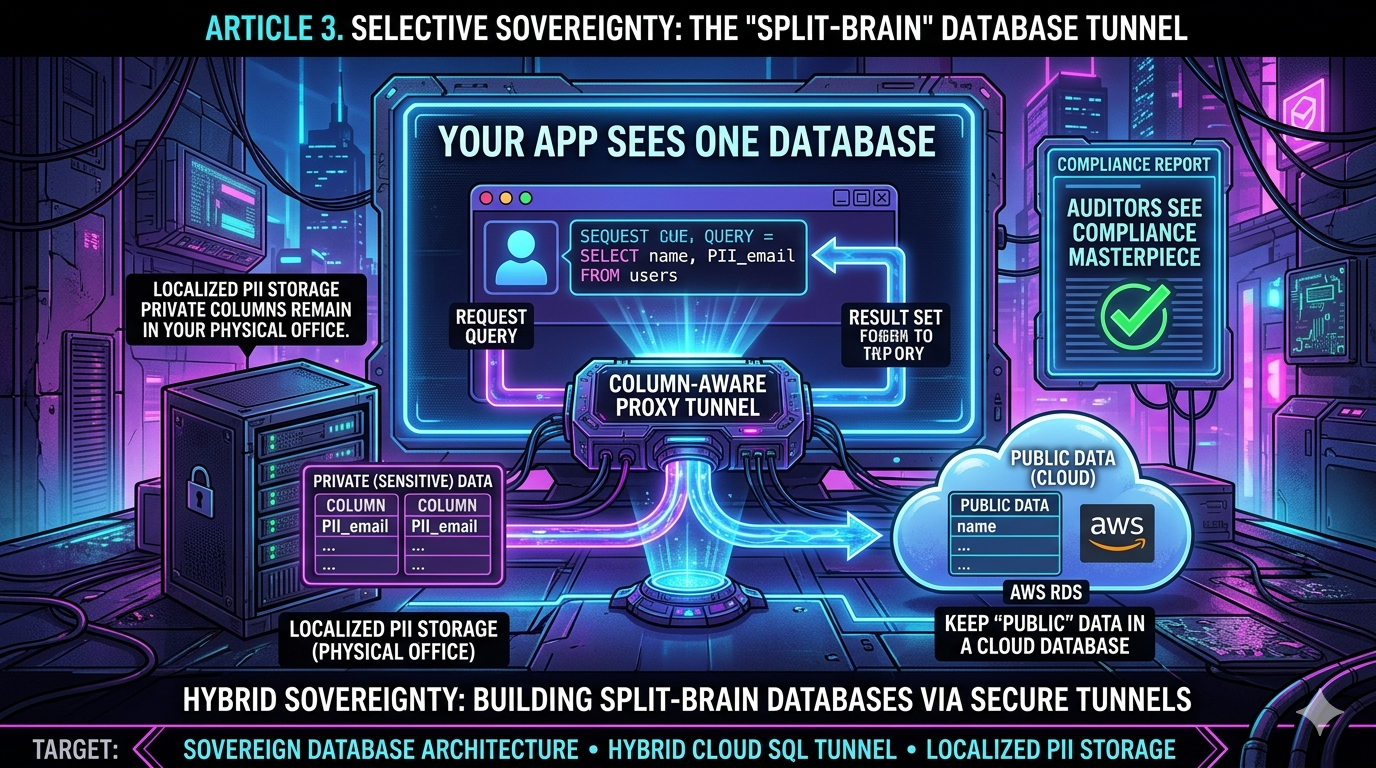
Hybrid Sovereignty: Building Split-Brain Databases via Secure Tunnels
Your app sees one database. Your auditors see a compliance masterpiece. Here is how to split a single table across the cloud and your local rack using a Column-Aware proxy — and why, in 2026, this is no longer optional.
1. The 2026 Data Compliance Dilemma
Digital sovereignty has crossed a threshold. What was once a policy discussion between legal teams and cloud architects is now a hard engineering mandate backed by real enforcement teeth.
The EU AI Act entered into force on 1 August 2024 and reached its most consequential milestone on 2 August 2026, when the full obligations for high-risk AI systems became enforceable. Penalties are not symbolic: fines reach up to €35 million or 7% of global annual turnover, dwarfing even the most aggressive GDPR actions. The EU’s Data Act has been in full effect since September 2025, granting both B2B and B2C users the right to access and port data generated by connected products — meaning organisations can no longer treat usage data as a proprietary asset, and must architect Data-Sharing-by-Design from day one.
The regulatory pressure is not confined to Europe. Over 20 US states now have comprehensive consumer privacy laws. China’s Personal Information Protection Law mandates localization for certain data categories. The European Data Protection Board has specifically called out that transfer disclosures must explicitly identify third-country recipients — generic “we may share with service providers” language is no longer sufficient in 2026 EDPB enforcement.
The consequence is a hard engineering problem: teams rely on managed cloud databases — Amazon RDS, Google Cloud SQL, Azure SQL — for automated backups, read replicas, high availability, and ML pipeline integration. Migrating an entire database back to an on-premise data centre to satisfy PII localization laws cripples developer velocity and inflates operational overhead significantly.
The traditional workaround — two entirely separate databases, joined in application memory — breaks ORM tooling, introduces severe N+1 query problems, and destroys transactional integrity.
The emerging answer is the Split-Brain Database Tunnel: a sovereign database architecture that provides the application with the illusion of a single, unified database, while physically fragmenting data across cloud and local boundaries at the column level.
2. Unpacking the Split-Brain Architecture
The Split-Brain Database Tunnel centres on a Column-Aware Database Proxy. Positioned between the application backend and the storage layer, this proxy speaks native database protocols — including the PostgreSQL wire protocol and the MySQL binary protocol — so the application connects to it exactly as it would connect to a normal database, with zero awareness that storage is physically distributed across jurisdictions.
The Core Division
For 2026 compliance, many regulatory regimes permit “Public” data — user IDs, account creation dates, generic preferences, relational metadata — to reside in a public cloud database. “Private” data — full names, social security numbers, exact geolocation coordinates, biometric data — must remain on a physical server inside the company’s premises or a sovereign data centre.
A split-brain tunnel takes a single logical table, such as Users, and divides it:
- Cloud RDS (
Users_Public): Containsid,created_at,subscription_status - Local Rack (
Users_Private): Containsid,first_name,last_name,social_security_number
When the application queries SELECT * FROM Users WHERE id = 123;, the proxy intercepts the request, routes sub-queries to both locations concurrently, and returns a single, unified result row. The application never knows the underlying distributed execution occurred.
3. The Mechanics of a Column-Aware Proxy
Existing work in the PostgreSQL ecosystem illustrates how far protocol-level proxying has advanced. Tools such as PgDog (released April 2025) are network proxies that understand SQL and can infer routing decisions from query semantics without requiring any changes to application code. Similarly, CipherStash Proxy has demonstrated that the PostgreSQL wire protocol is fully parseable for column-level interception — intercepting SQL statements, rewriting them, and performing encryption or decryption transparently. ProxySQL, as of its April 2026 release, natively supports both the MySQL and PostgreSQL wire protocols and handles query-level routing across distributed backends.
A true column-aware sovereign proxy extends these patterns with three execution stages.
Stage 1: Abstract Syntax Tree (AST) Parsing
Every incoming query is parsed into an Abstract Syntax Tree. The proxy’s routing engine consults a pre-configured schema map that assigns each column a residency rule.
SELECT id, subscription_status FROM Users;→ routed entirely to the cloud RDS instanceSELECT first_name FROM Users;→ routed through the secure tunnel to the local database
Stage 2: Query Rewriting and Federated Execution
The proxy’s power is most visible when a query mixes public and private columns:
SELECT first_name, subscription_status FROM Users WHERE subscription_status = 'active';
The proxy rewrites this into a federated execution plan:
- Query A (Cloud):
SELECT id, subscription_status FROM Users_Public WHERE subscription_status = 'active'; - Query B (Local):
SELECT id, first_name FROM Users_Private WHERE id IN (...ids from Query A);
This pattern mirrors the federated query architecture patented for distributed database systems, where a federated server generates per-source subqueries, distributes them asynchronously, and aggregates the results — with the key difference that here the routing decision is driven by column-level data residency policy rather than horizontal sharding.
Stage 3: In-Memory Result Merging
Once both backends return their result sets, the proxy performs a hash join on the primary key, stitching first_name and subscription_status back together before returning a single, unified result to the application.
4. Establishing the Secure Hybrid Cloud Tunnel
Exposing an on-premise database directly to the public internet is a catastrophic security risk. The standard approach is a reverse tunnel combined with mutual TLS (mTLS).
Rather than opening inbound firewall ports on the local office network, the on-premise environment runs a lightweight tunnel daemon that initiates a persistent, outbound, mTLS connection to the column-aware proxy running in the cloud. Because the connection originates from inside the local network, it bypasses standard inbound firewall restrictions. The result is a secure, bidirectional, authenticated pipeline with no publicly exposed ports.
Fog and Edge Nodes for Latency Reduction
To address the latency introduced by querying localized storage, modern split-brain deployments incorporate fog computing principles — extending cloud capabilities to the edge of the network to process data near its source, reduce round-trip latency, and address data mobility constraints. A fog node positioned near the local data centre can cache frequently accessed private data, handle localized encryption and decryption, and serve the private portion of a federated query before the full cloud round-trip would complete.
5. Overcoming Latency and Performance Bottlenecks
The most common criticism of any cross-jurisdiction database architecture is latency. Network latency is a physical constraint — there is no software fix for the speed of light between, say, an AWS Virginia region and a corporate rack in London. The architecture addresses this through three techniques.
Push-Down Operations
A naive proxy fetches all data from both backends and filters in memory. A smart column-aware proxy pushes predicates down. If the application requests:
SELECT * FROM Users ORDER BY created_at LIMIT 10;
The proxy recognises created_at lives in the cloud database, pushes the ORDER BY and LIMIT to the cloud, retrieves only 10 primary keys, and then queries the local backend for precisely those 10 rows. Data transfer is minimised on both legs.
Asynchronous Fetching
The cloud sub-query and the local sub-query execute in parallel over asynchronous I/O — using Linux primitives such as epoll or io_uring. The total latency is determined by whichever backend is slower, not the sum of both. This is the same principle used by federated database systems that pass subquery results between source servers using message queues rather than routing everything through a central aggregation point.
Read-Through Caching
Private columns such as a user’s legal name or date of birth are read frequently but updated rarely. The proxy can maintain an encrypted, in-memory cache (such as Redis) for the joined result. Subsequent reads are served entirely from the proxy tier in microseconds, bypassing the local tunnel. Cache invalidation is triggered on write.
6. The Compliance Layer: Proving Sovereignty to Auditors
From a regulatory perspective, the architecture addresses three of the hardest compliance requirements in one design decision.
Provable Data Location. A core finding from 2026 data sovereignty analysis is that “sovereignty is a data path property” — if the storage layer cannot enforce and expose where data physically resides, policy compliance becomes fragile and operationally expensive. The split-brain proxy makes location a structural property, not a convention. If a malicious actor gains root access to the cloud RDS instance, or if a snapshot is accidentally made public, no PII is present. The cloud database contains only meaningless IDs and metadata.
Simplified Right to Erasure. The GDPR’s Right to be Forgotten is notoriously difficult to honour across cloud backups, read replicas, data lakes, and snapshot chains. With the split-brain model, erasing a user’s personal data means deleting a single row in the local Users_Private table. The data is immediately and irreversibly removed from the entire logical system. No cloud backup scrubbing. No replica propagation delays.
Column-Level Audit Trails. Because every query passes through the column-aware proxy, the proxy serves as a centralised, irrefutable audit log recording exactly which application service requested which PII column, for which user record, and at what timestamp. This granular observability is structurally impossible in a standard monolithic cloud database, and directly addresses the EU AI Act’s Article 10 requirement for data governance documentation on training datasets — specifically the obligation that personal data be removed “where technically feasible.”
The EU AI Act’s transparency rules coming into effect in August 2026 also require that organisations be able to produce audit trails on demand. The proxy’s centralised query log satisfies this requirement by design.
7. Addressing Failure Modes and Availability
Distributed systems create new failure vectors. What happens when the secure tunnel drops, the local ISP has an outage, or the on-premise rack loses power?
Graceful Degradation
The proxy can be configured to return the public portion of the data with NULL or masked values substituted for private columns when the local tunnel is unreachable. An e-commerce application rendering an order history primarily needs cloud data — order dates, item IDs, shipping status. If the local PII rack is temporarily down, the order page still renders, perhaps showing “Name Unavailable” rather than failing the entire HTTP response. A local hardware failure does not cascade into a global application outage.
High Availability On-Premise via Distributed Consensus
To eliminate the local office as a single point of failure, production deployments use clustered micro-datacenters with synchronous replication — for example, Raft consensus across three corporate office locations. The cloud proxy load-balances the secure tunnels across these locations. If one office goes offline, the private data remains available through the other two nodes, and the tunnel failover is transparent to the application.
8. Hardware Enclaves at the Proxy Layer
One of the residual concerns with any in-memory data joining is that the proxy process itself — though residing on infrastructure you control — handles decrypted PII during the result merge. Confidential computing addresses this directly.
Technologies such as Intel SGX, AMD SEV, and AMD SEV-SNP implement hardware-based Trusted Execution Environments (TEEs) that ensure data and code remain protected even during active processing in RAM. By running the proxy’s merge logic inside a TEE, even a privileged attacker with root access to the proxy host operating system cannot read the joined PII rows during computation — the memory is encrypted below the CPU hardware boundary, accessible only to the enclave code itself.
The tradeoff is real: TEE isolation introduces computational overhead, typically around 10% for standard workloads, and more for I/O-intensive operations that require continuous encryption and decryption as data crosses the enclave boundary. For a query proxy, this overhead lands on every join operation. Whether this cost is acceptable depends on query volume and latency requirements, but for regulated industries the cryptographic auditability often outweighs the performance penalty.
An emerging alternative is Intel TDX (Trust Domain Extensions), which operates at the VM level rather than the process level like SGX, reducing the complexity of securing multi-process workloads while maintaining hardware-enforced memory isolation.
9. The Future of Sovereign Database Architecture
The architectural paradigm is shifting away from “where do we put our monolithic database?” toward “how do we federate data across a compliance-aware mesh?”
As of 2026, industry data indicates that 93% of US executives are actively redesigning their data stacks in response to regulatory pressure — not because cloud technology failed, but because monolithic cloud-only architectures have become a legal liability. The C-suite framing has shifted from the “Modern Data Stack” to the “Sovereign Intelligence Stack”: decoupling data from compute, keeping proprietary data in infrastructure the organisation controls, and federating access through governance planes rather than centralised cloud ownership.
European initiatives such as Gaia-X are accelerating the standardisation of this model. The Gaia-X trust framework provides mechanisms for automation of compliance and interoperability across sectors, with digital sovereignty defined through “trust, openness, and common standards.” The International Data Spaces Association (IDSA) is developing standards for self-sovereign data exchange that allow participants to maintain full control over their data while sharing across organisational boundaries — the precise problem the column-aware proxy solves at the database layer.
Looking ahead, standardised protocols for attribute-based routing are emerging — where queries are routed not just by column names, but by cryptographic tags embedded in the data payload itself. Combined with hardware enclave support at the proxy layer, this points toward a future where the compliance guarantee is mathematically provable rather than architecturally inferred.
The Split-Brain Database Tunnel is the practical instantiation of this trajectory: an architecture where the unstoppable force of global cloud infrastructure meets the immovable object of data sovereignty law, and the proxy layer becomes the point of reconciliation.
Your application interacts with a simple, unified database interface. Your development team maintains velocity. Your auditors receive an architecture with provable, structural compliance built into every query path.
References and Further Reading
- European Commission. (2026). EU AI Act — Full Applicability, August 2, 2026. digital-strategy.ec.europa.eu
- European Commission. (2025). The Data Act — in effect September 2025. Official Journal of the European Union.
- Simplyblock. (2026, March 31). Achieving Data Sovereignty in 2026: A Practical Guide. simplyblock.io
- Towards Data Science. (2026, March 15). The 2026 Data Mandate: Is Your Governance Architecture a Fortress or a Liability?
- Analytics Week. (2026, March 2). AI Sovereignty: Why US Executives Are Redesigning Their Data Stack.
- Kokotov, L. (2025, April 14). Hacking the Postgres Wire Protocol. PgDog Engineering Blog. pgdog.dev
- CipherStash. (2025). How We Used the PostgreSQL Wire Protocol to Bring You Searchable Encryption. cipherstash.com
- ProxySQL. (2026, April 17). ProxySQL 3.0.8 Release Notes. proxysql.com
- Mathis, A. (2025, May 19). Confidential Computing: What It Is and Why It Matters in 2025. Medium.
- Cisco Systems. (2025). Confidential Computing Overview White Paper. cisco.com
- Gaia-X. (2026, January). Danube Release of the Gaia-X Trust Framework. InfoQ.
- Secure Privacy. (2026, April 9). Data Residency Requirements: EU vs US Explained. secureprivacy.ai
- Legal Nodes. (2026, April 10). EU AI Act 2026 Updates: Compliance Requirements and Business Risks. legalnodes.com
- Özdal Oktay, S., Heitmann, S., & Kray, C. (2023). Linking location privacy, digital sovereignty and location-based services: a meta review. Journal of Location Based Services, 18, 1–52. https://doi.org/10.1080⁄17489725.2023.2239180
- Khater, B. S. et al. (2021). Classifier Performance Evaluation for Lightweight IDS Using Fog Computing in IoT Security. Electronics, 10(14), 1633. https://doi.org/10.3390/electronics10141633


Comments
Post a Comment