Fully Homomorphic Encryption Network Tunnels: The Future of Zero-Exposure Local Development
IT
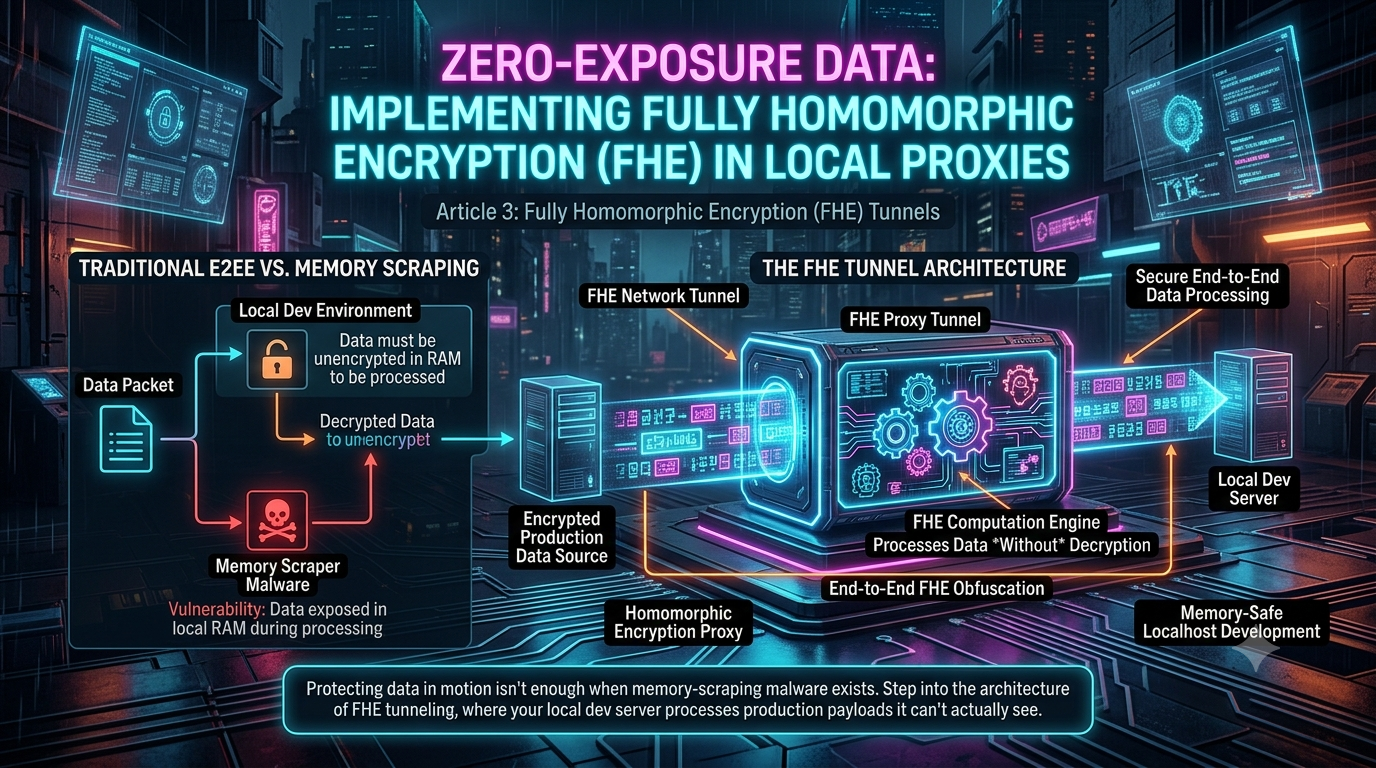
Imagine a world where production data flows freely to your local development environment — where engineers debug real payloads, run live analytics, and stress-test edge cases against genuine user data — and yet a compromised machine reveals absolutely nothing. No plaintext. No recoverable values. No breach. This is not a theoretical security proposal. It is the operational promise of Fully Homomorphic Encryption (FHE) network tunnels, and in 2026, that promise is closer to engineering reality than ever before.
What Is Fully Homomorphic Encryption?
Fully Homomorphic Encryption is a class of cryptographic scheme that allows arbitrary mathematical computations to be performed directly on encrypted data — without ever decrypting it. The result of those computations, when eventually decrypted by the authorized key holder, is identical to what you would have obtained by performing the same operations on the original plaintext.
In traditional security models, a server must decrypt data before it can process it. This creates an unavoidable exposure window: the moment data lives in RAM as plaintext, it becomes vulnerable to memory-scraping malware, side-channel attacks, hypervisor-level introspection, and insider threats. FHE eliminates that window entirely.
Traditional Tunnel:
Plaintext ──► [Encrypt] ──► Ciphertext ──► [Decrypt] ──► Plaintext in RAM (Vulnerable)

FHE Tunnel:
Plaintext ──► [Encrypt] ──► Ciphertext ──► [Compute on Ciphertext] ──► Encrypted Result
The decryption key never travels to the processing environment. The local server, proxy, or container operates entirely on ciphertext — mathematically blind to the underlying truth of the data it is manipulating.
From Theory to Engineering Reality: A Brief History
The concept of homomorphic encryption predates FHE itself, with early ideas explored by Rivest, Adleman, and Dertouzos in 1978. However, a practical, fully homomorphic construction — one capable of evaluating circuits of arbitrary depth — remained out of reach for three decades.
That changed in 2009, when Craig Gentry published his landmark PhD thesis at Stanford, demonstrating the first working FHE scheme built on ideal lattice problems. The construction was a landmark moment in cryptographic history, but it came with a crippling cost: early FHE schemes were slower than plaintext computation by factors measured in the billions. A simple integer comparison could stall a high-performance processor for hours. FHE remained, for years afterward, an elegant proof of concept rather than an engineering tool.
The path from Gentry’s 2009 proof to practical deployment is one defined by four generations of scheme optimization. Each generation introduced novel mathematical constructions — moving from ideal lattices to more structured problems like Learning With Errors (LWE) and Ring-Learning With Errors (RLWE) — that offered superior performance and stronger, quantum-resistant security guarantees.
The Cryptographic Schemes Powering Modern FHE
Today’s practical FHE implementations are built on two dominant scheme families, each optimized for distinct computational workloads.
TFHE — Torus Fully Homomorphic Encryption
TFHE (originally published at Asiacrypt 2016 and described as “Faster fully homomorphic encryption: Bootstrapping in less than 0.1 seconds”) is built for bitwise and Boolean operations. Its defining feature is a remarkably fast bootstrapping procedure — the process of refreshing a noisy ciphertext to prevent error accumulation from corrupting computation results.
TFHE’s speed on gate-level operations makes it the natural choice for building conditional logic within encrypted data pipelines: proxy routing tables, encrypted access control lists, and conditional firewall rules that evaluate encrypted boolean conditions without ever reading the underlying data.
The scheme has continued to evolve rapidly. Zama’s TFHE-rs, a pure Rust reimplementation of TFHE, released version 1.5 in January 2026, with active performance improvements and expanded API coverage for production use. Their Concrete compiler — built atop TFHE-rs — allows developers to write standard Python functions and compile them into FHE circuits, dramatically lowering the barrier to entry.
CKKS — Cheon-Kim-Kim-Song
CKKS is optimized for approximate arithmetic on real numbers, trading exact computation for significantly better performance on floating-point workloads. This makes it the scheme of choice for privacy-preserving machine learning inference, encrypted data analytics, and statistical computations where a bounded approximation error is acceptable.
Research published through the CRYPTO 2025 conference introduced general functional bootstrapping for CKKS, further expanding the class of computations it can support within encrypted circuits. OpenFHE — the open-source successor to PALISADE, supported by ARPA-H and DARPA — ships production implementations of CKKS alongside BGV, BFV, and CGGI (TFHE) schemes, with active development on more efficient bootstrapping designs as of 2025 and 2026.
Why Developer Environments Are the New Breach Surface
To understand why FHE tunnels matter for local development specifically, consider the threat landscape that has crystallized around developer workstations in 2025 and 2026.
Supply chain attacks have escalated in both scale and sophistication, with threat actors targeting open-source ecosystems, developer credentials, and CI/CD pipelines as primary entry vectors. The Shai-Hulud campaign — one of the most automated npm supply chain attacks observed in 2025 — saw attackers compromise developer accounts and publish self-propagating malicious packages that spread stolen credentials across interconnected repositories and build systems. A follow-up campaign, Shai-Hulud 2.0, reused stolen CI tokens and maintainer credentials to silently modify legitimate repositories rather than publishing new malicious packages.
In September 2025, attackers hijacked 18 popular npm packages collectively downloaded over 2 billion times weekly, introducing malicious scripts capable of executing during build processes. The S1ngularity attack in August 2025 compromised multiple high-profile GitHub repositories through social engineering and weak repository permission controls, exposing thousands of organizations and millions of downstream users.
OWASP’s 2025 Top 10 now explicitly lists Software Supply Chain Failures as a primary vulnerability class, noting that malicious packages can use post-install scripts to harvest and exfiltrate sensitive data, including npm tokens that then self-propagate across any accessible package the victim machine can publish to.
The pattern across all of these campaigns is consistent: developer workstations are not just endpoints — they are the attack surface for the entire software supply chain. A compromised dependency that runs a background script can attach to runtime processes, dump heap memory from local Docker containers, or sniff loopback traffic at localhost:8080 to capture raw JSON payloads flowing from production-adjacent data sources.
When engineers work with live or even anonymized production datasets to reproduce complex edge-case bugs, those datasets are immediately at risk the moment a malicious dependency executes on the same machine. Data tokenization and masking offer limited protection: sophisticated correlation techniques can de-anonymize masked records when combined with auxiliary data from public or dark-web sources.
An FHE network tunnel neutralizes this entire attack class at the architectural level.
Architecture of an FHE Network Tunnel
Implementing an FHE-driven network tunnel requires rethinking the trust model between a data source, a network proxy, and a local application runtime. The classic client-server architecture assumes the destination is a fully trusted entity that must read data in order to serve it. An FHE proxy framework instead treats the local development environment as potentially compromised by design — and engineers a data pipeline that remains secure even under that assumption.
Component 1: The Production Data Source and Key Holder
The production database or upstream enterprise gateway acts as the data owner. It holds the Master Secret Key (MSK), which never leaves the boundary of its Hardware Security Module (HSM). Before any payload is dispatched to a developer’s local machine, the production gateway encrypts it using the chosen FHE scheme and generates an accompanying Evaluation Key (EK).
Component 2: The Evaluation Key
The Evaluation Key is a public cryptographic artifact that permits anyone holding it to perform mathematical operations on a ciphertext. Critically, it provides no capability to reverse the encryption or recover plaintext values. The EK is bundled with the ciphertext and transmitted through the network tunnel alongside the encrypted payload.
Component 3: The Local FHE Proxy
On the developer’s machine, a specialized proxy intercepts the incoming encrypted stream. Unlike a conventional NGINX or Envoy proxy — which terminates TLS and processes plaintext payload — the FHE proxy passes ciphertext blocks directly to the containerized local application without decrypting them. The proxy itself operates on an opaque stream it cannot interpret.
OpenFHE’s network examples repository, developed under DARPA’s OPS5G program, demonstrates practical patterns for exactly this kind of encrypted data distribution between network processes across multiple trust zones — with applications well beyond 5G, including general wireline network architectures.
Component 4: The Blinded Local Application Server
The local development server — running Node.js, Python, Go, or any other runtime — is configured to ingest homomorphic ciphertexts using an FHE SDK. If the developer is implementing a feature that computes user analytics, filters search results, or flags fraudulent transaction patterns, the application code executes those functions via FHE operations using the Evaluation Key.
The application can add, multiply, sort, and conditionally branch on the data. It can produce encrypted results that are structurally correct. Throughout the entire cycle, the local machine’s RAM contains nothing but dense, randomized ciphertext. A memory dump of the process yields zero recoverable intelligence.
[Compromised Local Machine]
│
├──► Malware dumps process heap ──► Finds only FHE ciphertext (cryptographically useless)
│
└──► Malware sniffs loopback ──► Captures blinded payloads (no plaintext recoverable)
Component 5: Encrypted Return and Authorized Decryption
The local server returns the encrypted result back through the tunnel to the production gateway or authorized client device. Only the entity holding the Master Secret Key can decrypt the final output. The local machine participates in the computation but never participates in the decryption.
Implementation: A Concrete FHE Proxy Loop
The following illustrates the foundational logic of an FHE tunnel using Zama’s Concrete framework. This example demonstrates how a local development server can evaluate whether an encrypted user score qualifies for a service tier — without the server ever learning the score value.
Step 1 — Define and Compile the FHE Circuit (Production Gateway)
import concrete.fhe as fhe

# Define the computation the local server will execute blindly
def evaluate_tier_qualification(encrypted_score):
    # Returns 1.5 if score exceeds threshold, 0 otherwise
    # Local server runs this without knowing the actual score
    return (encrypted_score > 700) * 1.5

# Compile the function into an FHE circuit
compiler = fhe.Compiler(
    evaluate_tier_qualification,
    {"encrypted_score": "int"}
)
inputset = [600, 650, 720, 800]  # Calibration set for noise budget
circuit = compiler.compile(inputset)

# Generate cryptographic keys
keys = circuit.keygen()
client_keys = keys.get_client_keys()       # Stays at production gateway
evaluation_keys = keys.get_evaluation_keys()  # Travels with ciphertext
Step 2 — Encrypt and Transmit
# Production gateway encrypts the live payload
sensitive_score = 750
encrypted_payload = circuit.encrypt(sensitive_score, client_keys)

# Serialize ciphertext and evaluation keys for network transmission
serialized_data = encrypted_payload.serialize()
serialized_ek = evaluation_keys.serialize()

# Transmitted over the FHE tunnel to local proxy
# The value 750 never appears in transit or on the local machine
Step 3 — Blind Execution on the Local Server
# Local server receives and deserializes
received_payload = circuit.deserialize_ciphertext(serialized_data)
received_ek = circuit.deserialize_evaluation_keys(serialized_ek)

# Execute the circuit on encrypted data
# At no point does local RAM contain the integer 750
encrypted_result = circuit.run(received_payload, evaluation_keys=received_ek)
Step 4 — Authorized Decryption at the Production Gateway
# Only the production gateway, holding client_keys, can decrypt
final_result = circuit.decrypt(encrypted_result, client_keys)
print(f"Tier Multiplier: {final_result}")  # Output: 1.5
The local server performed real computation. It produced a correct result. At no moment did it possess the plaintext value it computed on.
Hardware Acceleration: Closing the Performance Gap
For years, the performance penalty of FHE was the primary obstacle to real-world deployment. Modern hardware research has made significant inroads.
GPU acceleration has emerged as one of the most effective approaches. Research published in 2025 demonstrated that using the ArctyrEX framework, a dot product subroutine runs approximately 6× faster on a single NVIDIA A100 GPU and over 42× faster on an NVIDIA DGX A100 compared to a 256-thread AMD EPYC CPU baseline — producing an end-to-end application speedup of 31× on MNIST classification tasks. The CAT framework, benchmarked against an NVIDIA RTX 4090 and AMD EPYC 9654, demonstrated similar GPU-acceleration gains across CKKS, BFV, and BGV scheme operations.
On the hardware architecture side, the ARK accelerator addresses one of FHE’s core bottlenecks: bootstrapping requires loading gigabytes of evaluation keys from off-chip memory, making acceleration fundamentally limited by memory bandwidth. ARK’s algorithm-architecture co-design uses runtime data generation and inter-operation key reuse to fully exploit on-chip memory, substantially reducing working set size and eliminating the off-chip bandwidth bottleneck.
These advances are translating the performance overhead of FHE from the billions-of-times penalty observed in 2009 into ranges that are increasingly compatible with real-time data processing.
Real-World Security Guarantees
An FHE tunnel provides layered protection against the attack classes most relevant to compromised developer environments.
Zero plaintext in volatile memory. Because computation occurs on ciphertext, the application’s heap and stack allocations contain no string literals, no integer values representing financial data, and no identifiable field contents. Memory scraping yields cryptographic noise.
Resistance to side-channel attacks. Even if a rogue process exploits hardware-level side-channel vulnerabilities — speculative execution flaws, cache timing attacks, or cross-VM memory boundary reads in virtualized environments — it harvests ciphertext. Without the Master Secret Key, no information about the underlying data is recoverable.
Multitenant isolation. In shared cloud development environments or enterprise dev-boxes running on shared hypervisors, FHE ensures that even infrastructure administrators with root access to the underlying host cannot observe the data being processed within a specific tenant’s container. The computational boundary and the privacy boundary are the same.
Engineering Trade-offs to Understand Before Deploying
FHE tunnels are not a drop-in replacement for conventional proxies. Teams considering adoption need to understand three significant operational constraints.
Ciphertext Expansion
A standard 32-bit integer occupies 4 bytes of plaintext. Wrapped in a lattice-based FHE scheme with parameters designed to provide 128-bit post-quantum security, the same value can expand to kilobytes or megabytes of ciphertext. For data-intensive pipelines, this places substantial pressure on network throughput and serialization efficiency. High-performance compression and efficient binary serialization protocols are required to make ciphertext transmission practical at scale.
Programmability Constraints
Standard programming relies on conditional branching: an if statement reads a value and selects a code path based on it. In an FHE circuit, the executing environment cannot read values, which means it cannot branch on them in the traditional sense. Developers must instead write code using multiplexers and arithmetic encodings that evaluate both branches of a conditional simultaneously, folding the result together algebraically. This is a genuine paradigm shift that requires developers to think in terms of circuits rather than imperative logic.
Compiler toolchains like Concrete and OpenFHE’s scheme compilers are designed to abstract some of this complexity, but non-trivial application logic still requires deliberate FHE-aware design.
Encrypted State and Indexing
Because an FHE tunnel keeps data encrypted throughout its lifecycle, conventional database indexing, full-text search, and relational sorting become complex operations. Local test environments using encrypted production-like data must either tolerate linear scan costs or integrate specialized encrypted database engines capable of querying ciphertext directly.
The State of the Ecosystem in 2026
The FHE tooling ecosystem has matured substantially. OpenFHE — funded by ARPA-H and DARPA and affiliated with NumFocus — provides production implementations of all major FHE schemes (BGV, BFV, CKKS, FHEW, TFHE/CGGI) with active community development and regular webinars. Research from the CRYPTO 2025 conference introduced general functional bootstrapping for CKKS, expanding the depth of circuits the scheme can practically evaluate.
Zama’s TFHE-rs — a Rust-native implementation of TFHE — released version 1.5 in January 2026 with performance improvements and new API features, and serves as the backend for both the Concrete compiler (Python-to-FHE) and Concrete ML (privacy-preserving machine learning). Intel’s HE Toolkit provides integration pathways for hardware-accelerated homomorphic operations at the CPU level.
Privacy-preserving machine learning has emerged as one of the most active FHE application areas, with published research demonstrating LLM inference over GPU-accelerated FHE, encrypted transformer inference using BERT-derived architectures, and practical inference pipelines for classification tasks — though training workloads remain computationally intensive at scale.
Conclusion: Toward Zero-Trust Local Development
The convergence of escalating supply chain threats, maturing FHE compiler toolchains, and GPU-accelerated cryptographic computation has brought FHE network tunnels from a theoretical curiosity to a credible architectural choice for security-critical engineering teams.
The value proposition is straightforward: production data can flow to local development environments with full fidelity, enabling engineers to reproduce complex edge cases and validate behavioral correctness against real-world payloads — while the local machine remains provably blind to the data it processes. A compromised dependency, a memory-scraping implant, or a rogue hypervisor administrator gains nothing from a heap full of lattice ciphertext.
Performance overhead, ciphertext expansion, and the programmability constraints of FHE circuits remain real challenges. They require deliberate engineering investment and are not suited to every pipeline or every team today. But the trajectory is clear: hardware acceleration is closing the performance gap, compiler toolchains are lowering the developer burden, and the threat environment is making the cost of not protecting developer environments increasingly difficult to justify.
In an era where developer workstations have become the attack surface for the entire software supply chain, processing data anywhere without letting the processor see a single byte of truth is no longer a luxury. It is a security baseline worth building toward.
References and further reading: OpenFHE (openfhe.org), TFHE-rs by Zama (tfhe.com), Zama Concrete compiler, IACR ePrint Archive, OWASP Top 10:2025, Sygnia Q4 2025 Supply Chain Report, Barracuda Networks Supply Chain Malware Brief (March 2026), The Hacker News — Developer Workstations Are Now Part of the Software Supply Chain (May 2026).
Related InstaTunnel pages
Continue from this article into the most relevant product guides and workflows.


Comments
Post a Comment