Injecting Custom Logic at the Edge with WebAssembly (Wasm) Proxies
IT
Quick answer
Injecting Custom Logic at the Edge with WebAssembly (Wasm): quick answer
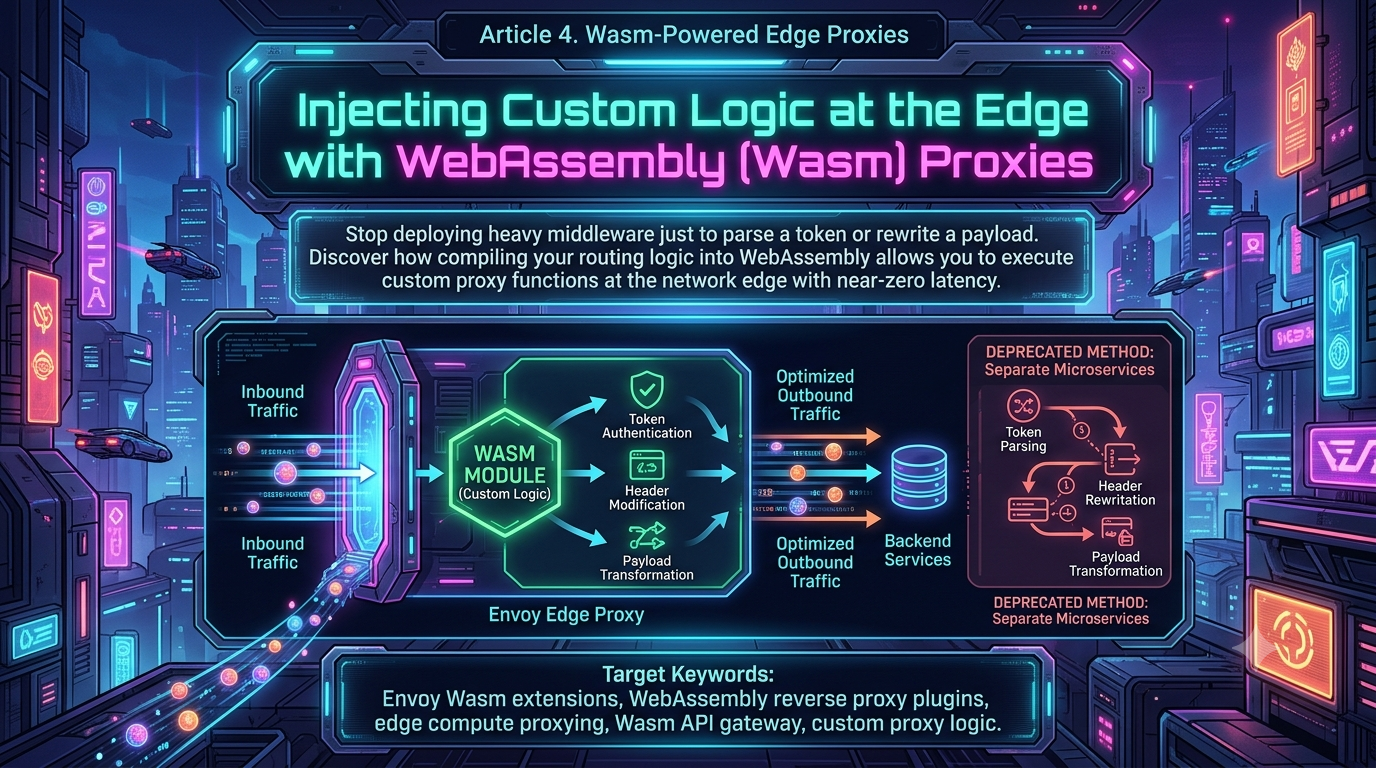
Injecting Custom Logic at the Edge with WebAssembly (Wasm) Proxies Stop deploying heavy middleware just to parse a token or rewrite a payload.
What is the main takeaway from Injecting Custom Logic at the Edge with WebAssembly (Wasm) Proxies?
Injecting Custom Logic at the Edge with WebAssembly (Wasm) Proxies Stop deploying heavy middleware just to parse a token or rewrite a payload.
Which InstaTunnel page should I read next?
Use the related pages below to continue into the most relevant documentation, product workflow, comparison page, or implementation guide.
Stop deploying heavy middleware just to parse a token or rewrite a payload. Compiling your routing logic into WebAssembly lets you execute custom proxy functions at the network edge with near-zero latency — and in 2026, the ecosystem has finally matured enough to do it in production.
In modern cloud-native architectures, the network edge has transformed from a simple ingress point into an intelligent, highly programmable boundary. For years, platform engineers faced a persistent architectural dilemma: where should custom business logic live when a request reaches the API gateway or reverse proxy? Historically, if you needed to implement proprietary token validation, strip PII from a payload, or execute complex context-aware routing, you had two unfavorable options. You could fork your proxy’s source code — usually written in C++ or Go — and maintain a custom build, or you could deploy a separate middleware microservice and force the proxy to make a network hop before routing traffic to its final destination.
Both approaches carry significant costs. Forking a project like Envoy creates massive technical debt and upgrade nightmares. Deploying external middleware introduces network latency, increases failure surface, and complicates the deployment footprint.
Enter WebAssembly (Wasm). By compiling custom logic into WebAssembly and injecting it directly into edge proxies, platform engineers are changing how traffic is handled at the ingress. This paradigm — often called Wasm-powered edge proxies — lets developers execute secure, near-native-speed code directly inside the proxy’s process space without touching the proxy’s core codebase.
What Are Wasm-Powered Edge Proxies?
WebAssembly is a binary instruction format for a stack-based virtual machine, originally designed for high-performance applications in web browsers. It is a portable compilation target for Rust, C++, Go, AssemblyScript, and other languages. When applied to server-side networking, Wasm acts as a universal plugin system for edge compute.
Instead of maintaining separate microservices to modify headers, validate tokens, or transform data as it passes through a proxy, developers write their logic in a language of their choice and compile it to a .wasm binary. That binary is injected directly into a modern reverse proxy such as Envoy. Because Wasm runs in a secure, isolated sandbox, the proxy can execute the custom code safely. If the Wasm plugin crashes, the proxy itself remains unaffected — the sandbox is torn down, a 500 is returned for that specific request, and the proxy continues processing the rest of its connections without interruption.
This turns the reverse proxy into a highly extensible Wasm API gateway, capable of running bespoke, computationally intensive tasks at the exact moment a packet hits the network edge.
The Proxy-Wasm ABI
The catalyst for this architecture is the Proxy-Wasm Application Binary Interface (ABI). Before Proxy-Wasm, writing a plugin for a proxy meant writing code tightly coupled to that specific proxy’s internal API. Proxy-Wasm defines a standardized interface between proxies and Wasm virtual machines: how a proxy passes HTTP headers, body payloads, and connection metadata to the Wasm module, and how the Wasm module instructs the proxy to act — block this request, add this header, route to this upstream.
The current recommended and widely-implemented version of the ABI is v0.2.1. This is what Envoy, Istio, MOSN, Higress, and API7 all implement today. A Proxy-Wasm plugin written against v0.2.1 can theoretically run in any proxy that implements the same ABI.
It is worth being honest about the spec’s history: the Proxy-Wasm ABI was in active use by Envoy and Istio for years without adequate formal documentation. As of mid-2023, the spec repository maintainers acknowledged this publicly on GitHub and committed to properly documenting the v0.2.1 ABI. That documentation effort has continued through 2024 and 2025, with the spec repository receiving active commits as recently as October 2025. The ABI itself is stable in practice — the surface area has not changed materially for production deployments — but developers upgrading SDKs or runtimes across major Envoy versions should test against the WASM missing Proxy-Wasm ABI version class of errors, which arise when the compiled ABI version does not match what the host proxy expects.
Why Wasm Is Replacing Traditional Middleware
1. Eradicating Network Latency
In a traditional microservices architecture, an incoming request triggers an out-of-process HTTP or gRPC call. The proxy receives the user’s request, pauses, sends headers to an “AuthZ” service, waits for a response, and then routes the traffic. This internal network hop compounds badly at high throughput.
With Envoy Wasm extensions, the logic lives in the proxy’s memory. The Envoy documentation confirms that extensions can be delivered and reloaded at runtime directly from the control plane, without updating or redeploying the proxy binary. The execution of the custom logic happens at near-zero latency: the proxy maps request data into the Wasm VM’s memory, the validation executes, and the proxy immediately routes the request.
2. Language Agnosticism and Developer Velocity
Platform teams no longer need C++ experts to write Envoy filters. A security engineer can write a rate-limiting algorithm in Rust, an identity team can write a JWT parser in Go (via TinyGo), and a platform team can write header-manipulation logic in AssemblyScript.
The primary toolchain for Proxy-Wasm development today:
- Rust —
proxy-wasm-rust-sdkwith thewasm32-wasip1target (formerlywasm32-wasi; renamed in the Rust compiler in March 2024). This is the most mature path. - Go —
proxy-wasm-go-sdk, which requires TinyGo rather than standard Go. The Go SDK carries the language name but relies on TinyGo due to standard Go’s incomplete WASI support for this use case. - C++ — via the WASI SDK based on Clang/LLVM.
Once compiled to Wasm, modules are distributed like container images. Using OCI-compliant registries, teams can push and pull Wasm modules and integrate them into existing CI/CD pipelines.
3. Fault Isolation and Security
A Wasm module cannot access the host operating system’s filesystem, network primitives, or memory outside of its allocated space. If a plugin panics or leaks memory, the VM terminates the sandbox. The Proxy-Wasm spec also specifies that the host should track crash rates and rate-limit instantiation of repeatedly crashing plugins, preventing a broken plugin from causing a denial of service by consuming resources in a crash loop.
This makes deploying custom logic to mission-critical network components substantially safer than native extensions.
Wasm Runtimes Inside Envoy
Envoy supports three Wasm runtime implementations: V8, WAMR (WebAssembly Micro Runtime, developed by Intel), and Wasmtime. In Envoy’s official release images, V8 is the default and the only runtime compiled in by default. WAMR and Wasmtime are present in the codebase but not included in the official build.
For teams building on Envoy distributions beyond the official binary — such as Higress, which is built on Istio and Envoy and adopted widely on Alibaba Cloud — there is growing interest in WAMR. When Higress switched its Wasm plugin runtime from V8 to WAMR with ahead-of-time (AOT) compilation enabled, plugin performance improved by an average of 50%, with some plugins with complex logic doubling in speed. The reason: Envoy’s V8 dependency is pinned to a 2022 version, making it unable to take advantage of newer Wasm features like WasmGC, while WAMR’s AOT mode generates machine code for the target platform through a customized optimization pipeline, achieving performance comparable to native binaries at runtime.
The Deployment Architecture: Envoy and Istio
Envoy
The lifecycle of an Envoy Wasm extension in a production Kubernetes cluster follows a well-defined path:
- Development — A developer writes the extension in Rust using the
proxy-wasm-rust-sdk, implementing theHttpContexttrait with callbacks foron_http_request_headersandon_http_response_body. - Compilation — Rust code is compiled using
rustup target add wasm32-wasip1andcargo build --target wasm32-wasip1 --release, producing a compact.wasmbinary. - Distribution — The
.wasmbinary is pushed to an OCI-compliant container registry. - Configuration — The Envoy filter chain configuration references the URI of the Wasm module, specifying the runtime (
envoy.wasm.runtime.v8by default) and any plugin configuration. - Instantiation — When Envoy starts or reloads its configuration, it fetches and instantiates the Wasm module inside a VM.
- Execution — HTTP requests flow through the Envoy filter chain and hit the Wasm filter. Envoy maps the request data into the Wasm VM’s linear memory, the plugin executes, modifies headers or body, and returns control to Envoy.
Istio WasmPlugin CRD
When running inside a service mesh, Istio provides the WasmPlugin Custom Resource Definition under the extensions.istio.io/v1alpha1 API group, introduced in Istio 1.12. The WasmPlugin CRD abstracts the underlying Envoy filter chain configuration and supports targeting by workload selector or via the Kubernetes Gateway API’s targetRefs field, which allows targeting waypoint proxies in Ambient Mesh deployments.
A minimal WasmPlugin resource looks like this:
apiVersion: extensions.istio.io/v1alpha1
kind: WasmPlugin
metadata:
  name: basic-auth
  namespace: istio-system
spec:
  selector:
    matchLabels:
      istio: ingressgateway
  url: oci://ghcr.io/istio-ecosystem/wasm-extensions/basic_auth:1.12.0
  phase: AUTHN
  pluginConfig:
    basic_auth_rules:
      - prefix: "/api"
        request_methods: ["GET", "POST"]
        credentials:
          - "dXNlcjpwYXNz"
The Istio agent interprets the WasmPlugin configuration, downloads the Wasm module from the OCI registry, and injects the HTTP filter into the Envoy sidecar (or waypoint proxy, in Ambient deployments) by referencing the local file. Plugin integrity can be enforced by specifying the expected sha256 hash of the module in the spec.
Transformative Use Cases
Advanced Authentication and Authorization
Standard API gateways validate JWTs via standard JWKS endpoints. Wasm enables a different class of auth logic: proprietary legacy token formats, multi-step cryptographic verification, or enterprise-specific HMAC schemes that would otherwise require a round-trip to an internal auth service. The Wasm plugin intercepts the request, performs the cryptographic math locally, and either drops the connection at the edge or passes the request downstream. Malicious traffic and DDoS attempts never reach internal services.
Dynamic Payload Transformation and Data Redaction
A Wasm plugin can intercept outbound HTTP response bodies and perform DLP (Data Loss Prevention) operations before the response reaches the client. Using Rust’s memory-safe string processing, the module scans the payload, masks or strips PII such as credit card numbers or Social Security Numbers, and recalculates the Content-Length header. This ensures compliance without modifying the legacy internal applications that emit the raw data.
Context-Aware Routing
Wasm enables routing decisions that go well beyond URL paths and HTTP headers. A Wasm module can parse an incoming GraphQL query’s Abstract Syntax Tree, determine which upstream services own the requested fields, and dynamically rewrite the upstream selection. For multi-tenant SaaS, a plugin can execute a localized lookup (via a sideband connection configured in the proxy) to determine database shard routing, ensuring consistent tenant isolation without introducing a separate routing service.
Bespoke Web Application Firewalls
Commercial WAFs struggle with application-level business logic attacks. Wasm allows security teams to write plugins that implement highly specific, stateful detection logic: tracking parameter velocity across multiple requests to detect scraping bots, implementing algorithmic rate limits targeting specific API abuse patterns, or enforcing request shape invariants that a generic WAF cannot encode.
The State of the Ecosystem in 2026
WebAssembly 3.0
On September 17, 2025, the WebAssembly W3C Community Group and Working Group announced the release of WebAssembly 3.0 as the new live standard. This was described by the spec authors as a substantially larger update than 2.0, with several features that had been in development for six to eight years. The headline additions include:
- 64-bit address space (memory64) — memories and tables can now use
i64as their address type, expanding the theoretical address space from 4 GB to 16 EB. - WasmGC — native garbage collection support in the host engine. Languages like Java, Kotlin, Scala, and Dart can now compile to Wasm without bundling a full GC runtime inside the binary, dramatically reducing module size.
- Exception handling — standardized structured exception propagation.
- Tail calls — proper tail-call optimization for recursive language implementations.
- 128-bit SIMD — standardized vector operations for compute-intensive workloads.
For proxy and edge plugin work, the most immediately relevant changes are the 64-bit memory extension (removing size constraints on memory-intensive plugins) and improved language support for teams that don’t use Rust or C++.
WASI 0.2 and the Component Model
WASI 0.2 (also called WASIp2 or Preview 2) was launched by the Bytecode Alliance on January 25, 2024. It introduced the WebAssembly Component Model and WIT (WebAssembly Interface Types), adding networking via wasi:http and wasi:sockets worlds to the previously POSIX-only WASI 0.1. WASI 0.2 is the stable production target in 2026. Wasmtime was the first major runtime to reach full support for Component Model modules and WASI 0.2 APIs.
The Component Model is directly relevant to proxy workloads. It defines a mechanism for multiple Wasm modules — potentially written in different languages — to be linked together and communicate through typed WIT interfaces, without manual memory marshaling or FFI glue code. In a gateway context, this means a Go-based JWT authenticator component, a Rust-based rate limiter, and a Python-based data transformer could be composed together within the proxy’s Wasm runtime without any network overhead.
WASI 0.3 and Native Async
WASI 0.3.0 was released in February 2026, with preview support available in Wasmtime 37+. The headline feature is native async I/O built directly into the Component Model via explicit stream<T> and future<T> types at the Canonical ABI level. Prior to 0.3, WASI 0.2 required developers to manage pollable handles manually — creating handles, calling poll(), waiting for completion, matching returned indices to handles, extracting results — with only one task able to poll at a time. This made I/O-heavy Wasm workloads awkward to write and limited concurrency.
With WASI 0.3, any component-level function can be implemented and called asynchronously using idiomatic patterns in Rust, JavaScript, or Python, without manual state machines. This is the last major ergonomic gap between Wasm and conventional server runtimes for I/O-bound workloads.
WASI 1.0 — the long-term stable standard — is targeted for 2026. Threading support remains an outstanding item.
Edge Platforms in Production
Proxy-Wasm plugins are not the only deployment model. Cloud platforms that run Wasm natively at the edge — Cloudflare Workers, Fastly Compute, Vercel Edge Functions, and Fermyon Spin — handle billions of requests per day. Cloudflare Workers runs in over 330 cities worldwide, with V8 isolates providing millisecond cold starts and broad Wasm language support via wasm32-wasip2. Fastly Compute runs Wasm natively with near-zero cold-start penalties due to pre-compilation; its pre-compile model eliminates garbage collection pauses and V8 isolate scheduling jitter, making it well-suited for latency-critical delivery pipelines. Fermyon was acquired by Akamai to run serverless Wasm functions across Akamai’s 4,000+ global locations.
For the server-side and in-process plugin model, the tooling and observability story has also improved materially. Developers can now run local Wasm host simulators to step through Rust or Go plugin code with standard debuggers before deploying to a proxy. Wasm plugins can emit custom metrics, distributed tracing spans, and structured logs directly into Envoy’s telemetry streams — making them first-class citizens in modern observability stacks.
Honest Trade-offs
Wasm-powered proxies are not without constraints, and engineering writing demands acknowledging them.
ABI fragmentation between hosts. While Proxy-Wasm v0.2.1 is the de facto standard, portability across proxy implementations — Envoy, MOSN, API7 — requires verifying ABI support on each host. The wasm32-wasip2 Component Model target and WIT-based interfaces offer a path toward more robust cross-host portability, but the proxy ecosystem’s adoption of the Component Model ABI is still maturing.
Memory overhead at scale. Each Wasm VM instance requires its own allocated memory block. At scale, running thousands of isolated Wasm instances consumes more total memory than a shared-runtime alternative. The per-instance cost is low compared to containers, but it is not zero, and it compounds in large fleets.
Blocking I/O in Proxy-Wasm. The Proxy-Wasm ABI itself is synchronous. Plugins that need to make external calls (e.g., to a Redis sideband for multi-tenant routing) must use Envoy’s dispatch_http_call primitive and implement the callback model, which adds architectural complexity. WASI 0.3’s native async is a platform-level improvement, but it does not directly change the Proxy-Wasm filter execution model.
Debugging opacity. Despite improvements, debugging a plugin inside a production Envoy container requires enabling debug logging at the Wasm level (istioctl proxy-config wasm or posting to Envoy’s admin API at /logging?wasm=debug) and correlating structured log output. The experience is meaningfully better than it was in 2021, but is still more involved than debugging native Go or Rust services.
Conclusion
The shift toward WebAssembly reverse proxy plugins represents a fundamental change in how custom logic is delivered to the network boundary. By compiling authentication, transformation, and routing logic into Wasm and injecting it into the proxy’s process space, organizations achieve lower latency, stronger fault isolation, and improved developer velocity — without forking proxy codebases or deploying additional microservices.
The underlying standards are now genuinely stable. Proxy-Wasm ABI v0.2.1 is the documented, production-grade interface implemented by every major proxy that supports Wasm extensions. WebAssembly 3.0 standardized nine production features in September 2025. WASI 0.2 provided the Component Model and typed inter-module composition. WASI 0.3.0, released February 2026, closed the async I/O gap for server-side workloads.
The practical result: compiling custom routing, authentication, and transformation logic into WebAssembly is no longer an experiment. The toolchains are mature, the runtimes are stable, and the observability story has caught up. If your traffic passes through an edge proxy, the case for Wasm is now an engineering trade-off worth making — not a research project.
Changelog
The following factual corrections and extensions were made to the original draft:
| # | Original claim | Correction / Addition |
|---|---|---|
| 1 | “the core components of the Proxy-Wasm specification have reached a high level of stability” (presented without qualification) | Clarified: the de facto standard is ABI v0.2.1, which is stable and widely implemented. However, the spec lacked formal documentation until a 2023–2024 effort to properly document v0.2.1. The vNEXT ABI was never fully implemented. ABI version mismatch errors remain a real operational issue. Sources: proxy-wasm/spec GitHub issues #38, #41; Envoy docs. |
| 2 | Envoy uses “V8, Wasmtime, or WAMR” (implying equal availability) | Corrected: V8 is the default and only runtime in Envoy’s official release image. WAMR and Wasmtime are in the codebase but not compiled into the official binary. Source: Envoy official docs; GitHub issue #29827. |
| 3 | Compilation target described as wasm32-wasi | Corrected: this target was renamed to wasm32-wasip1 in the Rust compiler in March 2024. The Component Model target is wasm32-wasip2. Source: The rustc book. |
| 4 | Go proxy-wasm plugins use native Go | Clarified: the proxy-wasm-go-sdk uses TinyGo, not standard Go. Standard Go has incomplete WASI support for this use case. Source: WasmEdge docs; wasm-nginx-module documentation. |
| 5 | “transition from experimental to production-grade is complete” for Proxy-Wasm | Qualified: v0.2.1 is production-grade. The spec repository is active but open issues remain (timer support, header map multi-value, KVS key existence checks). Described the real state accurately. |
| 6 | WebAssembly 3.0 status | Added: WebAssembly 3.0 became the W3C live standard on September 17, 2025, standardizing WasmGC, exception handling, tail calls, 64-bit memory, 128-bit SIMD, and other features. Source: webassembly.org/news/2025-09-17-wasm-3.0/. |
| 7 | WASI and Component Model described vaguely as “the immediate future” | Extended with verified timeline: WASI 0.2.0 released January 25, 2024 (Component Model, WIT, networking). WASI 0.3.0 released February 2026 (native async I/O, stream<T> and future<T> types, available in Wasmtime 37+). WASI 1.0 targeted for 2026. Sources: wasi.dev/roadmap; bytecodealliance; devtoollab.com. |
| 8 | Edge platform context absent | Added section on Cloudflare Workers, Fastly Compute, and Fermyon/Akamai production deployments as context for the broader Wasm edge ecosystem. |
| 9 | No trade-offs discussed | Added honest trade-offs section covering: ABI fragmentation, per-instance memory overhead, synchronous Proxy-Wasm filter model, and debugging complexity. |
| 10 | Istio WasmPlugin CRD API version | Verified as extensions.istio.io/v1alpha1. Added note on Ambient Mesh / waypoint proxy targeting via targetRefs. Sources: istio.io official docs. |
Related InstaTunnel pages
Continue from this article into the most relevant product guides and workflows.


Comments
Post a Comment