MASQUE: The HTTP/3 Tunneling Protocol Redefining Network Proxying
IT
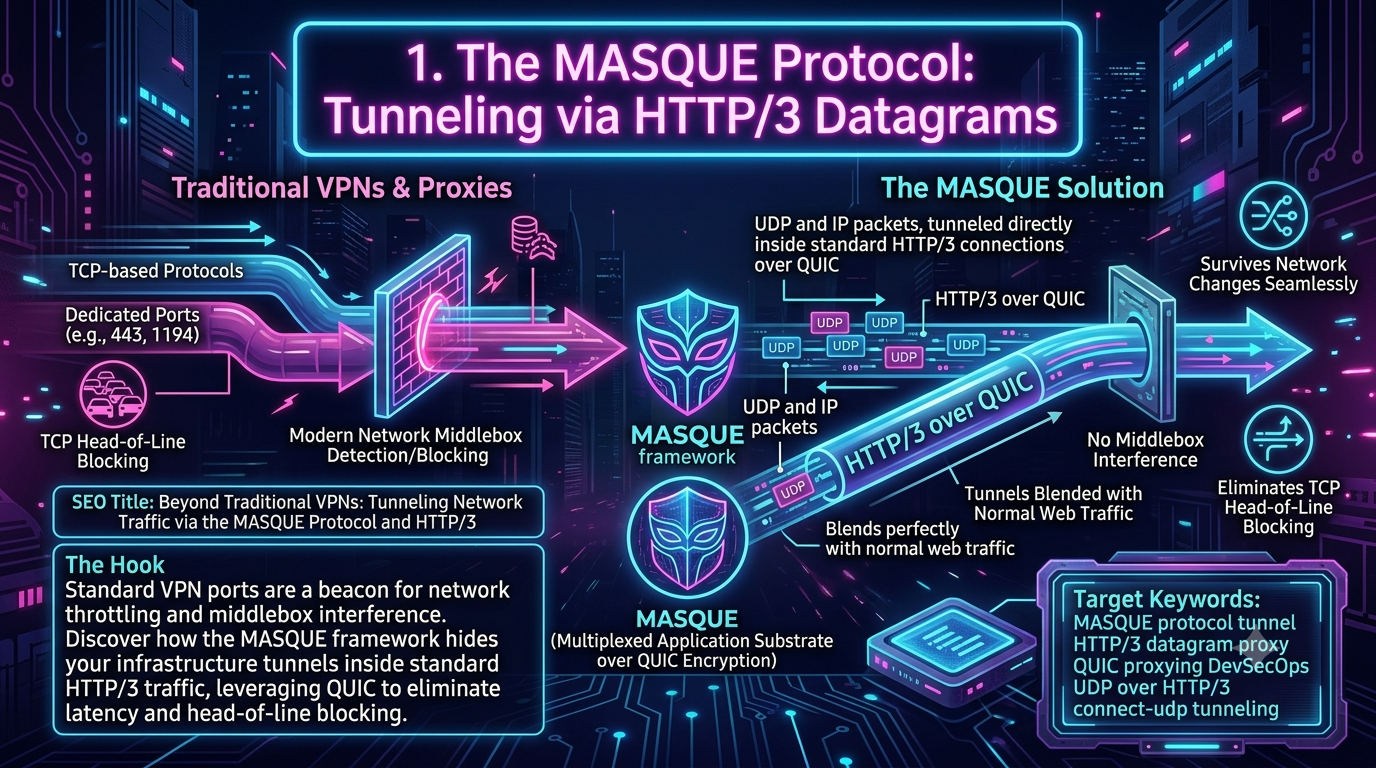
The way networks proxy traffic is undergoing a fundamental shift. For decades, two failure modes defined every VPN or tunnel deployment: either you used TCP-over-TCP (slow, fragile, latency-compounding) or you exposed a dedicated UDP port that a DPI appliance could immediately fingerprint and block. MASQUE—Multiplexed Application Substrate over QUIC Encryption—dissolves both problems at once. By encoding arbitrary UDP and IP traffic as standard HTTPS datagrams on port 443, it makes tunneled traffic statistically and structurally indistinguishable from normal web browsing. This is not a clever hack; it is the result of several years of deliberate IETF standardization, and the ecosystem is now large enough that it underpins Apple’s iCloud Private Relay, Cloudflare’s entire WARP fleet, and an expanding catalogue of enterprise Zero Trust products.
This article traces the complete technical stack: from the QUIC transport primitives that make MASQUE possible, through the Extended CONNECT method and the RFC-defined mechanisms for UDP and IP proxying, to the real-world deployments and the protocol extensions that are still being standardized today.
Why the Existing Proxy Stack Needed Replacing
To understand MASQUE’s design choices it helps to start with the failure modes it was built to address.
The classic HTTP CONNECT method, introduced to support SSL over HTTP proxies, works well for TCP streams. A client sends CONNECT target:443 HTTP/1.1, the proxy opens a TCP socket to the target, and from that point onward the proxy is a transparent pipe. The problem is that HTTP/3 uses QUIC, which itself runs over UDP. A TCP-based proxy cannot forward QUIC datagrams without encapsulating UDP inside TCP—exactly the double-transport problem that causes the well-known latency compounding seen in VPN-over-TCP configurations.
A second failure mode is detectability. WireGuard, for example, uses a fixed UDP port (51820 by default) and a distinctive handshake that commodity deep-packet inspection can identify and throttle. Wrapping WireGuard inside a dedicated port-8443 TLS session moves the fingerprint problem rather than solving it; a server listening on a non-standard port with no legitimate HTTP traffic is itself a signal.
MASQUE solves both. Because QUIC runs over standard UDP/443 and TLS 1.3 encrypts the connection metadata, a MASQUE proxy is, from the network’s perspective, a web server. The tunneled payload—whether WireGuard, WebRTC, or raw IP packets—is carried inside HTTP Datagrams on an established QUIC connection and is invisible to any middlebox that has not broken TLS.
The Standards Stack
MASQUE is not a single RFC; it is a layered family of specifications produced by the IETF MASQUE Working Group. The relevant documents form a clear dependency chain.
RFC 9000 – QUIC (May 2021) defines the UDP-based multiplexed transport. Its connection migration mechanism is central to MASQUE’s resilience: a QUIC connection is identified by a Connection ID, not by a 4-tuple, so it survives IP address changes without renegotiation.
RFC 9221 – QUIC DATAGRAM Extension (March 2022) adds unreliable delivery on top of QUIC streams. Datagrams sent via this extension are not retransmitted by the transport; they are fire-and-forget, which is exactly what tunneled UDP applications require.
RFC 9114 – HTTP/3 (June 2022) defines the HTTP layer over QUIC. The Extended CONNECT method—a mechanism that allows upgrading a stream to an arbitrary protocol—was retrofitted to HTTP/3 here.
RFC 9297 – HTTP Datagrams and the Capsule Protocol (August 2022) is the foundational MASQUE primitive. It defines how to convey multiplexed, potentially unreliable datagrams inside an HTTP connection. In HTTP/3, these are sent as QUIC DATAGRAM frames when the extension is available; a Capsule Protocol fallback handles situations where QUIC datagrams are unavailable, such as when falling back to HTTP/2 over TCP.
RFC 9298 – Proxying UDP in HTTP (August 2022) defines the CONNECT-UDP mechanism: how a client sends an Extended CONNECT request specifying :protocol: connect-udp, how the target host and port are encoded in a URI template in the request path, and how the proxy maps QUIC DATAGRAM frames to UDP packets sent to the target. This is the core document for UDP proxying.
RFC 9484 – Proxying IP in HTTP (October 2023) extends the model from a single UDP flow to the full IP layer. With CONNECT-IP, a client can push raw IP packets into HTTP Datagrams, effectively turning an HTTP/3 server into a full VPN gateway supporting TCP, UDP, and ICMP simultaneously.
The IETF MASQUE Working Group’s stated primary goal is to develop mechanisms that allow configuring and concurrently running multiple proxied stream- and datagram-based flows inside an HTTP connection, and the group has specified CONNECT-UDP and CONNECT-IP—collectively known as MASQUE—to enable this functionality. Active extension drafts currently in progress include CONNECT-Ethernet (Layer 2 tunneling), CONNECT-UDP-Listen (server-initiated UDP, enabling STUN/TURN replacement), template-driven CONNECT for TCP, and a reverse-connect mechanism that allows a proxy client to accept inbound sessions, published in April 2025.
How the Tunnel Is Established
The wire-level flow for a CONNECT-UDP tunnel is worth tracing in detail because it illustrates how elegantly the pieces compose.
The client opens a QUIC connection to the proxy on UDP/443. The TLS 1.3 handshake is embedded in the QUIC handshake, so encryption is established before any application data is sent. The ALPN negotiation selects
h3, identifying this as an HTTP/3 connection.On an HTTP/3 request stream, the client sends an Extended CONNECT request:
:method = CONNECT
:protocol = connect-udp
:scheme = https
:path = /.well-known/masque/udp/target.example.com/51820/
:authority = proxy.example.com
The target host and port are encoded in the URI template path, not in a Host-style header. This design allows proxies to apply URL-based policy and load balancing using the same infrastructure they use for regular HTTP traffic.
The proxy receives this request, performs any authentication and policy checks, then opens a UDP socket to
target.example.com:51820. It responds with a200status on the same stream.From this point, the client sends QUIC DATAGRAM frames (RFC 9221) tagged with the stream’s Quarter Stream ID. Each datagram carries one UDP payload, encapsulated as an HTTP Datagram per RFC 9297. The proxy extracts the UDP payload and sends it as a standard UDP packet to the target, and performs the reverse mapping for returning traffic.
A critical property of this design is that datagram delivery is explicitly unreliable. If the underlying network drops a QUIC datagram, neither the proxy nor the client retransmits it—that responsibility belongs to the inner protocol. For WireGuard, which manages its own handshake state and data integrity, this is ideal: the outer transport does not impose TCP’s retransmission semantics on a protocol that already has its own. This eliminates the latency compounding that plagues TCP-over-TCP tunnels.
CONNECT-IP and Full Network Tunnels
CONNECT-UDP is sufficient for proxying a known application to a fixed target. But when you need to route an entire device’s network stack—arbitrary destination IPs, mixed TCP and UDP, ICMP—through the proxy, CONNECT-IP (RFC 9484) is the right mechanism.
The Extended CONNECT request specifies :protocol: connect-ip. Once the proxy accepts, the client and proxy exchange IP-prefix and MTU negotiation via Capsule messages on the established stream. The client can request an assigned IP address range, which the proxy either grants or declines. After negotiation, the client pushes raw IP packets into HTTP Datagrams; the proxy decapsulates them and routes them to the internet.
The protocol requires strongly preferring HTTP/3 and QUIC DATAGRAM frames when available, with HTTP/2 as a mandatory fallback when QUIC is blocked on the network path. MTU handling is explicit: the tunnel endpoints inform each other of their maximum forwarding MTU to avoid fragmentation, an especially important consideration given that IPv6 does not permit in-path fragmentation.
This mechanism is the foundation of production deployments like iCloud Private Relay, which routes Safari traffic through a two-hop architecture where no single relay can see both the client identity and the destination.
Production Deployments
Apple iCloud Private Relay
iCloud Private Relay is the most widely deployed public application of MASQUE. The service routes traffic through two independent relay hops. Apple operates the ingress (first) relays, which see the client’s real IP address but cannot read the destination; the egress (second) relays see the destination but receive only an anonymized GeoHash-derived IP address representing the client’s general region, not their real address.
The egress relays are operated by third parties—currently Akamai, Cloudflare, and Fastly. Cloudflare has documented that the same infrastructure powering Private Relay—its Rust-based proxy framework and its open-source quiche QUIC implementation—is deployed globally across its network. Proxies are authenticated with TLS 1.3, and client authentication uses RSA blind signatures to prevent the proxy from correlating authentication events with traffic. DNS queries travel separately over Oblivious DoH (RFC 9230) so that even the DNS resolver cannot correlate queries to a client IP.
The result, described in Apple’s WWDC 2023 engineering session, is that no single entity in the chain can combine an IP address and browsing activity into a complete user profile—precisely the property a MASQUE chain with separated ingress and egress relays provides.
Cloudflare WARP and Zero Trust
Cloudflare introduced MASQUE into its WARP client in 2024, initially for Zero Trust (enterprise) customers. The motivation was twofold: enterprise customers needed their VPN traffic to appear as standard HTTPS to avoid detection by restrictive corporate and campus firewalls, and a significant number required FIPS-compliant encryption—something QUIC’s TLS 1.3 substrate delivers natively.
In Zero Trust WARP, MASQUE establishes a tunnel over HTTP/3 that delivers the same connectivity as the existing WireGuard tunnel. QUIC’s multiplexing allows many HTTP sessions to run over the same UDP connection, and packet coalescing reduces the number of system interrupts per unit of data. The Cloudflare network, which spans more than 310 cities across 120 countries and peers with over 13,000 networks, means the QUIC path to the nearest ingress is short.
The migration from WireGuard to MASQUE as the default protocol has advanced rapidly. Cloudflare’s 2025 WARP client changelog shows that MASQUE is now the default protocol for all new WARP device profiles, and from version 2025.7.106.1 onward, MASQUE is the only protocol that can be used in Proxy mode—WireGuard has been deprecated for that configuration. Administrators who had configured Proxy mode on a WireGuard profile must migrate, or affected devices will lose connectivity.
HTTP/3 at Scale
The scale at which MASQUE operates is worth quantifying. According to Cloudflare Radar’s 2025 Year in Review, approximately 21% of global requests to Cloudflare’s network were made over HTTP/3 in 2025, a figure that has been growing steadily. Among platforms with high adoption, more than 75% of Facebook’s traffic uses QUIC and HTTP/3, with Meta reporting that QUIC reduced request errors by 6% and tail latency by 20% relative to HTTP/2. HTTP/3 adoption at Cloudflare itself stands at 78% of CDN-served traffic. The practical consequence for MASQUE deployments is that HTTP/3 tunnels blend into a substantial and growing fraction of internet traffic—not an exotic fingerprint.
Applications: WireGuard Obfuscation and WebRTC
WireGuard via MASQUE
WireGuard’s design choices—a fixed UDP port, a distinctive public-key handshake, and no built-in obfuscation—make it straightforward for firewall operators to identify and block. This has driven a category of MASQUE-based obfuscation tools that wrap WireGuard UDP traffic inside HTTP/3.
The open-source usque project, for example, is a community reimplementation of the Cloudflare WARP MASQUE protocol. Its author notes explicitly that WireGuard was blocked on local train Wi-Fi while MASQUE was not—a direct demonstration of the practical value of traffic indistinguishability. Because MASQUE traffic appears as standard HTTPS to any network observer without TLS interception, it passes through firewalls and DPI systems that apply blanket blocks to known VPN ports and protocols.
The inner WireGuard protocol continues to handle its own handshake, key rotation, and data integrity. The MASQUE layer provides only transport and obfuscation; it does not re-implement any security that WireGuard already provides.
WebRTC and Real-Time Media
STUN and TURN, the protocols used to traverse NATs for WebRTC, rely on UDP. Enterprise firewalls that block UDP traffic other than DNS and QUIC force WebRTC applications to fall back to TCP-based TURN relays, which reintroduce head-of-line blocking on media flows and increase latency substantially.
MASQUE’s CONNECT-UDP-Listen draft directly targets this use case. It allows a proxy client to advertise a UDP listening socket to the proxy, enabling the server to push inbound UDP datagrams to the client—the functional equivalent of a TURN relay but implemented entirely inside an HTTP/3 connection. For WebRTC and VoIP applications, this means high-quality real-time media can be maintained even behind enterprise firewalls that permit only HTTPS traffic, without the latency penalty of a TCP relay.
QUIC’s Structural Advantages for Tunneling
Several QUIC features matter specifically in the tunneling context and deserve examination.
Connection Migration. QUIC identifies connections by a Connection ID negotiated during the handshake, not by the 4-tuple of source/destination IP and port. When a mobile device switches from Wi-Fi to cellular, the source IP changes—but the Connection ID remains valid, and the QUIC connection migrates automatically without renegotiation. For a MASQUE tunnel, this means that the outer tunnel survives network handoffs transparently, and the inner protocols see no disruption.
Head-of-Line Blocking Elimination. HTTP/2 over TCP multiplexes streams, but TCP’s in-order delivery means a lost packet blocks all streams until it is retransmitted. QUIC’s streams are independent: a lost packet on one stream does not delay delivery on others. For a MASQUE tunnel carrying mixed workloads—a latency-sensitive WebRTC flow and a bulk file transfer, for instance—this isolation is directly beneficial.
Integrated Encryption. TLS 1.3 is woven into the QUIC handshake at the protocol level; there is no option to run QUIC without encryption. This means a MASQUE tunnel inherits cryptographic authentication and confidentiality by construction, not by configuration.
HTTP/2 Fallback. Both RFC 9298 and RFC 9484 require that implementations support HTTP/2 as a fallback when QUIC is unavailable. Apple’s documentation confirms that MASQUE relays fall back to HTTP/2 in networks where QUIC/UDP is blocked. This ensures connectivity in maximally restrictive environments at the cost of native UDP semantics.
DevSecOps and SASE Architecture
The MASQUE framework is reshaping enterprise architecture in ways that extend beyond VPN replacement.
Eliminating Dedicated VPN Concentrators. Because MASQUE runs on standard HTTP/3, a MASQUE proxy is just an HTTP server. It can be deployed behind the same load balancers, ingress controllers, and WAFs that serve the company’s web applications. There is no requirement for dedicated VPN concentrator hardware or separate firewall rules. For DevSecOps teams, this means tunnels are managed through the same observability and policy stack as web traffic.
Layer 4 Proxying Without L3 Plumbing. Traditional Zero Trust clients that route through WireGuard must manage a virtual network interface, assign IP addresses, and handle the translation between the application’s TCP connections and the VPN’s IP layer. MASQUE’s CONNECT-UDP mechanism allows the client to proxy application-layer flows directly into QUIC streams, bypassing the need for kernel-level TUN/TAP device management. The client software is simpler and less resource-intensive.
FIPS Compliance. QUIC mandates TLS 1.3, which supports the NIST-approved cipher suites required for FIPS 140-2⁄140-3 compliance. WireGuard uses ChaCha20-Poly1305 and Curve25519, neither of which is in the FIPS-approved list. For regulated industries, MASQUE’s TLS 1.3 substrate directly unblocks use cases that WireGuard cannot address.
Congestion Control at Scale. QUIC implements modern congestion control (CUBIC and newer variants) with flow control at both the stream and connection level. DevSecOps teams managing remote access for thousands of concurrent users no longer need to tune TCP window sizes or deal with the throughput collapse that TCP-over-TCP tunnels exhibit under packet loss. They inherit QUIC’s well-tested behavior by default.
Unified Traffic Telemetry. Since MASQUE traffic is HTTP/3, it flows through the same CDN edge, WAF, and logging infrastructure as web traffic. Access logs, rate limiting, and anomaly detection apply to tunnel flows without custom integrations. For security teams, this collapse of the VPN and web-traffic observability planes into a single stack significantly reduces operational overhead.
The Frontier: Reverse CONNECT and Ethernet Tunneling
Two drafts in active IETF development point to where MASQUE is heading next.
Reverse HTTP CONNECT (draft-rosomakho-masque-reverse-connect-00, April 2025) specifies an extension that allows a proxy client to accept inbound TCP and UDP sessions through the proxy. In the current MASQUE model, the client always initiates outbound connections; Reverse CONNECT inverts this. The client advertises available local services to the proxy using an AVAILABLE_SERVICES Capsule, and the proxy forwards inbound connections to those services. This directly enables the use case of exposing a local development server through a MASQUE proxy without configuring port forwarding or public IP routing—a secure tunnel for inbound traffic using the same HTTP/3 stack.
CONNECT-Ethernet (draft-ietf-masque-connect-ethernet) extends the MASQUE model from Layer 3 to Layer 2. Where CONNECT-IP tunnels raw IP packets, CONNECT-Ethernet tunnels full Ethernet frames, allowing a client to attach to a remote Ethernet segment over HTTP/3. The semantics resemble a Layer 2 VPN but are implemented entirely within the MASQUE encapsulation stack.
Both drafts reflect the working group’s stated direction: exercising the extension points defined by CONNECT-UDP and CONNECT-IP to support new use cases and accommodate changes in deployment environments.
Conclusion
MASQUE represents a deliberate reorientation of network tunneling around the modern web stack. By building on QUIC’s connection migration, TLS 1.3 encryption, and HTTP/3’s multiplexed stream model, it achieves something that older protocols cannot: a tunnel that is cryptographically secure, functionally efficient, and structurally invisible to network observers—all simultaneously.
The RFC stack is now complete for the core use cases. CONNECT-UDP (RFC 9298) and CONNECT-IP (RFC 9484) are published standards. Production deployments at the scale of iCloud Private Relay and Cloudflare WARP demonstrate that the protocol handles real-world load. The extension drafts—Reverse CONNECT, CONNECT-Ethernet, UDP-Listen—show that the working group is actively expanding the model rather than treating it as finished.
For engineers building the next generation of Zero Trust access, secure development tunnels, or censorship-resistant communications, MASQUE is no longer an emerging option. It is the standard the industry is converging on, and the infrastructure to support it is already deployed globally.
References
- IETF RFC 9000 – QUIC: A UDP-Based Multiplexed and Secure Transport (May 2021)
- IETF RFC 9221 – An Unreliable Datagram Extension to QUIC (March 2022)
- IETF RFC 9114 – HTTP/3 (June 2022)
- IETF RFC 9297 – HTTP Datagrams and the Capsule Protocol (August 2022)
- IETF RFC 9298 – Proxying UDP in HTTP / CONNECT-UDP (August 2022)
- IETF RFC 9484 – Proxying IP in HTTP / CONNECT-IP (October 2023)
- IETF MASQUE Working Group charter – https://datatracker.ietf.org/wg/masque/about/
draft-rosomakho-masque-reverse-connect-00– Reverse HTTP CONNECT for TCP and UDP (April 2025)draft-ietf-masque-connect-ethernet– Proxying Ethernet in HTTP- Cloudflare Blog – “Zero Trust WARP: tunneling with a MASQUE” (March 2024)
- Cloudflare Blog – “iCloud Private Relay: What Cloudflare Customers Need to Know”
- Cloudflare Radar 2025 Year in Review
- Cloudflare WARP macOS changelog – version 2025.7.106.1
- Apple WWDC23 – “Ready, set, relay: Protect app traffic with network relays”
- APNIC Blog – “An investigation into Apple’s new Relay network” (January 2023)
- Fastly Blog – “iCloud Private Relay and a privacy-preserving internet”
Related InstaTunnel pages
Continue from this article into the most relevant product guides and workflows.


Comments
Post a Comment