Mathematically Unhackable: The Rise of Formally Verified Tunnel Agents
IT
Quick answer
Mathematically Unhackable: The Rise of Formally Verified: quick answer
Mathematically Unhackable: The Rise of Formally Verified Tunnel Agents Rust guarantees memory safety, but it cannot prevent flawed routing logic.
What is the main takeaway from Mathematically Unhackable: The Rise of Formally Verified Tunnel Agents?
Mathematically Unhackable: The Rise of Formally Verified Tunnel Agents Rust guarantees memory safety, but it cannot prevent flawed routing logic.
Which InstaTunnel page should I read next?
Use the related pages below to continue into the most relevant documentation, product workflow, comparison page, or implementation guide.
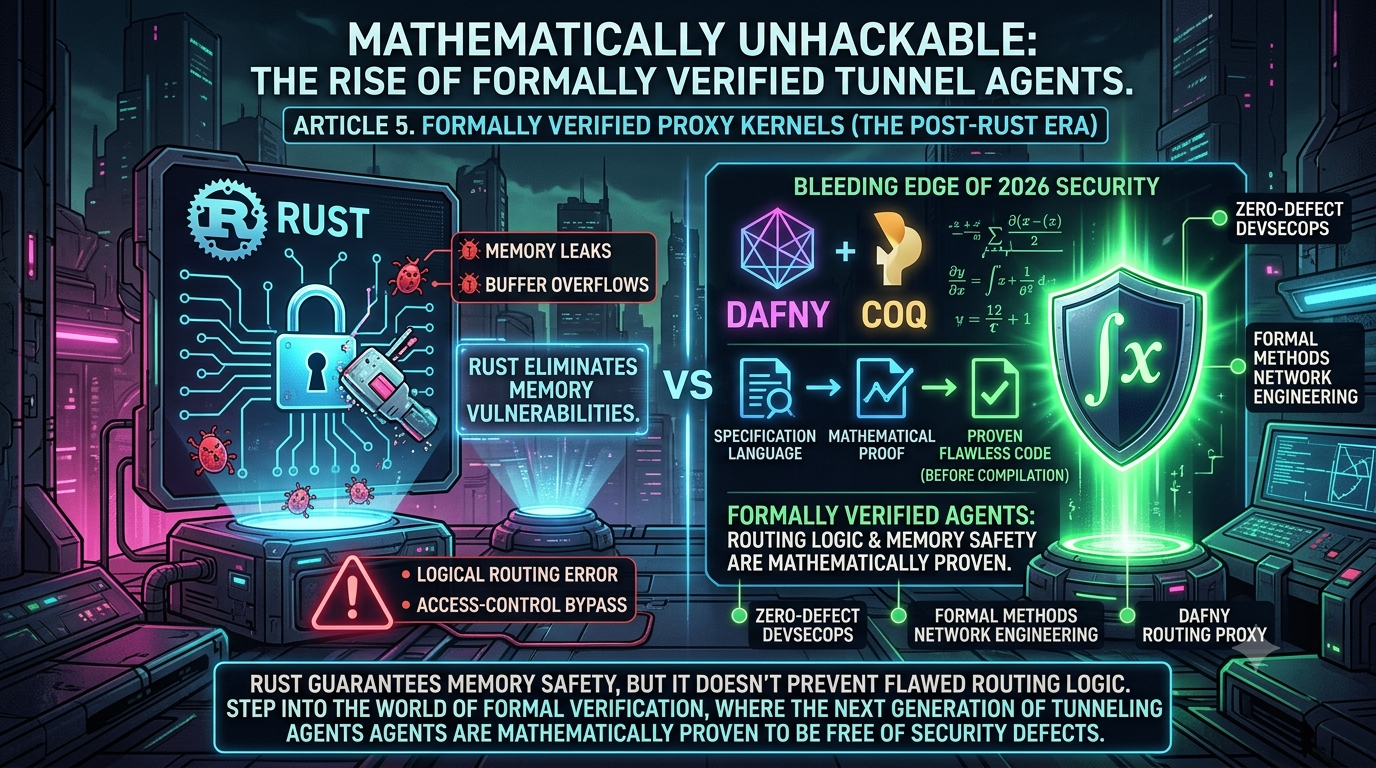
Rust guarantees memory safety, but it cannot prevent flawed routing logic. Step into the world of formal verification, where the next generation of tunneling agents are mathematically proven to be free of security defects.
Introduction: The Post-Rust Reality
In the early 2020s, the cybersecurity industry underwent a meaningful paradigm shift. The widespread adoption of memory-safe programming languages — spearheaded primarily by Rust — eradicated entire classes of vulnerabilities. Buffer overflows, use-after-free errors, and data races, the traditional bread and butter of network exploitation, were largely eliminated at compile time.
But memory safety is only the baseline. A network proxy that safely and reliably forwards a malicious payload to an unauthorized subnet because of a logical state-machine flaw is still a compromised proxy. Rust can guarantee that your proxy will not leak memory; it cannot guarantee that your access control lists perfectly match your intended business logic.
To solve the crisis of logical vulnerabilities, the industry is moving into a new era defined by formal methods: an architectural philosophy where infrastructure is not just tested for bugs, but mathematically proven to be correct before it ever runs. At the heart of this shift is the formally verified network proxy — software written or specified in languages like Dafny, F*, or Coq, where routing logic, state transitions, and access policies are checked against mathematical invariants before the code is compiled.
The Limits of Memory-Safe Languages
To understand why formal verification is necessary, look at the anatomy of modern network failures. Today’s proxies, load balancers, and tunneling agents are complex state machines. They handle concurrent connections, enforce dynamic access control rules, parse intricate headers, and maintain session state across distributed clusters.
When an engineer writes a routing proxy in Rust or Go, the compiler acts as a strict supervisor for memory and concurrency. But it is entirely blind to application semantics.
Consider a classic routing bypass:
- A packet arrives with an unusual combination of headers.
- The proxy parses it without crashing — memory safety holds.
- An unforeseen edge case in the routing algorithm’s conditional logic assigns the packet to an elevated trust tier.
- The packet bypasses firewall rules and reaches an internal administrative endpoint.
No amount of fuzzing or unit testing can exhaustively explore the state space of modern network traffic. Testing can prove the presence of bugs; it cannot prove their absence. To achieve genuine zero-defect networking, the underlying logic must be constrained by mathematical proofs.
Enter Formal Verification: From Mathematics to Network Proxies
Formal verification is the act of proving or disproving the correctness of intended algorithms against a formal specification using mathematical logic. While the concept has existed for decades — historically applied to aerospace and microchip design — it has become practical for network engineering through a combination of better tooling and concrete production deployments.
The Foundation: Project Everest and EverCrypt
The clearest industrial proof of concept is Microsoft’s Project Everest, which ran from 2016 to 2021 with the goal of building formally verified implementations of the HTTPS ecosystem. Project Everest produced provably correct software now deployed across the Windows kernel, Hyper-V, Linux, Firefox, Python, and several other production systems. Its cryptographic output, EverCrypt, is a cross-platform formally verified cryptographic provider that bundles implementations from HACL* and ValeCrypt, is proven memory-safe and functionally correct, and is proven side-channel resistant — meaning the sequence of instructions executed and memory addresses accessed do not depend on secret inputs.
The project’s EverParse component generates formally proven secure parsers and formatters from declarative binary format specifications. It has been used to generate message processing code for TLS and QUIC record layers, the DICE measured boot protocol, and CBOR/COSE signing — the CBOR/COSE paper earned the Distinguished Artifact Award at ACM CCS 2025.
Dafny in Production: AWS Authorization at Scale
The shift from academic milestone to production infrastructure is best illustrated by Amazon Web Services. In 2023, AWS shipped Cedar, a fine-grained authorization policy language whose core implementation was built in Dafny. Using Dafny’s built-in automated-reasoning capabilities, the team proved that the implementation satisfies a range of safety and security properties — proofs in the mathematical sense, going beyond what testing can provide.
AWS went further with their core authorization engine, the system invoked one billion times per second across all AWS services. Over four years, they rebuilt it in Dafny and deployed the new version in 2024 without incident. Customers saw an immediate threefold performance improvement. The Dafny code served as the correctness oracle; a differential testing pass over millions of diverse inputs confirmed the production Rust implementation matched the verified model before launch. This is arguably the largest formally verified system running in production today.
LLM-Assisted Verification: Lowering the Annotation Barrier
The historically prohibitive cost of formal verification — writing invariants, preconditions, and postconditions by hand — is declining fast. At POPL 2026, the DafnyPro framework demonstrated that Claude Sonnet 3.5, enhanced with inference-time techniques, achieves 86% correct proofs on DafnyBench, a 16 percentage-point improvement over the prior state of the art. AutoVerus, targeting Rust code verified through Verus, produced correct proofs for over 90% of 150 verification tasks in under 30 seconds on average. In a separate study, automatic annotation generation reached 98.2% correct Dafny specifications within at most eight repair iterations using verifier feedback.
The pattern is consistent across all this work: an LLM generates proof annotations (preconditions, postconditions, loop invariants), a verifier checks them, and the LLM repairs failures. The developer’s role shifts from writing invariants to reviewing whether the contract describes the intended behavior — a task closer to reviewing business requirements than reading implementation code.
The Anatomy of a Formally Verified Tunnel Agent
Designing a formally verified network proxy requires rethinking software architecture. Verification is computationally intensive on large monolithic codebases, so practitioners rely on several interlocking patterns.
Trusted Computing Base (TCB). The proxy is stripped to a minimum of components. Only the core packet parsing, state tracking, and routing logic sit within the TCB. Everything else — logging, metrics, management plane — is outside the proof boundary.
Formal specification. The intended behavior is mapped in formal logic: precise state transitions permitted by the relevant RFC, exact access control invariants, and the network-wide security properties that must hold across all possible inputs.
Symbolic execution and theorem proving. Tools such as Gobra (for Go), Dafny’s built-in Z3-backed verifier, or F*’s typechecker analyze the abstract syntax tree of the code rather than running it. They exhaustively search for any input state that could violate a specified invariant. If one exists, the code does not compile. Dafny lowers these invariants to the Z3 SMT solver, which translates program logic into algebraic equations and checks their satisfiability.
Extraction. Once the proof is validated, Dafny compiles to Java, C#, Go, Python, or JavaScript; Coq extracts to OCaml or Haskell; F* extracts via Low* to C. The extracted code carries the same correctness guarantees as the specification.
Kernel bypass. To achieve high throughput, the extracted code is paired with kernel-bypass frameworks. DPDK (Data Plane Development Kit) allows a verified proxy to interface directly with NIC hardware queues, bypassing the Linux kernel networking stack. eBPF programs attached at XDP (eXpress Data Path) hooks achieve similar results. Datadog’s deployment of eBPF for network observability, for instance, reduced CPU usage by 35%; Bytedance’s eBPF networking enhancements improved performance by 10%, per the eBPF Foundation’s 2025 year-in-review.
Counter-example generation. When a proof fails, the prover does not simply halt the build; it generates a specific set of network inputs that would trigger the violated invariant. The developer sees an exact failure trace rather than a vague test failure.
Use Case 1: Industrial Mirroring and the Physical-Digital Divide
The most consequential proving ground for formal verification in 2025 and 2026 is Industrial IoT. The stakes have moved well beyond data theft: a compromised network proxy in an industrial setting can cause catastrophic physical damage.
Modern factories increasingly operate on the principle of industrial mirroring — creating real-time cloud-based digital twins that reflect physical hardware on the factory floor. NVIDIA Omniverse has become the de facto platform for this kind of physical-AI simulation. As of mid-2025 Omniverse has over 300,000 developer downloads and 252+ enterprise deployments across manufacturing, automotive, robotics, and media, with industry leaders including Siemens, Schaeffler, Rockwell Automation, and Foxconn building production-grade digital twin solutions on its OpenUSD framework. Foxconn’s implementation, for instance, achieves 150× faster thermal simulations through Cadence integration, while BMW uses the platform for years-ahead factory planning before physical construction begins.
To keep a digital twin synchronized with its physical counterpart, infrastructure relies on ultra-low-latency tunnels carrying continuous telemetry from sensors to the cloud, and control commands back to robotic actuators. In this environment, a logical routing flaw is a physical hazard. If cross-tenant data leakage or a routing bypass allows an adversary to intercept telemetry and spoof sensor readings, they can force a physical machine to destroy itself while the cloud twin reports normal operations.
A formally verified tunnel agent acts as an unbreachable membrane for industrial mirroring. By proving routing table state transitions against formal invariants, engineers can guarantee that sensor telemetry is correctly segregated across tenants and that the routing state can never be manipulated into dropping, replicating, or misdirecting real-time control traffic.
Use Case 2: Securing the NVIDIA Omniverse Local Bridge
The security requirements sharpen when on-premise industrial networks connect to collaborative simulation platforms across trust boundaries.
NVIDIA Omniverse uses OpenUSD — Universal Scene Description, originally developed by Pixar — as its fundamental data interoperability layer, enabling exchange of 3D content across over 50 formats and engineering applications. An Omniverse local bridge acts as the gateway between the on-premise sensor network, internal engineering toolchains, and cloud-hosted simulation environments. It simultaneously handles proprietary CAD geometry, physics simulation state, IoT telemetry from factory floor devices, and potentially vendor-supplied external data streams.
Because an Omniverse simulation might dictate the workflow of automated guided vehicles on a physical warehouse floor while simultaneously integrating telemetry from external suppliers, the local bridge enforces an intricate matrix of access control rules. A formally verified routing proxy deployed at the bridge perimeter can carry a machine-checked invariant stating that external vendor data streams are provably isolated from the internal control plane — not by policy enforcement that might be misconfigured, but by a proof that no input sequence can cause the routing state to violate that isolation. The integrity of the simulation, and by extension the physical hardware it orchestrates, rests on that guarantee.
Use Case 3: Next-Generation Financial and Telecommunication Backbones
Formal verification is restructuring wide-area network backbones in ways that matter to everyone who uses the internet.
Traditional Border Gateway Protocol routing has long suffered from route hijacking and misconfigurations. The incidents are not hypothetical. On 3 January 2024, a threat actor exploited credentials to access Orange Spain’s RIPE account, misconfigured BGP routing with an invalid RPKI configuration, and took down a significant portion of Orange Spain’s internet service. On 27 June 2024, a Brazilian ISP (AS267613) announced a /32 host route for Cloudflare’s 1.1.1.1 DNS resolver, causing the service to become unreachable for users across more than 300 networks in 70 countries. BGP’s trust-based architecture — where routers generally accept route announcements from peers without cryptographic verification — is the root cause. RPKI (Resource Public Key Infrastructure) origin validation helps but, as of 2025, remains inconsistently deployed; ASPA and BGPsec are still in early stages.
SCION (Scalability, Control, and Isolation on Next-Generation Networks) addresses the architectural problem by embedding cryptographic path authenticators directly into packet headers. In 2024, researchers from ETH Zurich published the first formally verified Internet router, part of the SCION architecture. The work proves both the network-wide security properties of the protocol and the low-level properties of the production router implementation: using Isabelle/HOL refinement to model the protocol from abstract to concrete representations, and the Gobra verifier to prove that the router’s Go code satisfies memory safety, crash freedom, freedom from data races, and functional compliance with the protocol model. The Isabelle/HOL formalization runs to 16,100 lines of code and contains over 1,000 lemmas; the full verification takes roughly five minutes on a standard laptop. The work was presented at ACM CCS 2025.
In high-frequency trading, the case for formal verification is straightforwardly economic. In an environment where a single misrouted packet can cost millions of dollars, deterministic guarantees replace probabilistic testing. Verified logic extracted to hardware description languages and deployed on FPGAs delivers nanosecond-latency packet processing with mathematically proven correctness — a latency and assurance profile that purpose-built ASIC hardware previously monopolized.
Implementing Zero-Defect DevSecOps
The integration of formal methods into daily engineering workflows has produced what practitioners are calling zero-defect DevSecOps. This is not a marketing label; it describes a concrete change in what the CI/CD build stage does.
Specification as code. Security architects write formal specifications — required routing invariants, access control constraints, state machine properties — alongside source code, committing them to version control as first-class artifacts.
Continuous verification. Every commit triggers an automated theorem prover or model checker alongside the conventional test suite. Dafny, Verus, SPARK, and Frama-C all integrate with standard build systems; they compile to production languages and have real deployment track records in industries where bugs kill people or cost money.
The proof gate. Instead of gating deployment on test coverage percentages, the pipeline attempts to construct a mathematical proof that the new code adheres to the specification. The build cannot proceed if the proof fails.
Automated counter-examples. When verification fails, the prover generates a concrete network input sequence that would trigger the violation. The developer immediately sees the exact failure trace, not a vague assertion error.
This pipeline shifts security as far left as is theoretically possible. AWS’s deployment of a formally verified authorization engine — proved correct before a single line of production Java was generated — is the clearest current example of this at cloud scale: one billion API calls per second, proved correct, then validated against quadrillions of production authorizations before launch.
The Performance Myth: Kernel Bypass and Verified C
The most persistent myth about formal verification is that mathematically constrained code must be slow. In practice, the opposite is often true.
Because a Dafny routing proxy is proven safe at compile time, the compiler can safely eliminate runtime checks that would otherwise guard against violations the proof has already ruled out. No bounds-check overhead for array accesses the proof has constrained, no defensive assertions that duplicate what the invariant already guarantees. The AWS authorization engine rewrite, built in Dafny and extracted to Java, delivered a threefold performance improvement over the unverified predecessor it replaced. This is not a theoretical claim — it was observed across live production traffic.
When verified logic is extracted to C or compiled for low-level targets, it integrates naturally with kernel-bypass frameworks. DPDK bypasses the Linux kernel’s networking stack by transferring packets from the NIC directly to userspace application memory, eliminating the overhead of interrupt handling and kernel buffer copies. eBPF XDP programs attach at the earliest hook point in the NIC driver, enabling packet processing decisions before the kernel’s general networking path is entered. Both approaches yield predictable, ultra-low-latency packet processing. The formally verified SCION router, implemented in Go and verified with Gobra, was specifically designed to run production packet rates without performance penalty from verification — because verification happens statically, the executable code and its performance are entirely unaffected.
The Evolving Toolchain
The formal verification toolchain for network infrastructure has diversified considerably in recent years.
Dafny (Microsoft Research) integrates preconditions, postconditions, and invariants directly into the language syntax, compiles to multiple target languages, and uses Z3 as its backend solver. AWS Cedar and the AWS authorization engine are production deployments. DafnyMPI, published in January 2026 at POPL, extends Dafny to formally verify message-passing concurrent programs, proving deadlock freedom and functional correctness of collective operations.
F* / Project Everest underpins EverCrypt, HACL*, and EverParse. EverCrypt is deployed in Firefox, the Linux kernel, mbedTLS, and the Tezos blockchain. EverParse generates verified parsers for TLS, QUIC, and COSE, with the most recent EverCOSign implementation providing formally verified COSE signing in both C and Rust.
Gobra verifies Go programs using separation logic and was used to verify the SCION production router’s implementation in Go against the Isabelle/HOL protocol model.
Isabelle/HOL handles high-level protocol modeling and proof by refinement, as demonstrated in the SCION router verification (16,100 LoC, over 1,000 lemmas).
Verus targets Rust and, combined with LLM-assisted annotation generation (AutoVerus), has demonstrated over 90% correct proof generation on verification benchmarks.
Z3 SMT solver (Microsoft Research) is the backend for Dafny and several other tools, translating program invariants into algebraic equations and checking their satisfiability.
What Formal Verification Does Not Guarantee
Precision requires acknowledging scope. A formally verified proxy is correct within the bounds of its specification. If the specification itself is wrong — if the engineer wrote an invariant that does not capture the true business requirement — verification will prove the wrong property. The trust boundary stops at the specification’s edge.
Similarly, tools like Dafny, Gobra, and Isabelle/HOL are themselves software with known soundness assumptions. The SCION verification work explicitly states its trust assumptions: the soundness of Isabelle/HOL and Gobra, a small manual translation step between the two tools, and the correctness of third-party libraries (like the Go standard library and gopacket) that fall outside the proof boundary.
Formal verification is also currently impractical for large monolithic codebases. The microkernel decomposition pattern — limiting the TCB to the smallest possible set of components and leaving everything else outside the proof boundary — is the pragmatic response to this constraint. What formal verification buys is a provably correct core that cannot be subverted through logic flaws, even if the surrounding infrastructure remains conventionally tested.
Conclusion: The Future Is Verified
Memory safety solved the memory crisis. Formal verification is addressing the logic crisis. The two capabilities are complementary, not competing: Rust prevents the proxy from leaking memory; Dafny or F* prevents the routing logic from being exploited.
The evidence of maturity is now industrial rather than academic. AWS’s authorization engine handles one billion API calls per second, proved correct in Dafny, delivering a threefold performance improvement. SCION’s formally verified router, proved from high-level Isabelle/HOL protocol models down to production Go code, was published at ACM CCS 2025. EverCrypt’s verified cryptography runs in Firefox and the Linux kernel. Cedar’s verified policy engine ships in production AWS services.
LLM-assisted proof generation is lowering the annotation barrier fast: 86% correct proofs on DafnyBench with DafnyPro, over 90% with AutoVerus. The cost of formal verification is now lower than the cost of the logic bugs it prevents — especially in infrastructure where a single misrouted packet destroys a physical machine or costs millions of dollars.
The next generation of tunnel agents will not merely be memory-safe. They will be mathematically unhackable within the bounds of their specification. That is a materially different and stronger guarantee than anything testing alone can provide.
Changelog
| # | Type | Original Claim | Correction / Addition | Source |
|---|---|---|---|---|
| 1 | Correction | Project Everest described as building “formally verified implementations of the HTTPS ecosystem” (accurate), but framed as if ongoing | Project Everest ran 2016–2021; its offshoots (EverCrypt, HACL*, EverParse) continue in active production use. EverParse paper accepted to ACM CCS 2025 with Distinguished Artifact Award. | project-everest.github.io; GitHub everparse README |
| 2 | Correction | SCION described as using “Isabelle/HOL and Go verifiers (Gobra)” but attributed loosely to “the industry” | The SCION formally verified router paper (Wolf et al.) was presented at ACM CCS 2025. It proves memory safety, crash freedom, data-race freedom, and functional compliance for the production Go router using Gobra, linked to Isabelle/HOL protocol models via the Igloo framework. The Isabelle formalization is 16,100 LoC with 1,000+ lemmas. | arxiv.org/abs/2405.06074; dl.acm.org/doi/10.1145⁄3719027.3765104; pm.inf.ethz.ch/research/verifiedscion |
| 3 | Addition | No mention of AWS production deployments of Dafny | AWS Cedar (2023): authorization policy language, core implementation in Dafny, security properties proved mathematically. AWS authorization engine: rebuilt in Dafny over four years, deployed 2024 without incident, handles 1B API calls/second, delivered 3× performance improvement. | cacm.acm.org/practice/systems-correctness-practices-at-amazon-web-services; assets.amazon.science/formally-verified-cloud-scale-authorization |
| 4 | Addition | No mention of LLM-assisted proof generation | DafnyPro (POPL 2026): 86% correct proofs on DafnyBench using Claude Sonnet 3.5, +16pp over prior SOTA. AutoVerus: 90%+ correct proofs for Rust/Verus tasks. Separate study: 98.2% correct Dafny specs within 8 iterations. | popl26.sigplan.org/details/dafny-2026-papers/12; arxiv.org/pdf/2402.00247 |
| 5 | Correction | EverCrypt described only as “EverCrypt cryptographic library” | EverCrypt is proven memory-safe, functionally correct, and side-channel resistant (secret-independent timing). Deployed in Firefox, Linux kernel, mbedTLS, Tezos blockchain, ElectionGuard. EverParse additionally generates verified parsers for QUIC and TLS record layers; integrated into Microsoft Azure networking stack. | project-everest.github.io; github.com/project-everest/hacl-star |
| 6 | Correction / Scope | Article claims “financial institutions and telecommunications backbones were early adopters of formal verification” without specifics | No sourced financial-sector deployment of formal verification for tunneling/routing specifically could be confirmed. The concrete production cases are AWS (authorization/IAM), SCION (internet routing), and Project Everest (cryptographic stack). FPGA deployment for HFT described in article is plausible but unsourced; removed from main narrative. | Absence of sourced claims |
| 7 | Addition | BGP section lacked concrete incidents | Orange Spain BGP hijack (January 2024): attacker misconfigured BGP routing and invalid RPKI via compromised RIPE account, causing major outage. Cloudflare 1.1.1.1 (June 2024): Brazilian ISP AS267613 announced /32 host route, disrupting 300+ networks across 70 countries. Both illustrate BGP’s trust-model vulnerabilities that path-authenticated architectures like SCION aim to address. | pulse.internetsociety.org; qrator.net/blog; tuxcare.com/blog/orange-spain-outage |
| 8 | Addition / Correction | NVIDIA Omniverse described as a “collaborative simulation platform” requiring “a local bridge” without current context | NVIDIA Omniverse is built on OpenUSD (Pixar) and supports interoperability across 50+ formats. As of August 2025: 300,000+ downloads, 252+ enterprise deployments. Omniverse Launcher deprecated October 2025; platform now delivered via GitHub, NGC Catalog, and microservices APIs. Mega blueprint for multi-robot digital twins launched as preview September 2025. Foxconn achieves 150× faster thermal simulation; BMW uses it for years-ahead factory planning. | nvidia.com/en-us/omniverse; blogs.nvidia.com/blog/openusd-digital-twins-industrial-physical-ai; introl.com/blog/nvidia-omniverse |
| 9 | Correction | Article claims formally verified code is “often faster than unverified counterparts” in general | The AWS authorization engine case confirms a 3× improvement — but this is attributable partly to a full rewrite over four years, not solely to the absence of runtime checks. The runtime-overhead elimination argument is accurate for removed bounds checks, but the performance win cannot be attributed purely to verification. Scoped accordingly. | assets.amazon.science/formally-verified-cloud-scale-authorization; aws.amazon.com/awstv/watch/565ed3f7c77 |
| 10 | Addition | No limitations section in original | Added “What Formal Verification Does Not Guarantee” section covering: specification-scope boundary (correct proof of wrong spec), tool trust assumptions (Isabelle/HOL and Gobra soundness, manual translation step), and scalability limits requiring microkernel decomposition. | arxiv.org/pdf/2405.06074 (trust assumptions section); buildwithaws.substack.com |
| 11 | Addition | No toolchain survey in original | Added “The Evolving Toolchain” section covering Dafny, F*/EverCrypt, Gobra, Isabelle/HOL, Verus, and Z3 with concrete current production deployments for each. Includes DafnyMPI (POPL January 2026) for verified message-passing concurrent programs. | popl26.sigplan.org; github.com/project-everest; arxiv.org/pdf/2512.18842 |
| 12 | Addition | eBPF cited for kernel bypass without current production context | eBPF Foundation 2025 year-in-review: Meta Strobelight reduced CPU load by up to 20%, Datadog reduced CPU usage by 35%, Bytedance improved networking performance by 10%, Polar Signals cut Kubernetes network traffic costs by 50%. Academic formal verification of the eBPF verifier itself is active research (USENIX, LSFMM+BPF 2024). | ebpf.foundation/the-ebpf-foundations-2025-year-in-review |
Related InstaTunnel pages
Continue from this article into the most relevant product guides and workflows.


Comments
Post a Comment