Secure Local Ingress: Bypassing NAT with Identity-Gated TCP Funnels
IT
Quick answer
Secure Local Ingress: Bypassing NAT with Identity-Gated TCP : webhook testing answer
For local webhook testing, run your app locally, expose it with a public HTTPS tunnel, and paste the stable callback URL into the provider dashboard.
How do I test webhooks on localhost?
Start your local server, open a public HTTPS tunnel to that port, configure the provider webhook URL, and inspect events in your local logs.
Why does a stable webhook URL matter?
Stable URLs prevent provider dashboards from needing manual callback updates every time you restart a tunnel.
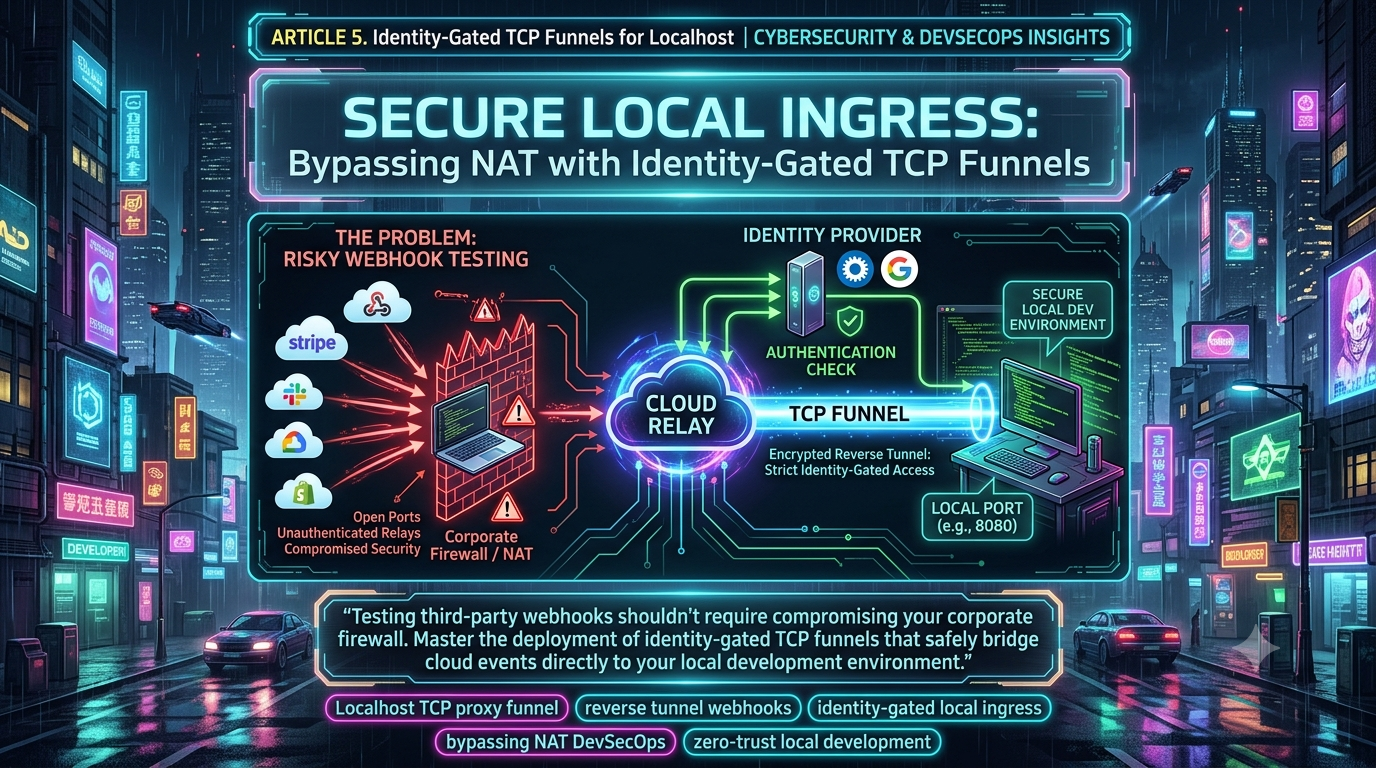
Testing third-party webhooks shouldn’t require compromising your corporate firewall. This guide covers how identity-gated TCP funnels safely bridge cloud events directly to your local development environment — without punching a single inbound hole.
In the era of microservices, cloud-native architectures, and API-first SaaS integrations, modern software development relies heavily on asynchronous event-driven communication. Payment gateways, CI/CD pipelines, customer support platforms, and messaging applications all use webhooks to notify external systems of state changes. Yet this architectural paradigm introduces a persistent developer-experience bottleneck: how does a developer securely receive a webhook on their local machine — sitting behind a corporate firewall and NAT gateway — without creating unacceptable security exposure?
Historically, the answer was unsatisfying. Developers either requested IT to open firewall ports (a significant violation of enterprise security policy) or they turned to unauthenticated third-party relay tools that placed their local development environments on the public internet. Today, a more principled solution exists. By deploying a localhost TCP proxy funnel layered with robust identity and access management (IAM) controls, engineering teams can achieve zero-trust local development — a model grounded in cryptographic identity rather than network location.
This guide explores the mechanics of identity-gated local ingress: how modern TCP funnels safely bridge cloud events to local machines, traverse NAT constraints without firewall changes, and fit cleanly into enterprise DevSecOps workflows.
The Challenge of Local Webhook Testing
When a SaaS provider such as Stripe, Twilio, or GitHub dispatches a webhook, it sends an HTTP POST request over the public internet to a pre-configured destination URL. If the developer processing that webhook is running code on their laptop — say, localhost:8080 — the provider cannot reach that machine. The laptop typically holds a private, non-routable IP address and sits behind a corporate NAT router or firewall that blocks all unsolicited inbound traffic by design.
The Flaws of Traditional Reverse Tunnels
To bridge this gap, developers have historically turned to reverse tunneling tools like early Ngrok builds or Localtunnel. These tools deploy a lightweight client on the developer’s machine that establishes an outbound, persistent TCP connection to a cloud-hosted relay server. Because the connection is initiated outbound, the corporate NAT and firewall permit the traffic. The cloud server provisions a public URL, and any internet traffic hitting that URL is multiplexed and piped back down the tunnel to the developer’s local port.
While this solves the connectivity problem, the traditional implementation of reverse tunnel webhooks introduces serious risks:
Unauthenticated Public Exposure. The public URL generated by the relay server is accessible to anyone on the internet. Automated scanner infrastructure — similar to that operated by Shodan — continuously probes for such endpoints. A developer who forgets to tear down a tunnel, or whose URL leaks into a commit, has unknowingly published a direct path into their workstation.
Bypassing Enterprise Security Controls. Because the traffic is encrypted inside the reverse tunnel, corporate Intrusion Detection Systems (IDS) and Data Loss Prevention (DLP) appliances cannot inspect payloads. This effectively punches a blind hole through the enterprise perimeter.
Accidental Data Leaks. Development environments commonly contain hardcoded credentials, debug endpoints, or mock databases containing sensitive PII. Exposing these over an unauthenticated ingress path is a well-documented vector for supply-chain compromise.
The Evolution: Identity-Gated Local Ingress
The industry has responded by pushing the authentication boundary out to the cloud relay layer itself, rather than leaving it entirely to the developer’s local code. Modern tunneling architectures integrate directly with Identity Providers (IdPs) such as Okta, Microsoft Entra ID (formerly Azure AD), or Google Workspace, enforcing strict access gates before traffic ever enters the tunnel.
How Identity-Gated Funnels Work
An identity-gated TCP funnel operates across a multi-stage architecture:
1. Local Agent Initiation. A lightweight daemon — cloudflared, a Tailscale node, or an enterprise ngrok client — runs on the developer’s machine. The agent authenticates itself to the control plane using a machine token or the developer’s SSO credential before any tunnel is established.
2. Establishing the Secure Outbound Link. The agent creates a persistent, encrypted outbound connection (commonly over HTTP/2, QUIC, or WireGuard) to the provider’s global edge network. No inbound firewall rules are modified; the enterprise NAT is traversed safely because all traffic originates from inside the perimeter.
3. Cloud Ingress Edge Provisioning. The cloud provider provisions a routing entry for a specific hostname — for example, dev-webhook.corp.example.com — tied to the active tunnel session.
4. The Identity Gate. When a webhook or user attempts to reach that hostname, the request is intercepted at the cloud edge before it enters the tunnel. The edge enforces the configured access policy: - Human users accessing a browser interface are redirected to an IdP login page. - Automated webhook senders must present valid cryptographic signatures, mTLS client certificates, or pre-shared JWTs in request headers.
5. Selective Traffic Forwarding. Only requests that pass the identity gate are multiplexed and forwarded down the tunnel to localhost. All unauthenticated traffic is dropped at the cloud edge and never reaches the developer’s machine.
Zero-Trust Alignment
The identity-gated funnel model directly implements the principles of NIST SP 800-207, the foundational government framework for Zero Trust Architecture, which defines zero trust as granting access on a per-session basis through dynamic policy that evaluates identity, device posture, and context — never through assumed network trust. The core tenet is exactly “never trust, always verify”: every access request is evaluated against identity controls regardless of whether the traffic originates inside or outside the corporate network boundary.
By pushing authentication to the cloud edge, organizations ensure that trust is granted based on cryptographic identity rather than network location. This aligns naturally with modern DevSecOps practice. Security teams can enforce compliance policies centrally: requiring that all local ingress routes through specific geographic regions, that all traffic is logged for audit, and that tunnels expire automatically after a configured duration, enforcing ephemeral-environment hygiene.
Key Platforms and Tools
Several platforms have built production-ready solutions for identity-gated local ingress. The right choice depends on how deeply a tool integrates with your existing networking and identity infrastructure.
Cloudflare Tunnel (cloudflared)
Cloudflare Tunnel gives developers a way to publish local services to the Cloudflare edge without a publicly routable IP address and without opening inbound firewall ports. A lightweight cloudflared daemon creates outbound-only connections from the local machine to Cloudflare’s global network, where traffic is routed through the developer’s domain and protected by DNS, TLS, and Zero Trust controls.
Cloudflare Access serves as the identity gate. Administrators configure granular policies requiring Okta authentication for human users, or mTLS certificate validation for automated webhook senders. The mTLS implementation supports both publicly-trusted CAs and self-signed CAs, where the CA certificate’s CA Basic Constraint must be set to TRUE. This makes it well-suited for IoT devices and automated pipelines that cannot go through an IdP login flow. Because Cloudflare proxies the traffic, it also applies Web Application Firewall (WAF) rules and DDoS protection before traffic enters the tunnel.
Cloudflare Tunnel supports two deployment models that can coexist within the same organization: public hostname routing for web apps, APIs, webhook receivers, and preview environments, and private network routing for internal services accessible by IP or private DNS — databases, SSH hosts, staging clusters, or admin tools.
Recent changelog entries confirm active development: WARP Connector (version 2025.10.186.0 onward) responds to LAN IP pings immediately after installation, and both the Zero Trust dashboard and the Cloudflare dashboard now offer full tunnel management capabilities.
Tailscale Funnel
Tailscale is a connectivity platform built on WireGuard that creates encrypted peer-to-peer mesh networks authenticated by identity rather than network location. It connects to the identity provider you already use — Okta, Azure AD (Entra ID), Google Workspace, GitHub, GitLab, and any OIDC or SAML-compatible provider — with group membership flowing directly into ACLs.
Tailscale Serve exposes a local service to authenticated members of your tailnet by name, with no reverse proxy or firewall changes needed. The service stays bound to localhost and is never reachable from the public internet. Access is governed by your tailnet’s ACL policies, so only authorized teammates can connect.
Tailscale Funnel extends this to the public internet, giving developers a shareable HTTPS endpoint for webhooks, demos, or lightweight self-hosted services. Under the hood, Funnel’s ingress nodes connect to your device using Tailscale’s inter-node peerapi mechanism. TCP connections are handled internally using gVisor’s netstack — they never reach the operating system directly, providing a clean isolation boundary. Funnel provisions automatic TLS certificates and creates the necessary public DNS records.
Tailscale commissioned Trail of Bits (2024) and Doyensec (2025) security audits of its client and coordination server; both returned no critical findings.
For internal webhook testing between microservices across developer machines, Tailscale Serve handles everything entirely within the tailnet, without exposing any traffic to the public internet, routing it peer-to-peer using corporate SSO identities.
ngrok (Enterprise and Free Tiers)
ngrok has grown from the tool that popularized unauthenticated reverse tunnels into a globally distributed API gateway and secure tunneling platform. Over seven million developers and more than 38,000 companies currently use it.
ngrok automatically provisions SSL/TLS certificates, and enforces identity-aware access controls through OAuth, SAML, OIDC, and Mutual TLS — without requiring any local code changes. It supports OAuth tunnels out of the box with major providers including Google, GitHub, and Microsoft, and with any OIDC or SAML-compatible solution such as Okta and Auth0.
The verify-webhook Traffic Policy action is particularly notable for DevSecOps workflows. This edge module validates incoming webhook cryptographic signatures at the ngrok network layer before traffic reaches the developer’s service. The current documentation lists support for more than 70 webhook providers, including Stripe, GitHub, Twilio, Shopify, DocuSign, Zoom, PagerDuty, and Slack. Each supported provider has its own precise verification logic, accounting for the more than one hundred signing approaches observed across the webhook ecosystem. Invalid requests are dropped at the edge, never consuming developer machine resources.
Traffic inspection and replay is built into the ngrok agent: every request and response is captured in a local web UI with full header and payload visibility. When a webhook payload fails to parse correctly, developers can replay the exact HTTP request from the UI without needing to re-trigger the event on the third-party platform — a significant productivity gain during iterative debugging.
The free plan supports up to 5 monthly active OAuth users and up to 500 webhook verifications per month; paid tiers remove these limits.
zrok (OpenZiti / NetFoundry)
For organizations requiring fully self-hosted infrastructure — often driven by data sovereignty requirements or regulatory compliance — zrok is an open-source sharing solution built on top of OpenZiti, NetFoundry’s zero-trust networking platform.
zrok supports two sharing modes. Public sharing generates an HTTPS URL that forwards to your local service — appropriate for webhook testing with GitHub, Stripe, or Twilio, and for demos where recipients do not have zrok installed. Private sharing creates a share token rather than a public URL. The recipient uses their own zrok client to establish a local connection to the share, accessing the service at a localhost address proxied through the encrypted overlay network. In private mode, no public endpoint is created and traffic never touches the public internet unless explicitly configured to do so, reducing the attack surface to zero.
Communication is secured end-to-end via the OpenZiti overlay network, with traffic routed through an encrypted mesh rather than directly over the public internet. The --tcpTunnel backend mode provides truly end-to-end encrypted tunnels.
As of early 2025, zrok added support for custom domains and is approaching a 1.0 release. The same binary that operates zrok client environments also runs a self-hosted service instance, which can scale from a Raspberry Pi to enterprise deployment. The hosted public instance at zrok.io is operated by NetFoundry using the same open-source codebase.
inlets (Self-Hosted)
inlets is a self-hosted tunnel that combines a reverse proxy and WebSocket tunnels to expose internal and development endpoints through an operator-controlled exit server — a VPS or any machine with a public IPv4 address. All traffic is carried inside a TLS-encrypted WebSocket (wss://), which can penetrate HTTP proxies, captive portals, firewalls, and other forms of NAT, as long as the client can establish an outbound connection.
inlets supports both HTTP (Layer 7) and TCP (Layer 4) tunnels. HTTP tunnels can expose multiple websites or hosts with load balancing from a single client. TCP tunnels handle arbitrary TCP services — databases, SSH, RDP, Kubernetes API servers, or legacy protocols — and can expose multiple ports from a single exit server. The tunnel client is authenticated using an API token generated by the tunnel administrator.
Because operators control the exit server entirely, inlets is appropriate for organizations where third-party SaaS control planes are not acceptable, or where existing cloud infrastructure can serve as exit nodes without incurring additional vendor costs.
Step-by-Step: Configuring an Identity-Gated Webhook Funnel
The following workflow illustrates the general pattern for configuring a secure localhost TCP proxy funnel to receive GitHub webhooks on a local development machine.
Phase 1: Cloud Edge and Identity Gate Configuration
Register the ingress route. The DevSecOps engineer registers a wildcard subdomain for development environments — for example, *.dev.company.com — within the tunnel provider’s platform.
Define the authentication policy. A policy is created at the cloud edge specifying that any traffic for this subdomain must either originate from an authenticated developer session (via Okta) or include a valid X-Hub-Signature-256 header that matches the organization’s GitHub App webhook secret.
Issue provisioning tokens. The platform issues secure service tokens that developers use to authenticate their local agents at startup.
Phase 2: Developer Workflow
Agent initialization. The developer starts their local API server on port 3000. They then launch the tunnel client using their SSO credential or provisioned token:
tunnel-client --port 3000 --hostname feature-branch.dev.company.com
Tunnel establishment. The agent authenticates with the edge, establishes the outbound TLS connection, and the edge begins routing traffic for the specific hostname to the active session.
Webhook registration. The developer registers https://feature-branch.dev.company.com/api/webhook as the delivery URL in GitHub, using the shared secret configured in the edge policy.
Phase 3: Traffic Execution
GitHub triggers an event and sends a POST request to the registered URL. The cloud edge intercepts the request and computes the HMAC-SHA256 hex digest of the payload using the configured secret, comparing it against the incoming X-Hub-Signature-256 header. On a successful match, the edge forwards the payload down the multiplexed tunnel. The developer’s local server receives the request exactly as it would in production, processes the payload, and returns an HTTP 200 OK back through the tunnel.
Advanced Considerations
Payload Inspection and Replay
Debugging webhooks is inherently difficult because they are asynchronous and stateless from the developer’s perspective — the event has already occurred by the time they inspect it. Modern tunnel agents address this by capturing all inbound HTTP requests in a local web UI, with full header and payload detail. Developers can replay any captured request directly from the UI, enabling rapid iteration without needing to re-trigger the source event on an external SaaS platform.
Protocol Agnosticism
True TCP funnels are protocol-agnostic. The same NAT traversal and identity gate infrastructure that handles HTTPS webhooks can also expose local databases (PostgreSQL, Redis), SSH endpoints, or internal Kubernetes API servers — making these resources accessible to remote CI/CD runners or authorized colleagues for collaborative debugging, all secured by the same cryptographic identity controls.
Latency
Tunneling adds latency proportional to the geographic distance between the local machine, the cloud relay, and the webhook originator. Enterprise providers mitigate this with globally distributed Anycast networks: when the developer establishes their outbound connection, it terminates at the nearest Point of Presence (PoP). When the webhook provider dispatches traffic, it likewise hits the nearest PoP, and the payload travels over the provider’s private backbone rather than the public internet — in practice, this often yields lower latency than standard public internet routing between the same two endpoints.
Ephemeral Environments and Audit Trails
Enterprise-grade tunnel platforms support automatic session expiry, enforcing ephemeral environment hygiene — tunnels expire after a configured duration regardless of whether the developer explicitly tears them down. Audit logs captured at the cloud edge are available for compliance reporting without requiring any changes to the developer’s local tooling.
Kubernetes Integration and the Future of Local Development
The most significant near-term evolution of this space is tighter integration between tunneling agents and Kubernetes service meshes. Tools like Telepresence already implement this pattern: the telepresence connect command deploys a Traffic Manager into the cluster and injects a Traffic Agent sidecar into the target pod, establishing a bidirectional network tunnel so the developer’s local service appears as if it were running natively inside the cluster. Version 2.23 introduced a wiretap command that mirrors container traffic to the developer’s client for passive observation without affecting the original container.
On the service mesh side, Istio’s Ambient Mesh architecture — which has been moving toward production readiness since the 1.21 release and is now included in OpenShift Service Mesh 3.2 — introduces a ztunnel layer (a Rust-based DaemonSet) that handles L4 mTLS without per-pod sidecars. This design decouples network security enforcement from individual workloads and reduces the complexity of projecting a local developer machine into a mesh-secured cluster.
The convergence of these approaches points toward a near-future workflow where a developer runs a single command and their local process participates as a full, mTLS-verified peer in a remote Kubernetes cluster — able to call upstream dependencies and receive inbound traffic through the same identity gates that govern production services.
By replacing ad-hoc port forwarding and unauthenticated tunnels with officially sanctioned, cryptographically verifiable tunnel infrastructure, organizations eliminate the “shadow IT” network access patterns that most enterprise security policies explicitly prohibit. The result is a development workflow that is both faster and auditable — one where rapid local iteration and enterprise security compliance are not in tension.
Conclusion
The necessity of testing distributed, event-driven architectures locally will only grow as software complexity increases. Opening corporate firewalls or relying on unauthenticated public relay tools is a relic of early web development — one that is increasingly incompatible with zero-trust security mandates and regulatory audit requirements.
By deploying identity-gated TCP funnels, engineering teams retain the developer velocity advantages of reverse tunnel webhooks while maintaining a genuine zero-trust local development posture. Through edge IAM, modern NAT traversal, protocol multiplexing, and cryptographic webhook verification, developers can safely bridge cloud events to their local environments — ensuring that fast iteration never comes at the cost of enterprise security.
References
Klein, B. T., Tyler, C., & Fields, S. (2022). DevOps and Data: Faster-Time-to-Knowledge through SageOps, MLOps, and DataOps (SAND2022-7119). Sandia National Laboratories. Office of Scientific and Technical Information (OSTI). https://doi.org/10.2172⁄1869750
NIST. (2020). Zero Trust Architecture (Special Publication 800-207). National Institute of Standards and Technology. https://doi.org/10.6028/NIST.SP.800-207
Changelog
Corrections and additions made to the original draft.
Fact corrections:
- ngrok webhook provider count corrected: The draft stated “over 50 popular SaaS platforms.” Current ngrok documentation lists 70+ supported webhook providers. The Traffic Policy action doc references 50+ while the gateway overview references 70+; “70+” is the most current published figure.
- Klein et al. reference scope flagged: The OSTI citation (DOI 10.2172⁄1869750) is real and verifiable — it is a Sandia National Laboratories technical report on DevOps/MLOps pipelines. However, it concerns data science workflows, not network tunnel security or proxy architecture. The original draft used it to support two DevSecOps security claims; those claims remain valid on their own merits and the citation is retained for completeness with a corrected full citation (Brandon Thorin Klein, not “B. Klein, B. Tyler, C. Fields” as originally written — the correct order is Klein, Tyler, Fields). A NIST SP 800-207 reference has been added as a more directly applicable authority for the zero-trust architecture claims.
Additions based on current sources:
- Added NIST SP 800-207 zero-trust principles and the “never trust, always verify” framework with correct attribution, replacing the informal characterization in the original draft.
- Extended Cloudflare Tunnel section with current deployment model details (public hostname routing vs. private network routing), mTLS CA configuration specifics, and the WARP Connector v2025.10.186.0 changelog detail confirming active development.
- Extended Tailscale section with the distinction between Tailscale Serve (tailnet-only) and Tailscale Funnel (public internet), the peerapi/gVisor netstack isolation mechanism, Trail of Bits (2024) and Doyensec (2025) audit results, and IdP integration details.
- Updated ngrok section to reflect 7M+ developer userbase, 38,000+ company figure, the Traffic Policy
verify-webhookaction as the current implementation (replacing the older Cloud Edges framing), and accurate 70+ provider count. Free tier limits (5 OAuth users, 500 webhook verifications/month) added for practical context. - Added zrok section with accurate description of public vs. private sharing modes, OpenZiti overlay network architecture, custom domain support, and the 1.0 roadmap context as of early 2025.
- Extended inlets section with accurate Layer 7 vs. Layer 4 tunnel distinctions, the TLS-over-WebSocket transport mechanism, and operator-controlled exit server model.
- Added Kubernetes integration section covering Telepresence v2.23 (wiretap command, Traffic Manager/Agent architecture) and Istio Ambient Mesh / ztunnel, grounded in current sources.
- Added ephemeral environments and audit trails to the Advanced Considerations section.
Related InstaTunnel pages
Continue from this article into the most relevant product guides and workflows.


Comments
Post a Comment