Sovereign Routing: Configuring Geofenced Reverse Tunnels for Data Residency Compliance
IT
Quick answer
Sovereign Routing: Configuring Geofenced Reverse Tunnels: localhost tunnel answer
A localhost tunnel gives your local app a public HTTPS URL without opening router ports, which is useful for demos, QA, mobile testing, and provider callbacks.
How do I expose localhost without opening ports?
Use a reverse HTTPS tunnel. Your machine connects outbound to the tunnel service, and the public URL forwards requests back to your local app.
When should I use a localhost tunnel?
Use one for webhook testing, OAuth callbacks, client demos, QA previews, mobile device checks, and short-lived development reviews.
In the rapidly evolving regulatory landscape of 2026, the definition of “data residency” has undergone a real transformation. Historically, compliance teams focused almost exclusively on the storage layer — ensuring that databases and S3 buckets were physically located within a specific jurisdiction, such as a localized AWS region in Frankfurt or Paris. Increasingly, that framing is incomplete. Regulators, auditors, and a new generation of “sovereign cloud” products are pushing the conversation from data at rest toward data in transit and in use.
If a developer sitting in Berlin establishes a reverse tunnel to test a local microservice against a cloud-based staging database, and that tunnel happens to route through a relay server in the United States or the UK, that’s a cross-border transfer under GDPR’s Chapter V rules on international data transfers — independent of where the data is ultimately stored. This isn’t a hypothetical edge case dreamed up by network engineers; it’s the same legal question GDPR has asked since 2018, now colliding with a tunneling and proxy ecosystem that was built almost entirely around the opposite assumption: route traffic wherever is fastest, and worry about geography later.
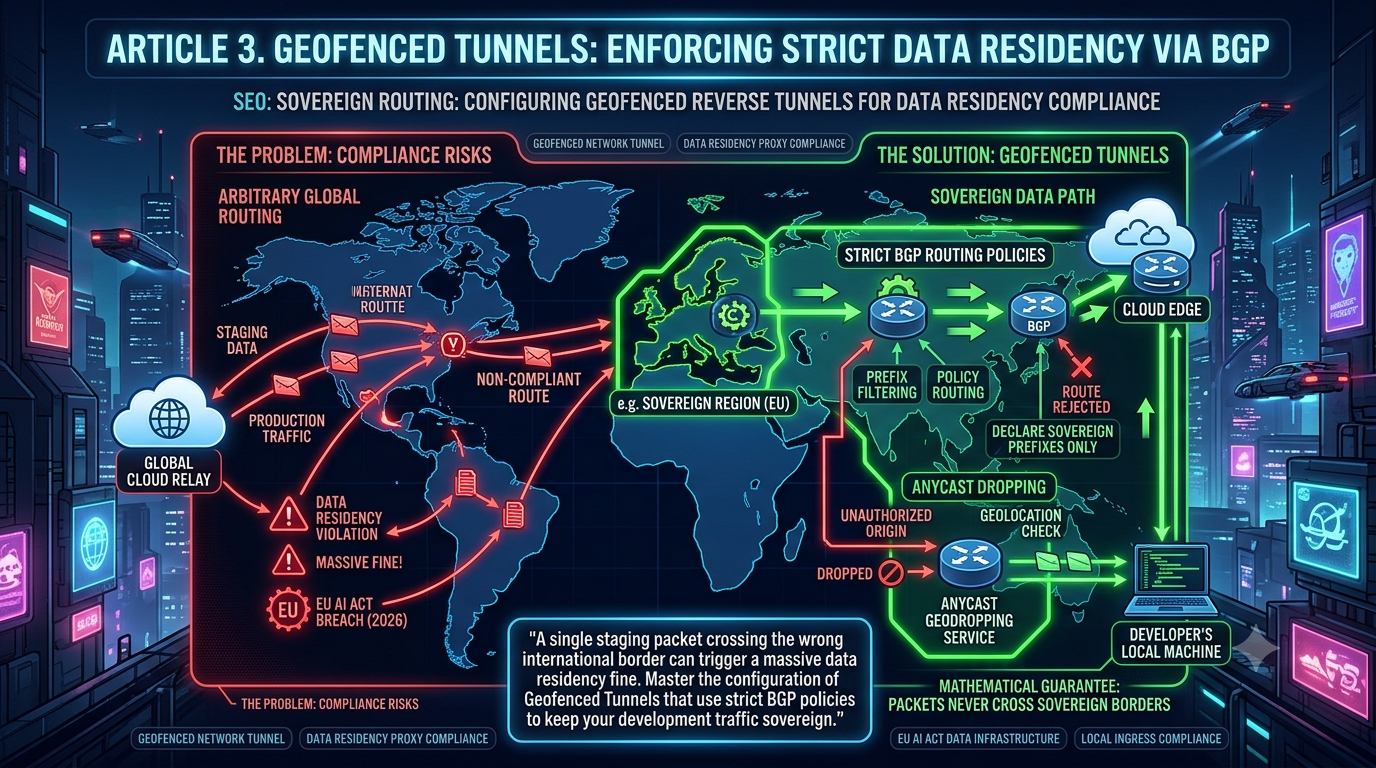
To solve this, platform engineering and network security teams are building what this article calls geofenced tunnels — tunnels that pair encrypted overlays with explicit routing-layer controls (BGP communities, route filtering, private interconnects, and increasingly, route-origin and route-path validation) so that a network connection has a much higher assurance of staying inside a defined jurisdiction. It’s worth being precise about what these controls can and can’t promise — more on that below — but the architecture pattern is real, increasingly productized, and worth understanding in detail.
The 2026 Regulatory Picture: GDPR Transit Rules Meet a Reshuffled AI Act Timeline
Two things are true at once in mid-2026, and conflating them is a common mistake.
First, the legal basis for “don’t let EU personal data transit through non-EU infrastructure” has always been GDPR, not the AI Act. Chapter V (Articles 44–49) governs international transfers, and the post-Schrems II landscape is genuinely unsettled. The CJEU’s 2020 Schrems II ruling invalidated the EU-US Privacy Shield specifically because US surveillance authorities — Section 702 of FISA and Executive Order 12333 — gave US intelligence agencies access to EU data in ways the Court found incompatible with GDPR. The current replacement mechanism, the EU-US Data Privacy Framework (adopted July 2023), has already survived one direct legal challenge at the CJEU, but most EU privacy lawyers still expect a “Schrems III” case, and Max Schrems himself has said the new framework doesn’t resolve the underlying surveillance-law conflict. Adding to the uncertainty, FISA Section 702 itself lapsed its prior two-year reauthorization in April 2026 and was kept alive only by a short-term extension into mid-June 2026, with longer-term reauthorization still being negotiated in Congress as of this writing. None of this is settled ground — which is exactly why infrastructure-level guarantees, not just paperwork like Standard Contractual Clauses, have become more attractive to risk-averse organizations.
Second, the EU AI Act’s high-risk system obligations — the part most directly relevant to AI/ML staging and inference workloads — are not on the timeline most people assume. The Act entered into force in August 2024 and has been rolling out in phases: prohibited practices and AI literacy obligations since February 2025, and general-purpose AI model rules since August 2025. The original target for the big one — Annex III high-risk system obligations (conformity assessments, human oversight, logging, registration) — was August 2, 2026. But on May 7, 2026, EU negotiators reached a provisional agreement on a “Digital Omnibus” package that pushes the Annex III high-risk deadline back by roughly sixteen months, to December 2, 2027. That agreement is provisional and still pending formal adoption as of mid-2026, so treating December 2027 as locked-in would be premature — but treating August 2026 as the operative deadline, as some compliance guidance still does, is now out of date.
The practical takeaway: the AI Act does not impose its own separate “data must stay in-region while in transit” regime. The legal exposure for cross-border tunnel traffic is — and has been all along — ordinary GDPR international-transfer law. What the AI Act adds, once Annex III obligations land (whenever that ends up being), is a parallel set of obligations around logging, human oversight, and Fundamental Rights Impact Assessments for high-risk systems, which raises the stakes of getting data handling wrong but doesn’t create new transit-specific routing rules of its own.
The Market Has Already Started Responding
Independent of the regulatory back-and-forth, the cloud and tunneling industry has moved. In January 2026, AWS opened its European Sovereign Cloud — a physically and logically separate AWS partition, operated exclusively by EU residents, representing a roughly €7.8 billion investment, with sovereign Local Zones planned in Belgium, the Netherlands, and Portugal. Microsoft’s equivalent EU Data Boundary effort, which restricts processing and storage of customer data to the EU, has been live since mid-2025 and has since been extended to cover more AI services. These aren’t marketing exercises — they involve genuine operational separation (AWS has stated that even its own US-based engineers cannot access European Sovereign Cloud customer environments) — but they also don’t, by themselves, solve the developer-tunnel problem this article is about. A sovereign cloud region only helps if the traffic actually reaching it took a sovereign path.
Enter the Geofenced Network Tunnel
A geofenced network tunnel, in the sense used here, is an encrypted connection between a local development environment and a cloud perimeter, engineered so that the underlying network path is constrained — through routing policy, private interconnects, and monitoring — to stay inside a defined jurisdiction.
It’s worth distinguishing two terms the industry tends to blur together: data residency (where data is physically stored — a regional bucket, a Frankfurt data center) and data sovereignty (who can access that data, under what legal jurisdiction, and under what conditions, including while it’s moving). A geofenced tunnel is fundamentally a data-sovereignty control aimed at the transit problem, not a residency control — residency is what your cloud region already gives you.
What BGP Can — and Can’t — Actually Guarantee
The original framing of “geofenced tunnels” often promises that BGP policy can mathematically guarantee a packet never crosses a border. That’s an overstatement worth correcting plainly: BGP is a control-plane, trust-based protocol. It tells routers which paths are preferred and which are advertised, but a misconfigured peer, a route leak, or a deliberate hijack can still move traffic somewhere you didn’t intend — which is precisely why route-hijacking remains a live problem on the internet today. What BGP-based controls actually provide is strong, auditable assurance and fast failure detection, not a cryptographic proof of physical path. Combined with private circuits that don’t depend on public internet routing at all, the assurance gets much stronger — but “mathematically sound” isn’t the right phrase for the public-BGP layer.
With that caveat in place, here’s what’s actually deployed in production networks today:
1. BGP Community Tagging and Route Filtering
Network engineers can tag prefixes with BGP community attributes and apply route maps so that specific peers only see specific routes. The best-known of these is the well-known NO_EXPORT community (RFC 1997), which instructs a receiving router not to re-advertise a route to any external (eBGP) peer — keeping it confined to iBGP/confederation peers. AWS Direct Connect, for example, automatically tags all routes received over a public virtual interface with NO_EXPORT. It’s important to be precise here: NO_EXPORT by itself doesn’t mean “EU-only” — it means “don’t propagate past this AS boundary.” Real geographic restriction comes from combining community tagging with explicit AS-path access control lists and prefix-lists at each regional peering point, so that only ASNs registered within the approved jurisdiction are ever accepted as next hops.
2. RPKI Route Origin Validation — and ASPA for Path Validation
The cryptographic piece that’s actually deployed at internet scale is RPKI (Resource Public Key Infrastructure, RFC 7115), not a bespoke “route attestation” scheme. Prefix holders publish signed Route Origin Authorizations (ROAs) through their Regional Internet Registry, declaring which AS is authorized to originate a given prefix. Routers performing Route Origin Validation (ROV) can then reject announcements that don’t match a valid ROA, which is the standard defense against accidental or malicious route hijacks.
RPKI ROAs only validate the origin AS, though — they don’t validate the full path a route took to get there, which is the more relevant question for “did this stay inside the EU.” That’s the gap a newer mechanism called ASPA (Autonomous System Provider Authorization) is meant to close: operators publish which providers are authorized to carry their routes upstream, letting routers detect AS-path patterns that don’t match the declared provider relationships — a real, if early-stage, defense against route leaks. As of early-to-mid 2026, ASPA validation is supported in major relying-party software (Routinator, FORT Validator, rpki-client) and in router implementations including BIRD and OpenBGPD, with Cisco IOS-XR support in progress. Adoption is genuinely nascent — well under 1% of the global ASN space had published ASPA records as of February 2026 — so treat this as an emerging control to watch, not something you can rely on as a complete solution today.
Implementation reality check: if your geofencing strategy depends on every transit AS in the path having deployed ROV and ASPA, you don’t have geofencing yet — you have a roadmap. The practical mitigation most sovereign-routing deployments use today is to minimize the number of hops that matter at all, via the next mechanism.
3. Remote-Triggered Black Hole (RTBH) Filtering
The draft’s original “anycast dropping” concept maps onto a real, well-established technique: Remote-Triggered Black Hole (RTBH) routing. Operators advertise a tagged route via iBGP that causes edge routers to forward matching traffic to a Null0 interface, silently discarding it. RTBH is a long-standing DDoS mitigation tool, not a purpose-built compliance feature — but the same mechanism can be repurposed at a sovereign perimeter’s edge: if traffic belonging to a geofenced tunnel’s address space somehow arrives at a border router from an unapproved direction, drop it rather than forward it onward. This is a legitimate defense-in-depth layer, but it’s a last resort that fires after a routing anomaly has already occurred, not a preventive geofence in itself.
4. Private Peering and Direct Interconnects
The strongest practical guarantee doesn’t come from public BGP at all — it comes from avoiding public transit entirely. Direct private peering at an Internet Exchange (DE-CIX in Frankfurt is a commonly used example) or a dedicated cloud interconnect — AWS Direct Connect, Azure ExpressRoute — gives you a physically identifiable, contractually bounded path that doesn’t depend on the public internet’s route-around-damage behavior. Hybrid-sovereignty deployments using ExpressRoute between an EU rack and an eu-central-1 AWS region have reported sub-2ms round trips in production, which is also a meaningful latency win, not just a compliance one.
Achieving Local Ingress Compliance
For platform teams, deploying geofenced tunneling requires rethinking how local development environments connect outward. The goal is local ingress compliance: any traffic reaching a developer’s machine through the tunnel has been authenticated and the path it took is verifiable after the fact.
A Conceptual Developer Workflow
There’s no single standardized product called “the geofenced tunnel” — this is an architecture pattern, assembled from existing pieces (WireGuard or similar for the encrypted overlay, FRRouting or BIRD for the BGP control plane, an IAM integration for device/identity checks). To illustrate the pattern concretely, imagine a CLI wrapper — call it sovereign-tunnel, purely illustrative — that a developer might run before starting work:
- Endpoint geo-verification. The agent checks local network signals (Wi-Fi BSSID, IP allocation, enterprise MDM posture) before allowing the tunnel to initialize. If a laptop has traveled outside the approved region, the tunnel refuses to start.
- Sovereign handshake. A TLS 1.3 session is established to a regional ingress point, with DNS resolution pinned to in-region resolvers to avoid a resolver-level path that defeats the routing-level work.
- Continuous route monitoring. During the session, the client (or a network observability pipeline behind it) watches the live AS-path and traceroute data. If the topology shifts to include an unapproved AS, the session is torn down.
This pattern doesn’t require building bespoke tooling from scratch. It’s worth noting that real, shipping tunnel products have started adding exactly the building blocks this requires: ngrok’s Region & IP Resolution (“region pinning”) lets a domain be locked to specific physical points of presence so all traffic for that domain only resolves through chosen regions — explicitly marketed for EU data-residency needs. Cloudflare’s Custom Regions (part of its Regional Services line) lets customers define groups of data centers by country and enforce that TLS termination and request processing happen only within that set. Neither of these is “BGP geofencing” in the deep sense described above, but they solve a meaningful chunk of the same problem at the application/edge layer with far less operational overhead — and for many teams, that combination (region pinning at the tunnel provider, plus private interconnects for the highest-sensitivity paths) is the actual 2026 answer, rather than hand-rolled BGP infrastructure.
Auditability for Regulators
Producing proof for a regulator that staging data didn’t leave a jurisdiction during a testing window is a real and reasonable ask, especially once AI Act deployer obligations (which require retaining automated logs for at least six months for high-risk systems, once those obligations apply) are layered on top. The realistic toolkit for that proof, given everything above, is: RPKI/ROA validation logs, AS-path telemetry captured at session time (not retroactively reconstructed), private-interconnect circuit records where used, and — where ASPA is deployed by your transit providers — path-legitimacy validation results. Calling this an “immutable, cryptographically sound ledger” overstates what most organizations can produce today; calling it “a defensible, timestamped audit trail assembled from several real, partially-deployed standards” is more accurate, if less catchy.
A Different Way to Frame Sovereignty: Access, Not Just Geography
It’s worth noting a genuine industry debate here rather than presenting BGP-centric geofencing as the only valid model. A growing line of argument — visible in recent “Sovereign SASE” and identity-centric sovereignty products — is that geography-first compliance (duplicate infrastructure in every jurisdiction, enforce routing at the network layer) is increasingly being supplemented, and in some architectures replaced, by access-first sovereignty: data stays anchored in one jurisdiction, and strict identity and access management governs who — and from where — can interact with it, rather than trying to physically constrain every packet’s path. This isn’t a replacement for the routing controls described above so much as a different layer of the same defense-in-depth stack; for a security blog audience, it’s worth treating “geofenced tunnels” as one tool in that stack rather than the whole answer.
Designing a Sovereign Cloud Routing Architecture: A Blueprint
A realistic, technology-grounded version of the implementation phases:
Phase 1: Define the Sovereign Perimeter
Identify the jurisdictions your data is legally permitted to touch, and enumerate the approved ASNs of your cloud providers and regional ISPs. Decide explicitly whether you’re aiming for EU/EEA-wide sovereignty or stricter single-country sovereignty (AWS’s sovereign Local Zones model, for instance, distinguishes “stays in the EU” from “stays in Belgium”).
Phase 2: Deploy Regional Ingress Gateways
Stand up dedicated edge proxy nodes (Envoy or NGINX clusters are common choices) within the approved region, using static, regionally-allocated IPs rather than a globally load-balanced anycast endpoint you don’t fully control.
Phase 3: Configure Routing Constraints
Work with transit providers and IXPs to: tag advertised prefixes with NO_EXPORT where appropriate; apply AS-path ACLs and prefix-lists so only approved regional ASNs are accepted as peers; enable RPKI ROV on border routers; and, where your upstreams support it, adopt ASPA as it matures rather than waiting for full ecosystem rollout.
Phase 4: Enforce Endpoint Compliance
Integrate tunnel initialization with your IAM provider — MFA and device-posture checks before a session is allowed to start — whether you build this in-house or rely on region-pinning features already shipping in tools like ngrok or Cloudflare Tunnel.
Phase 5: Implement Continuous Monitoring
Use route-collector visibility (RIPE RIS, RouteViews, or a commercial BGP monitoring service) to alert if your prefixes are ever seen being announced or transited outside your expected AS set — the standard signal for a route leak or hijack, repurposed here as a compliance tripwire.
The Bottom Line
The friction between a borderless internet architecture and increasingly localized regulation is real, and it long predates — and is largely independent of — the AI Act’s own timeline, which has itself just slipped by over a year for the obligations most people were watching. The actual legal driver for “keep my staging traffic inside the EU” remains GDPR’s transfer rules, layered on a Schrems-era landscape that is still not fully settled.
On the engineering side, the honest version of this story is less “mathematically sound, unbreakable perimeter” and more “defense in depth, assembled from several real but unevenly mature standards”: NO_EXPORT and route filtering, RPKI ROV (mature), ASPA (early), RTBH as a last-resort backstop, private interconnects where it matters most, and — increasingly — application-layer region pinning from the tunnel providers themselves, paired with identity-centric access controls rather than routing controls alone. None of that is less interesting than the all-BGP version of the story; it’s just more accurate about where the real guarantees come from and where you’re still relying on operational discipline and monitoring rather than cryptography.
Changelog
This piece was substantially fact-checked and extended from an earlier draft. Summary of changes:
Corrected / removed: - Removed the claim that the EU AI Act became “fully enforceable for high-risk systems in August 2026.” As of the May 7, 2026 provisional Digital Omnibus agreement, the Annex III high-risk deadline has been pushed to December 2, 2027 (pending formal adoption — not yet final as of this writing). Source: EU AI Act Service Desk timeline (ai-act-service-desk.ec.europa.eu); Digital Omnibus coverage (Global Policy Watch, Inside Global Tech, May–June 2026). - Removed the invented term “EU AI Act’s context-layer governance.” No such doctrine exists; the actual legal basis for cross-border transit restrictions is GDPR Chapter V (Articles 44–49), not the AI Act. The AI Act’s relevance to this topic is limited to logging/FRIA/oversight obligations for high-risk systems once those obligations apply. - Corrected the claim that BGP policy provides a “mathematical guarantee” against border-crossing packets. BGP is a trust-based control-plane protocol; added explicit caveats about route leaks/hijacks and reframed the claim around assurance and auditability rather than proof. - Replaced the vague “Cryptographic Route Attestation” concept with the real, named standards that actually exist: RPKI Route Origin Authorizations (RFC 7115) for origin validation, and ASPA for path/leak validation — including current adoption data (ASPA at well under 1% of ASNs as of February 2026). - Clarified that “Anycast Dropping” maps to the real, established technique of Remote-Triggered Black Hole (RTBH) filtering (RFC-era practice, widely used for DDoS mitigation), and noted it’s a reactive backstop, not a preventive control. - Clarified that NO_EXPORT alone does not equal regional geofencing — it restricts re-advertisement past an AS/confederation boundary, not to a specific geography. Real geo-restriction requires AS-path ACLs/prefix-lists in addition. - Reframed the sovereign-tunnel up --env staging CLI example as explicitly illustrative/conceptual rather than implying a specific existing commercial product.
Added (verified, current as of June 2026): - AWS European Sovereign Cloud: GA January 15, 2026, ~€7.8B investment, operational independence from global AWS, sovereign Local Zones planned for Belgium, Netherlands, Portugal. Sources: AWS Security Blog, DataCenterDynamics, Towards The Cloud, CSA. - Microsoft’s EU Data Boundary, live since mid-2025 with AI service coverage since extended. - Current EU-US data-transfer legal status: EU-US Data Privacy Framework (2023), its survival of an initial CJEU challenge, ongoing “Schrems III” expectations, and the April–June 2026 FISA Section 702 short-term reauthorization lapse/extension. Sources: Recording Law, Freshfields, Infosecurity Europe. - ngrok Region & IP Resolution (region pinning) and Cloudflare Custom Regions as real, shipping, application-layer alternatives/complements to BGP-level geofencing. Sources: ngrok docs, InfoQ (March 2026). - RPKI/ROV and ASPA mechanics and adoption status. Sources: NIST RPKI Monitor, Noction, FastNetMon, OneUptime. - The data residency vs. data sovereignty distinction, and the access-centric “sovereignty tunnel” framing as a complementary industry trend. Sources: Versa Networks, Fierce Network. - Private-interconnect latency data point (sub-2ms EU rack-to-eu-central-1 over ExpressRoute in a hybrid-sovereignty deployment).
Stripped: original italicized hook/dek line (metadata), not part of article body.
Related InstaTunnel pages
Continue from this article into the most relevant product guides and workflows.


Comments
Post a Comment