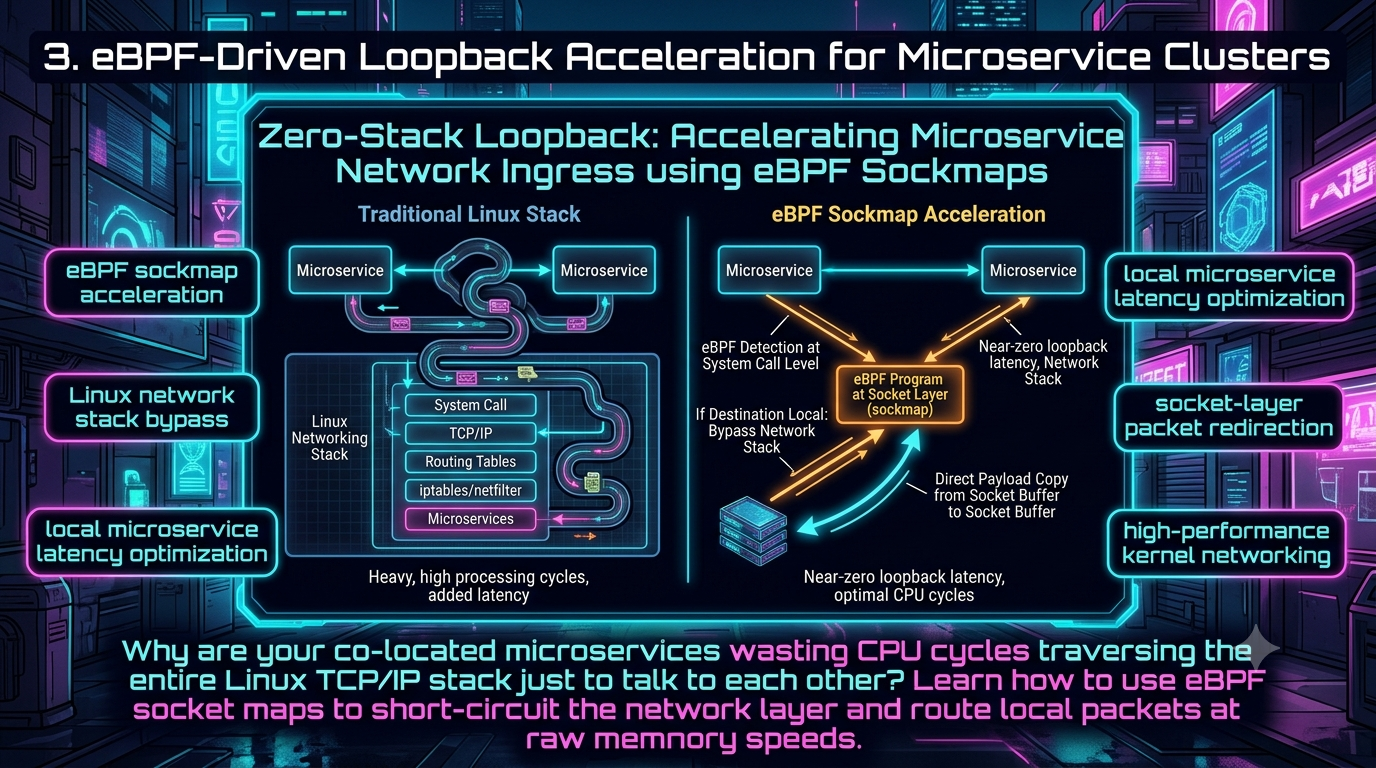
Zero-Stack Loopback: Accelerating Microservice Network Ingress using eBPF Sockmaps
IT
Quick answer
Zero-Stack Loopback: Accelerating Microservice Network Ingre: MCP tunnel answer
MCP tunneling gives a local MCP server a public HTTPS endpoint so AI tools can reach it during development without deploying the server first.
What is MCP tunneling?
MCP tunneling exposes a local Model Context Protocol server through a public endpoint so compatible AI tools can connect during development.
When should I use InstaTunnel for MCP?
Use InstaTunnel Pro when a local MCP endpoint needs public HTTPS access, stable routing, and stream-friendly tunnel behavior.
In the modern era of cloud-native infrastructure, the microservice architecture has become the de facto standard for building scalable applications. By breaking monolithic applications into smaller, decoupled services, engineering teams have unlocked unprecedented agility and deployment velocity. However, this distributed architecture introduces a formidable new challenge: network latency.
When a single user request requires a half-dozen internal microservices to communicate before returning a response, the cumulative network overhead can severely degrade application performance. To mitigate this, orchestration systems like Kubernetes frequently schedule heavily communicative pods on the same physical host. While co-locating services eliminates the latency of physical network hops, it exposes a different, hidden bottleneck — the Linux kernel’s networking stack itself.
Even when microservices reside on the same machine, their communications have historically had to traverse the full Linux TCP/IP stack. This article explores how eBPF sockmap acceleration uses socket-layer packet redirection to execute a Linux network-stack bypass for that local traffic, cutting latency and reclaiming CPU cycles otherwise spent re-deriving guarantees that local memory already provides.
The Loopback Illusion: The Hidden Tax of Local Networking
To understand the impact of eBPF socket acceleration, it helps to first trace the journey of a data packet in a traditional Linux environment.
When Microservice A (the client) sends data to Microservice B (the server) running on the same Kubernetes node, the application assumes it’s writing to a simple socket file descriptor. Beneath that abstraction, though, the kernel treats this local traffic remarkably similarly to traffic destined for a server on the other side of the planet.
When Microservice A calls sendmsg(), roughly the following sequence occurs:
- User-space to kernel-space transition. The application traps into the kernel, incurring a context switch.
- Socket buffer allocation. The kernel allocates an
sk_buffto hold the payload. - TCP layer processing. The TCP stack applies sequence numbers, checksums, and congestion-control bookkeeping — all unnecessary for a transfer that never leaves the host’s memory.
- IP layer processing. IP headers are added and the local routing table is consulted.
- Netfilter / iptables. The packet is evaluated against every applicable Netfilter hook and iptables rule.
- Traffic control (qdisc). The packet passes through the queuing-discipline layer.
- Loopback device (
lo). The packet reaches the virtual loopback driver. - The return journey. The driver loops the packet back up the stack: decapsulation, a second pass through Netfilter, and TCP reassembly before it lands in Microservice B’s receive buffer.
- Kernel-space to user-space transition. Microservice B wakes up and reads the data via
recvmsg().
That journey involves multiple memory allocations, full protocol processing, and several context switches. For traffic genuinely crossing a network, this machinery is indispensable. For two containers on the same host, it’s substantial overhead spent re-deriving guarantees that local memory already provides.
Enter eBPF: Programmability at the Kernel Level
Extended Berkeley Packet Filter (eBPF) has changed how engineers interact with the Linux kernel. Classic BPF was designed in the early 1990s as a simple packet-filtering mechanism — the technology that still underpins tools like tcpdump — but modern eBPF, whose core kernel infrastructure began landing with Linux 3.18 in late 2014, has grown into a sandboxed virtual machine that runs directly inside the kernel.
eBPF lets developers write restricted, C-like programs and attach them to hook points throughout the OS: network drivers, system calls, tracepoints, and more. Before any eBPF program runs, an in-kernel verifier statically checks that it can’t crash the kernel, loop forever, or touch memory it shouldn’t.
eBPF programs use specialized data structures called eBPF maps — hash tables, arrays, ring buffers — to hold state and exchange data with user space. Frameworks like XDP (eXpress Data Path) accelerate ingress at the NIC driver level, but XDP sits too low in the stack to help with loopback traffic that never reaches a physical NIC at all. To solve the microservice loopback problem, the useful hook point is higher up the stack: the socket layer itself.
Decoding Socket-Layer Packet Redirection
The fix for the loopback bottleneck is what’s commonly called eBPF sockmap acceleration: attaching eBPF programs directly to the socket layer so they intercept data the moment an application calls sendmsg(), then copy it straight into the receiving application’s socket buffer — bypassing the TCP/IP stack entirely.
1. The sockmap and sockhash map types
At the center of this mechanism are two purpose-built eBPF map types. BPF_MAP_TYPE_SOCKMAP is an array-backed map that stores references to open sockets, and was introduced in kernel 4.14. BPF_MAP_TYPE_SOCKHASH is a hash-backed variant that supports more flexible keys — a full 5-tuple, for instance — and arrived in kernel 4.18, per the official kernel sockmap documentation. Both map types were originally developed by John Fastabend and have been part of the upstream BPF subsystem ever since.
A sockmap is more than a lookup table — a parser program and a verdict program can be attached to it directly. When a userspace agent (a CNI daemon, for instance) inserts a socket file descriptor into the map, the kernel transparently swaps in the map’s callbacks for that socket, turning the map into a live registry of accelerated connections.
2. The SK_MSG program type
With sockets tracked in a map, developers attach an eBPF program of type BPF_PROG_TYPE_SK_MSG, which hooks the sendmsg()/sendfile() path for any socket belonging to the map, as documented in the eBPF program-type reference. The program receives the message buffer before any TCP or IP headers exist, and returns a verdict: SK_PASS to let the data through (optionally after redirecting it), or SK_DROP to discard it.
3. The redirect helper: bpf_msg_redirect_map()
Inside an SK_MSG program, the eBPF logic inspects where the data is headed. If the destination isn’t a socket the program recognizes, it returns SK_PASS and the message proceeds down the normal stack toward the NIC. But if the destination matches a socket already registered in the sockmap — meaning the peer lives on the same host — the program calls bpf_msg_redirect_map() (or its hash-map counterpart, bpf_msg_redirect_hash()).
That helper copies the payload directly from the sending socket’s buffer into the receiving socket’s buffer. TCP/IP processing, Netfilter, iptables, and the loopback driver are all short-circuited. This isn’t just theoretical: one eBPF tutorial walkthrough demonstrates that redirected traffic genuinely vanishes from tcpdump — capturing the loopback interface during a sockmap-accelerated transfer shows only the TCP handshake and teardown, because the payload itself never re-enters the part of the stack tcpdump taps into.
It’s also worth knowing sockmap started life as a TCP-only mechanism. Full bidirectional UDP support, plus a cross-protocol BPF_SK_SKB_VERDICT redirect type, arrived later: the patch series implementing it began circulating in the kernel community starting around 2021, closing a gap that Cloudflare’s own engineers had flagged as a rumored future feature in their early sockmap experiments.
Real-World Implementation: Service Mesh Acceleration
The theoretical benefits of socket-layer redirection are compelling, but the technology earns its keep in service mesh deployments, where it’s been put to work by projects including Cilium, Calico, and Merbridge.
The classic sidecar problem
In Istio’s original sidecar architecture, traffic between microservices is intercepted by Envoy proxies running alongside each application container. If Microservice A talks to Microservice B, the flow looks roughly like this:
- Microservice A writes to what it thinks is a normal socket.
- An iptables rule transparently redirects the packet to the Envoy sidecar in Pod A.
- Envoy processes the traffic — mTLS, tracing, routing.
- Envoy sends the packet out to Pod B over the network.
- The packet arrives at Pod B and is intercepted by iptables again.
- It’s handed to the Envoy sidecar in Pod B for decryption and inspection.
- Envoy finally forwards it to Microservice B.
When Pod A and Pod B share a host, this flow forces data through the Linux TCP/IP stack several times over for what is, physically, a single machine talking to itself. Recent measurement work puts a precise number on it: a February 2026 paper out of Peking University on a system called XLB found that inbound and outbound traffic in this model traverses the kernel’s TCP/IP stack three separate times, and that this duplicate protocol processing — together with the system calls needed for connection splicing between the sidecar and the application — accounts for more than half of total per-hop latency. Only about a fifth of that time is spent on the load-balancing logic that’s actually the point of the proxy.
It’s worth noting that Istio itself has since shipped a second, sidecar-less option aimed at exactly this problem. Ambient mode, built around a shared per-node Rust proxy called ztunnel plus optional per-namespace “waypoint” proxies for services that need Layer-7 features, reached General Availability in Istio 1.24 in November 2024. Ambient mode removes the per-pod sidecar tax for L4 traffic (mTLS, identity, basic authorization), but as the XLB researchers note, a sidecar-less L4 mesh like this still doesn’t carry enough context to make HTTP- or gRPC-aware L7 routing decisions on its own — that’s left to the optional waypoint proxies, which reintroduce a version of the same proxy hop for any service that actually needs it.
Cilium’s sockmap acceleration
Cilium’s eBPF datapath has used sockmap-based socket-layer enforcement for years to accelerate local connections — both pod-to-pod traffic on the same node and the hop between an application and Cilium’s own embedded Envoy instance, which Cilium uses for L7 network policy. Cilium’s architecture documentation describes a socket-operations hook that watches for TCP connections to a local peer (including a local proxy) and attaches a sockmap-based send/recv fast path once one is found, so messages bypass the rest of Cilium’s policy and NAT layers en route to the peer socket.
Running Cilium underneath Istio specifically — rather than using Cilium’s own native mesh capabilities — requires some care today. Cilium’s current Istio integration guide notes that Cilium’s socket-based load balancing for Kubernetes Services (a related but distinct mechanism, used to replace kube-proxy) can interfere with Istio’s iptables-based sidecar redirection unless it’s explicitly scoped with the socketLB.hostNamespaceOnly setting, with the CNI additionally configured as cni-exclusive: false so Cilium and the Istio CNI plugin can coexist on the same node.
Cilium isn’t the only CNI taking this approach, and it’s worth being honest about how that comparison shakes out. Calico shipped a comparable sidecar-acceleration feature using eBPF sockmap as early as Calico 3.8 in 2019, with Tigera’s own engineering blog describing it at the time as bypassing much of the networking overhead of the sidecar architecture. Tellingly, Tigera’s current documentation still marks the feature experimental and explicitly advises against using it in production clusters, citing reliability issues that require upstream kernel fixes — a useful reminder that “built on eBPF” and “production-ready” aren’t synonyms, even years after a feature ships. Merbridge, a smaller open-source project, takes a similar approach, replacing the iptables redirection used by Istio, Linkerd, and Kuma with sockmap-based redirection instead.
Next-Generation In-Kernel Load Balancing
Sockmap redirection solves the Layer-4 half of the problem — moving bytes between two local sockets — but it has no concept of HTTP requests, gRPC streams, or routing rules. As the XLB researchers put it, L4 tools like sockmap are useful building blocks but don’t carry enough context on their own to handle Layer-7 routing or load-balancing decisions; that has historically meant handing the message back up to a full userspace proxy like Envoy regardless of how fast the socket hop itself is.
XLB, built by Yuejie Wang, Chenchen Shou, Jiaxu Qian, and Guyue Liu at Peking University and posted in February 2026, pushes further: rather than redirecting bytes to a separate proxy process, it moves Layer-7 load-balancing logic itself into the kernel. The design extends the socket abstraction with two new types — a “proxy socket” that holds the load-balancing logic for a client connection, and “instance sockets” pre-established with each backend — and uses nested eBPF maps to represent Envoy-style routing configuration (clusters, routes, listeners) as in-kernel data structures, making it compatible with existing Envoy and Istio control-plane tooling without requiring any application changes.
The reported numbers are striking. Measured against Istio and Cilium across deployments of 50 or more microservice instances, the paper reports up to 1.5x higher throughput and a 60% reduction in average end-to-end latency. In a more granular microbenchmark at 128 concurrent connections, XLB delivered 2.18x and 1.83x the throughput of Istio and Cilium respectively. In a separate test holding the request rate fixed at 60,000 requests per second, XLB used roughly 75% and 76% less CPU than Istio and Cilium at that same throughput — the authors attribute most of that gap to eliminating the cross-process scheduling, context-switching, and cache-coherence costs of running the proxy as a separate process from the application, a cost that persists even when the socket hop between them is itself sockmap-accelerated.
The paper also describes a real production deployment: a banking customer running payment-processing microservices across more than 100 ARM (Kunpeng-920) nodes, where XLB is reported to have cut transaction latency by around 41%, reduced proxy-related CPU consumption by an order of magnitude, and allowed roughly 30% more service instances to run on each node — useful headroom for absorbing transaction spikes during peak shopping periods. The authors describe it as the first eBPF-based L7 load balancer they’re aware of serving external customers in a public cloud.
It’s worth being precise about what this is, though: XLB is a research system described in a recent academic paper with an associated production case study, not — as far as could be confirmed — a publicly released open-source project available to download today. It’s a strong signal of where kernel-resident networking is headed, rather than a drop-in tool for a weekend project.
The Performance Impact of Zero-Stack Networking
1. Lower latency, with caveats
Eliminating queuing-discipline, routing-table, and protocol-encapsulation overhead does measurably shrink local inter-process latency. Independent, informal benchmarking of a basic sockmap-redirected echo workload has found roughly a 30% latency reduction over the unaccelerated path — a meaningful win, if more modest than “near-instant” framing might suggest.
It’s also worth knowing the technology had a rockier start than its current maturity suggests. When Cloudflare engineers benchmarked an early sockmap-based TCP-splicing implementation against simpler alternatives back in 2019, on what was then a brand-new 4.14 kernel, sockmap came out the slowest of everything they tested, with occasional multi-millisecond stalls traced to kernel bugs of that era. More recent academic comparisons paint a more positive but still nuanced picture: a 2023 paper on the FlatProxy architecture found that plain sockmap redirection had only a minor effect on latency in their test setup, and that its throughput advantage over a full Envoy proxy disappeared once concurrent TCP connections climbed past roughly four — a limitation the authors traced to sockmap’s lack of native connection management. The fair summary: sockmap is a real, durable win for simple, high-connection-count byte-shuffling, but it isn’t an unconditional free lunch, which is exactly the gap that’s pulling research toward fuller in-kernel L7 systems like XLB.
2. Real CPU savings
The CPU case is easier to make with hard numbers. Beyond the general principle that fewer context switches and less protocol processing means fewer wasted cycles, the XLB benchmarks above are a useful concrete anchor: roughly 75% less CPU at a matched 60K req/s throughput compared to Istio, and 76% less compared to Cilium, with an order-of-magnitude CPU reduction reported in XLB’s production banking deployment. For container-dense hosts, CPU saved on proxying is CPU — or instance density — gained back for actual application work.
3. Security is real, but not automatic
A common assumption is that bypassing iptables means giving up firewalling and policy enforcement. In practice, eBPF-based systems like Cilium reimplement policy enforcement natively: Cilium’s datapath maps every packet to a Kubernetes-label-derived identity and enforces L3/L4 (and, via its proxy, L7) policy before any sockmap fast path is allowed to engage, so accelerated connections aren’t actually unpoliced.
That said, “implemented in eBPF” isn’t a synonym for “bug-free.” Sockmap’s own kernel code has had a real run of security issues. In 2025 alone, the BPF-TCP/sockmap subsystem was patched for a use-after-free vulnerability in tcp_bpf_send_verdict() (CVE-2025-39913) that could be triggered by a failed memory allocation during message “corking,” and was serious enough to enable a kernel crash or local privilege escalation. Separate fixes also landed for a sockmap/vsock null-pointer issue (CVE-2025-21854) and a kTLS-interaction panic affecting sockmap (CVE-2025-38166). None of this is a reason to avoid sockmap — but it is a reason to treat it like any other kernel attack surface: track CVEs for your distribution and stay current on patches, rather than treating “it’s eBPF” as a security guarantee in itself.
Challenges and Future Outlook
eBPF sockmap acceleration is genuinely useful, but it comes with real operational considerations.
First, kernel version requirements matter more precisely than “recent enough.” BPF_MAP_TYPE_SOCKMAP requires at least kernel 4.14; BPF_MAP_TYPE_SOCKHASH, which most real deployments use for its more flexible keying, requires 4.18; and if your workload includes UDP, you’ll want a kernel new enough to include the cross-protocol BPF_SK_SKB_VERDICT redirect path that began landing around 2021. Organizations running older enterprise long-term-support kernels should check their distribution’s specific backport status rather than assuming “we have eBPF” is sufficient on its own.
Second, troubleshooting genuinely requires new tooling. Traditional packet captures like tcpdump hook into the lower network-driver and TCP layers, so sockmap-redirected payloads simply don’t appear in them — only connection setup and teardown will show up on a loopback capture. Platform teams need eBPF-native observability, such as Cilium’s Hubble, to see what’s actually happening to accelerated local traffic.
Third — and this is easy to miss in vendor marketing — maturity varies considerably by implementation. Cilium’s sockmap-based acceleration has been a documented, stable part of its architecture for years. Calico’s comparable feature, by contrast, has carried an explicit experimental warning in Tigera’s own documentation since its 2019 introduction. Before adopting sockmap acceleration through any particular CNI or service mesh, it’s worth checking that implementation’s current production-readiness status rather than assuming all eBPF sockmap features are equally battle-tested.
Conclusion
The shift to cloud-native microservices brought real architectural flexibility, but it put real strain on a Linux networking stack designed for the open internet, not for adjacent containers sharing a single host. As container density climbs, routing local inter-process traffic through full TCP/IP encapsulation is an increasingly expensive default.
eBPF sockmap acceleration closes a meaningful part of that gap today, and it’s mature enough — at least in implementations like Cilium’s — to be running in production already. The frontier is moving further, though: from simple byte-level socket redirection toward systems like XLB that move entire Layer-7 load-balancing decisions into the kernel itself, eliminating the sidecar process rather than just making the hop to it faster. Whichever layer of that stack ends up fitting a given workload best, the direction is clear — kernel-resident networking, not user-space proxying, is where the next round of microservice performance gains is coming from.
Changelog
Metadata removed - Stripped the bolded SEO hook/meta-description line that appeared beneath the title in the original draft.
Corrected - Kernel version requirement for sockmap: the draft claimed eBPF generally “has been present since kernel 4.4.” Verified against the official kernel docs and corrected to the specific, accurate requirements: BPF_MAP_TYPE_SOCKMAP requires kernel 4.14 and BPF_MAP_TYPE_SOCKHASH requires kernel 4.18. - The “three to four times” stack-traversal estimate for sidecar hops is now paired with a precise, sourced figure (three traversals) from a 2026 academic measurement study, rather than standing as an unsourced approximation.
Verified accurate, left substantively unchanged - The 9-step loopback packet walkthrough, the sockmap/sockhash/SK_MSG/bpf_msg_redirect_map() mechanics, and the claim that tcpdump cannot see sockmap-redirected payloads — all confirmed against kernel documentation, eBPF reference docs, and independent tutorials. - The XLB performance claim (“up to 1.5x throughput, 60% lower latency vs. Istio and Cilium”) was already accurate in the original draft. It previously had no citation; it’s now attributed to the actual source — a real, very recent (February 2026) Peking University paper — with substantially more verified detail added (architecture, benchmark breakdown, and a production case study).
Added (new, verified information) - Istio Ambient Mode’s General Availability status (Istio 1.24, November 2024) and its relationship to the L7 problem this article focuses on, sourced from Istio’s own blog. - Current (not historical) operational detail on running Cilium underneath Istio, including the specific configuration flags needed to avoid conflicts, sourced from Cilium’s current documentation. - Calico’s sidecar-acceleration feature and its continued “experimental, not for production” status per Tigera’s current documentation, plus a brief mention of the Merbridge project. - Balanced, sourced performance context (Cloudflare’s 2019 benchmarking findings, a 2023 FlatProxy paper’s more nuanced results, and an independent ~30% real-world latency benchmark), replacing unsupported “near-zero latency / raw memory speed” framing with numbers that can be checked. - A security caveat covering three 2025 CVEs affecting the sockmap/BPF-TCP kernel subsystem, including a use-after-free bug capable of local privilege escalation. - Sockmap’s UDP support history (TCP-only at launch; full bidirectional UDP support added via patches beginning around 2021). - A clarifying note on what XLB currently is (a research system with a documented production deployment) versus what it isn’t (a publicly available open-source download), to avoid overstating availability.
Formatting - Reduced repetitive bolding of the same handful of SEO phrases throughout the body; technical terms are now emphasized at first mention rather than every recurrence.
Sources consulted
- Linux kernel sockmap documentation
- eBPF Docs:
BPF_PROG_TYPE_SK_MSG - eunomia.dev sockops tutorial
- LWN: sockmap UDP /
BPF_SK_SKB_VERDICTpatches - Cloudflare: “SOCKMAP – TCP splicing of the future” (2019)
- Cilium: current Istio integration guide
- Tigera/Calico: Istio sidecar acceleration docs
- XLB paper (arXiv, Feb. 2026)
- Istio: “Ambient Mode Reaches General Availability in v1.24”
- FlatProxy paper (arXiv, 2023)
- eBPFChirp: sockmap local-socket latency benchmark
- CVE-2025-39913 deep dive; CVE-2025-21854
Related InstaTunnel pages
Continue from this article into the most relevant product guides and workflows.


Comments
Post a Comment