Sub-Second Failover: Engineering Anycast-to-Unicast Reverse Ingress Fabrics
IT
Quick answer
Sub-Second Failover: Engineering Anycast-to-Unicast Reverse : MCP tunnel answer
MCP tunneling gives a local MCP server a public HTTPS endpoint so AI tools can reach it during development without deploying the server first.
What is MCP tunneling?
MCP tunneling exposes a local Model Context Protocol server through a public endpoint so compatible AI tools can connect during development.
When should I use InstaTunnel for MCP?
Use InstaTunnel Pro when a local MCP endpoint needs public HTTPS access, stable routing, and stream-friendly tunnel behavior.
In the modern era of massively distributed multi-region cloud architecture, the definition of “high availability” has fundamentally shifted. Decades of conventional wisdom dictated that if a localized data center went offline, disaster recovery protocols would update Domain Name System (DNS) records to point traffic toward a backup site.
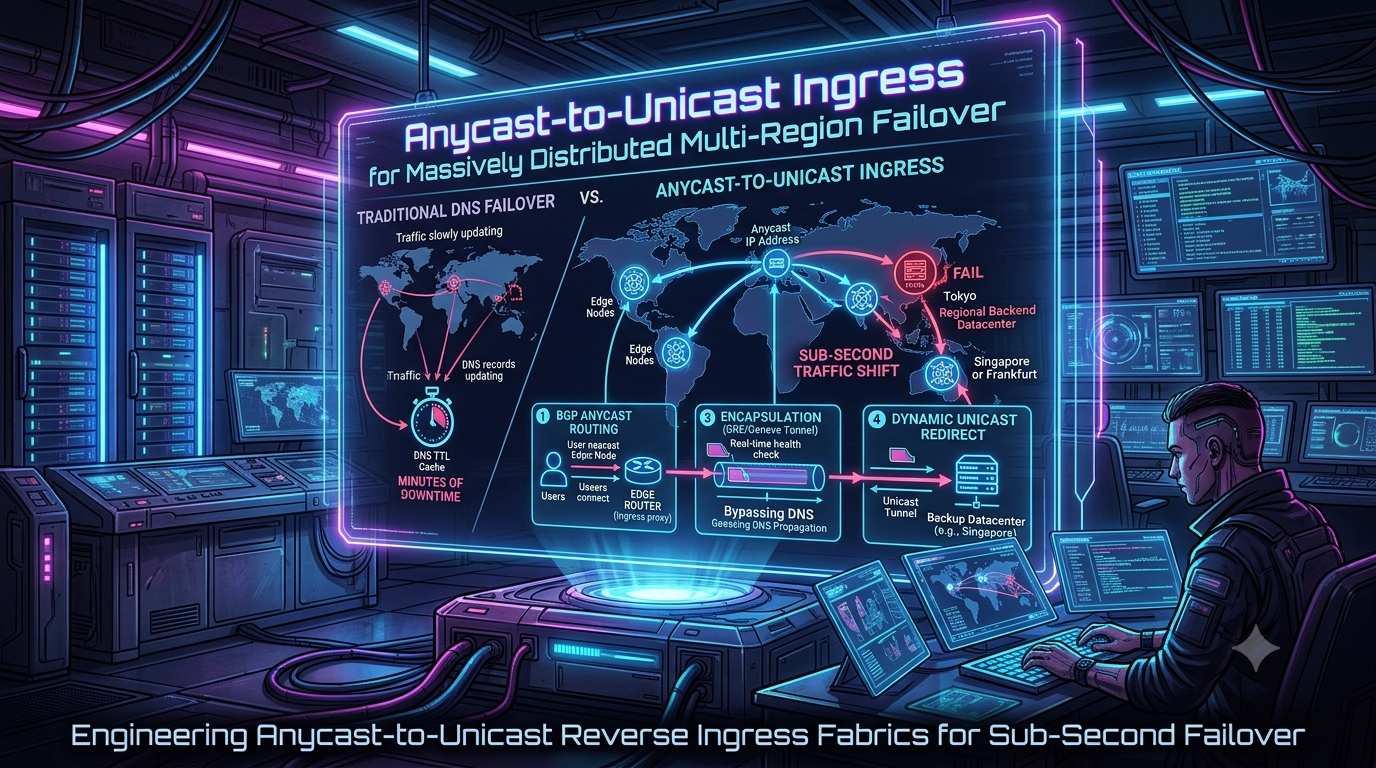
Today, that approach is a relic for latency-sensitive workloads. Relying on DNS for failover introduces an unacceptable variable into the reliability equation: Time to Live (TTL) caching. Modern infrastructure increasingly relies on a different paradigm instead: BGP Anycast routing paired with Anycast-to-Unicast proxy encapsulation. By intercepting traffic at a globally distributed edge and dynamically wrapping it in stateless tunnels, network architects can route around localized failures in milliseconds — bypassing DNS entirely.
The Fragility of DNS-Based Multi-Region Failover
To understand the necessity of an Anycast-to-Unicast ingress fabric, one must first deconstruct why DNS is fundamentally unsuited for real-time failover.
DNS operates as a globally distributed, hierarchical database. When a client wants to connect to an API endpoint (api.enterprise.com), it queries a recursive resolver, which queries authoritative servers to resolve the domain into an IPv4 or IPv6 address. To prevent the internet from collapsing under the weight of these queries, every response includes a Time to Live (TTL) value, instructing the resolver and the client’s local operating system to cache the result for a specified duration.
If your primary US-East data center suffers a catastrophic power failure, your global traffic manager will detect the outage and update the authoritative DNS record to point to the US-West backup region. You might set your TTL to a highly aggressive 30 seconds.
However, you do not control the entire resolution chain.
Zombie Caches: Many Internet Service Providers (ISPs) and corporate networks actively ignore low TTL values to reduce bandwidth overhead, artificially inflating TTLs to 15 or 30 minutes.
Client-Side Stub Resolvers: Web browsers and operating systems implement their own aggressive DNS caching. A user’s browser might hold onto the dead IP address long after the ISP cache has cleared.
Propagation Delays: Even in the best-case scenario, rolling out a global DNS update takes time.
During these minutes of delay, traffic continues to hurl itself into a black hole. Client applications time out, API requests drop, and critical database synchronizations fail. For standard web browsing, a few minutes of downtime might be a minor inconvenience. For mission-critical workloads, it is catastrophic.
This isn’t a hypothetical risk confined to slow TTL propagation, either. On October 19–20, 2025, a region-wide disruption to Amazon DynamoDB in AWS’s US-EAST-1 region showed how DNS automation itself can become the single point of failure, independent of caching behavior entirely. According to AWS’s own post-event summary, the outage began at 11:48 PM PDT when a latent race condition between two independent “DNS Enactor” processes — components responsible for keeping Route 53 records synchronized with a constantly changing fleet of load balancers — resulted in an empty DNS record for the regional DynamoDB endpoint. The system’s own automation could not detect or repair the inconsistency, and manual operator intervention was required before DNS state was fully restored around 2:25 AM. The disruption cascaded into EC2 instance launches, Network Load Balancer health checks, Lambda, and a long list of dependent services for the better part of a day. It’s a useful, current reminder that DNS fragility isn’t only a caching problem — even at hyperscale, DNS remains a single coordination point that packet-layer failover architectures sidestep entirely.
The Real-Time Imperative: Industrial IoT and Digital Twins
Consider the network architecture required for advanced Industrial IoT (IIoT) mirroring. A modern manufacturing plant streams massive volumes of real-time sensor data to a cloud-based digital twin, utilizing an NVIDIA Omniverse local bridge. This cloud-based 3D model must remain in millisecond-perfect lockstep with the physical machinery it mirrors.
If the primary cloud region processing this telemetry goes down, the digital twin desynchronizes from the physical hardware. If an automated safety override is triggered in the physical world but the cloud simulation is unreachable, the resulting data collision can corrupt the predictive maintenance models. In these ultra-low latency tunneling environments, waiting even 60 seconds for a DNS record to propagate is an eternity. Failover must occur at the packet layer, invisibly to the client, in sub-second intervals.
The Global Edge: BGP Anycast Routing
The foundation of sub-second failover is BGP Anycast. In a traditional Unicast network, a single IP address corresponds to a single physical server or load balancer in a specific geographic location.
Anycast breaks this 1:1 mapping. By leveraging the Border Gateway Protocol (BGP) — the routing protocol that makes the internet work — network engineers can advertise the exact same IP address (e.g., 198.51.100.25) from dozens of different physical edge locations around the globe.
When a client in Berlin attempts to connect to that IP address, the internet’s core routers evaluate the BGP tables to find the shortest Autonomous System (AS) path. The routing protocol naturally directs the client’s TCP SYN packet to the closest available edge data center (e.g., Frankfurt). Meanwhile, a client in Tokyo connecting to the exact same IP address will be routed to an edge node in Osaka.
The Statefulness Problem of Anycast
Anycast is brilliant for routing traffic to the closest geographical point, but it introduces a severe complication for stateful protocols like TCP.
BGP is a dynamic protocol. If a link goes down somewhere on the internet, the routing tables recalculate. If the path changes mid-session, a client whose packets were initially flowing to the Frankfurt edge might suddenly have their packets routed to a Paris edge. Because Paris has no memory of the TCP handshake that occurred in Frankfurt, it will silently drop the packets or send a TCP RST (Reset), breaking the connection.
Furthermore, an Anycast edge node cannot directly serve complex backend database queries or render 3D simulations. The edge is merely a globally distributed ingress point. The actual compute workload must happen in a localized backend data center (a Unicast destination).
This is where the Anycast-to-Unicast proxy architecture becomes mandatory.
Architecting the Anycast-to-Unicast Proxy
To utilize Anycast for global ingress without dropping stateful connections, enterprise networks deploy specialized Layer 4 (Transport Layer) load balancers at their edge PoPs (Points of Presence). Instead of terminating the TCP connection at the edge — which requires immense compute resources and breaks down during routing shifts — these edge routers act as stateless packet forwarders. They intercept the inbound Anycast traffic and encapsulate it within a tunnel, forwarding it to a specific Unicast IP address corresponding to a backend compute server.
Four Production Systems, Four Different Tradeoffs
This isn’t a theoretical architecture — several hyperscale operators have published, and in some cases open-sourced, their own implementations, and the differences between them are instructive.
Google’s Maglev, presented at NSDI 2016, is the system that popularized the whole approach. It runs on commodity Linux servers behind ECMP routers, encapsulates matched flows in GRE, and relies on Direct Server Return for replies. Rather than the ring-based “consistent hashing” most engineers picture, Maglev uses its own scheme — Maglev hashing — which builds a large, prime-sized lookup table (the paper’s own benchmarks use M = 65,537 entries) from a permutation of preferences each backend generates. Maglev’s authors found this beats both classic Karger-style ring hashing and Rendezvous hashing on load-balance evenness at realistic table sizes: to match Maglev’s balance across 1,000 backends with a 65,537-entry table, Karger hashing needs backends over-provisioned by roughly 30%, and Rendezvous hashing by roughly 50%.
GitHub’s GLB Director, open-sourced in 2018 and still powering all of GitHub’s datacenter traffic today, takes a different path. It uses a derivative of Rendezvous Hashing (also called Highest Random Weight hashing), keyed with SipHash rather than a general-purpose cryptographic hash. GLB builds a static, 65,536-row forwarding table (roughly 512 KB) where each row names a primary and secondary backend; a “second chance” mechanism — an iptables module called glb-redirect — lets a draining or recently failed backend still forward in-flight connections to whichever server actually holds their state. The director tier runs on DPDK for line-rate, kernel-bypass packet processing, and encapsulates using an extended form of Generic UDP Encapsulation (GUE), with replies sent via Direct Server Return.
Cloudflare’s Unimog, described in Cloudflare’s engineering blog, solves an adjacent problem. Once Anycast has already delivered a packet to one of Cloudflare’s edge data centers, Unimog balances load across the individual servers inside that data center, using XDP for packet forwarding. Cross-region rerouting — the scenario this article is primarily concerned with — is handled by a separate system Cloudflare calls Traffic Manager, which shifts load between entire data centers when local capacity is exhausted or degraded.
Meta’s Katran, open-sourced in 2018, pushes the forwarding plane further into the kernel than any of the others. Built on eBPF and XDP, Katran processes packets in the NIC driver context before the kernel allocates a full socket buffer, running a modified Maglev hashing algorithm with substantially lower CPU overhead than a userspace forwarder. It defaults to IPIP encapsulation — crafting a distinct, RSS-friendly outer source IP per flow — and can optionally use GUE. Like Maglev and GLB, it operates in DSR-only mode.
Why Encapsulation Over NAT?
Historically, load balancers used Network Address Translation (NAT) to change the destination IP of an incoming packet before forwarding it. However, NAT requires the load balancer to maintain a massive connection state table (tracking Source IP, Source Port, Destination IP, Destination Port).
If an edge node fails, its NAT table dies with it, severing millions of connections. To achieve true mass-scale resilience, the edge must be entirely stateless.
Instead of modifying the original IP headers, the Anycast proxy leaves the client’s packet completely untouched and wraps it inside a new, outer IP packet. This process is known as encapsulation.
GRE and Geneve Tunneling Protocols
The two dominant protocols used for Anycast-to-Unicast encapsulation are GRE (Generic Routing Encapsulation) and Geneve (Generic Network Virtualization Encapsulation).
GRE (IP Protocol 47): Defined in RFC 2784 and updated by RFC 2890 with optional Key and Sequence Number fields, GRE is a mature, highly efficient protocol. Its minimal form adds just 24 bytes of overhead: a 20-byte outer IPv4 header plus a 4-byte GRE header. The outer header’s Source IP is the edge router, and the Destination IP is the backend Unicast server.
Geneve (UDP Port 6081): A more modern, extensible protocol formalized in RFC 8926 in November 2020 — codifying what had already been running in production as an Internet-Draft for years inside tools like Open vSwitch. Because Geneve encapsulates the payload in standard UDP, it passes through traditional network hardware and Equal-Cost Multi-Path (ECMP) hashing algorithms without special handling. Its minimum overhead is 36 bytes (20-byte outer IPv4 header, 8-byte UDP header, 8-byte Geneve base header), growing further once optional Type-Length-Value (TLV) metadata — tenant IDs, VPC segmentation tags, ingress timestamps — is attached. This extensibility is Geneve’s headline advantage over GRE’s fixed structure.
The Kernel-Bypass Generation: GUE, XDP, and eBPF
GRE and Geneve both still hand packets to the normal Linux networking stack for processing — fine at moderate scale, but a real bottleneck at hyperscale packet rates. Two further developments, both visible in the systems described above, are worth understanding on their own terms.
The first is Generic UDP Encapsulation (GUE), an IETF Internet-Draft championed primarily by Tom Herbert. GUE is deliberately minimal — a lean, extensible UDP-based header — and both GitHub’s GLB and Meta’s Katran build on variants of it. It’s worth being precise about its standing, though: the draft (draft-ietf-intarea-gue) expired without ever being ratified as an RFC, so despite genuine production use at hyperscale, GUE never became a de jure Internet standard the way GRE and Geneve did.
The second is the move to XDP (eXpress Data Path) and eBPF, exemplified by Katran. Instead of running the load balancer as a userspace process that only sees packets after the kernel has already built a full socket buffer for them, an XDP program runs directly in — or just after — the network driver, inspecting and re-encapsulating packets before most of the kernel networking stack ever touches them. This gets close to the throughput of a full kernel-bypass framework like DPDK (which GLB Director uses) without requiring the load balancer to take exclusive ownership of the NIC, meaning other software can keep running unaffected on the same host. It’s a meaningful architectural fork from the GRE/Geneve-in-userspace model: same encapsulation goals, radically different place in the stack where the work happens.
Consistent Hashing: The Magic of Statelessness
If the edge proxy is stateless — it maintains no connection tables — how does it ensure that all packets belonging to a specific TCP flow are consistently forwarded to the same backend Unicast server?
The answer is consistent hashing, broadly construed. When an edge router receives a packet, it extracts a 5-tuple from the inner IP header (Source IP, Source Port, Destination IP, Destination Port, Protocol) and runs it through a hashing algorithm, generating a deterministic integer.
This is often described as mapping the flow onto a virtual hash ring, which is the right mental model for textbook consistent hashing — the scheme Karger et al. proposed in 1997. In production, though, the exact algorithm varies by system: as covered above, Google’s Maglev builds its own permutation-based lookup table rather than a literal ring, and GitHub’s GLB uses Rendezvous Hashing, which scores every candidate backend for a given flow and selects the highest scorer. All three approaches share the property that actually matters for failover: the same flow deterministically lands on the same backend, and losing or adding a backend disturbs only a small, predictable fraction of other flows — not the entire table. The hash function itself is also typically a fast, non-cryptographic one chosen for raw throughput at line rate rather than a general-purpose cryptographic hash; GLB, for instance, uses SipHash, a keyed pseudorandom function that has the added benefit of resisting the hash-flooding denial-of-service attacks a predictable, unkeyed hash would be vulnerable to.
Because the hash is mathematically deterministic, every packet in a given TCP stream yields the same result and is routed to the same Unicast backend server — all without the edge router ever needing to remember the connection in a state table.
Sub-Second Multi-Region Failover in Action
With the global Anycast ingress layer and a stateless encapsulation architecture in place, we can now achieve sub-second failover, completely bypassing the limitations of DNS TTLs.
Here is the sequence of events during a multi-region failover scenario:
1. The Steady State
A stream of real-time sensor data from a manufacturing facility is destined for 198.51.100.25 (the Anycast IP).
The internet routes the packets to the closest edge PoP in Chicago.
The Chicago edge proxy runs the hash on the packet’s 5-tuple.
The result dictates that this flow should be handled by 10.100.5.50, a Unicast compute node located in the primary US-East (Ohio) data center.
The Chicago edge encapsulates the sensor data in a tunnel and fires it to Ohio.
The Ohio server decapsulates the packet, processes the telemetry, and updates the cloud-based digital twin.
2. The Catastrophic Failure
At 14:00:00 UTC, a severe power anomaly cascades through the Ohio data center. The compute nodes at 10.100.5.x go dark.
If this architecture relied on DNS, a monitoring system would detect the failure at 14:01, trigger a DNS API call at 14:02, and clients would begin caching the new IP address between 14:03 and 14:15. The IIoT sensor synchronization would be hopelessly broken.
3. Packet-Layer Rerouting
In the Anycast-to-Unicast architecture, the edge proxies (like the one in Chicago) continuously run aggressive active health checks — often every 500 milliseconds — against the backend Unicast IP addresses.
At 14:00:01 UTC, the Chicago edge proxy registers consecutive failed health checks from the Ohio region.
The edge router instantly removes the Ohio Unicast IP addresses from its active forwarding table.
It replaces them with the IP addresses of the US-West (Oregon) backup region.
When the very next sensor packet arrives from the manufacturing facility at 14:00:02 UTC, the Chicago edge recalculates the hash.
The result now maps the flow to 10.200.8.80, a server in Oregon.
The packet is encapsulated and forwarded to US-West.
The result: the client application experienced at most one second of dropped packets. The TCP session may see a brief retransmission window, but the connection is preserved. The routing shift occurred entirely at the network layer. No DNS records were modified, and the client application was completely unaware that the primary data center experienced a catastrophic failure.
Solving the Asymmetric Return Path: Direct Server Return (DSR)
One of the complexities of routing traffic through an Anycast edge proxy is managing the return traffic. If a backend server in Oregon decapsulates a request, processes it, and then sends the response back to the client, routing that response back through the Chicago edge proxy creates an inefficient “hairpin” turn. This dramatically increases latency and forces the edge proxy to process twice as much bandwidth.
To solve this, all four of the production systems described above — Maglev, GLB, Unimog, and Katran — use Direct Server Return (DSR).
When the backend Unicast server in Oregon decapsulates the tunnel, it extracts the original client packet. When generating a response, the Oregon server bypasses the edge proxy entirely. It constructs an outbound packet where the Destination IP is the client, but it spoofs the Source IP to be the global Anycast address (198.51.100.25).
The Oregon data center injects this response directly into the internet. The client receives a TCP packet originating from the Anycast IP it initially connected to, oblivious to the fact that the packet was actually generated by a backup server 2,000 miles away from the ingress point. DSR ensures the Anycast edge proxy only has to process lightweight inbound requests, allowing it to scale to mitigate massive volumetric DDoS attacks without bottlenecking outbound data transfer.
Architectural Challenges and Considerations
While Anycast-to-Unicast ingress is the gold standard for high availability, it is not without engineering challenges. Implementing this proxy fabric requires deep network expertise and careful mitigation of protocol overhead.
MTU and MSS Clamping
Encapsulating a packet adds overhead. A standard Ethernet frame has a Maximum Transmission Unit (MTU) of 1500 bytes. If a client sends a 1500-byte IP packet and the edge proxy attempts to add a 24-byte GRE header, or a Geneve header — a minimum of 36 bytes, more once TLV options are attached — the resulting packet will exceed the MTU and be dropped by intermediary routers, or subjected to costly IP fragmentation.
To prevent this, the Anycast edge must aggressively intercept TCP handshakes and rewrite the Maximum Segment Size (MSS) value. By utilizing MSS Clamping, the edge proxy mathematically forces the client and the backend server to agree on a smaller payload size (e.g., 1400 bytes), leaving ample room for the encapsulation headers.
Connection Draining During BGP Flaps
Because the edge proxies rely on BGP Anycast, they are susceptible to BGP route flapping. If an ISP’s routing table recalculates, a client’s traffic might suddenly shift from the Chicago edge PoP to the Dallas edge PoP.
If Dallas does not share the exact same forwarding state as Chicago, the traffic will be forwarded to the wrong backend server, breaking the connection. This is precisely the problem GLB’s “second chance” mechanism and Maglev’s connection-tracking table are designed to mitigate: large-scale Anycast networks must either synchronize their hashing state globally or utilize a secondary layer of proxying, where Dallas forwards the stray packet back to Chicago over an internal backbone, recognizing that Chicago owns the connection state.
Security and Spoofing
Because backend Unicast servers are designed to receive encapsulated traffic from the edge, they must be rigorously secured against spoofing — and this isn’t a theoretical concern.
In January 2025, CERT/CC published VU#199397, describing research from KU Leuven’s DistriNet research group — presented at USENIX Security 2025 — that identified millions of internet-facing systems accepting unauthenticated GRE, IPIP, and related tunneling traffic. The underlying weakness was assigned CVE-2024-7595 for GRE and CVE-2024-7596 for GUE: neither protocol validates or verifies the source of an encapsulated packet by design, so a misconfigured or exposed decapsulation endpoint can be abused as a one-way traffic proxy, used to spoof arbitrary source addresses, or drafted into denial-of-service attacks. The researchers demonstrated two amplification techniques — one that concentrates reflected traffic in time for roughly 13x amplification, another that loops packets between vulnerable systems for up to 75x — plus an “Economic Denial of Sustainability” attack that runs up a victim’s cloud egress costs rather than knocking them offline outright.
None of this is a flaw unique to the Anycast-to-Unicast architecture described here; it’s a reminder that GRE and GUE were both designed assuming a closed, trusted network, an assumption that stops holding the moment backend Unicast IPs are reachable from anywhere on the public internet. To enforce Zero Trust network access, backend servers must drop any encapsulated packet that doesn’t prove it originated from a verified edge proxy. Geneve’s own RFC explicitly anticipates this, recommending IPsec in transport mode when a Geneve tunnel crosses an untrusted link such as the public internet; the same principle applies to GRE and GUE deployments, which have no comparable protection built in and must instead rely entirely on network-layer controls — private backbone links, strict ACLs limiting decapsulation to known edge-proxy source IPs, or an IPsec overlay — to keep the backend reachable only from legitimate ingress points.
Conclusion: The Future of Autonomous Routing
The era of relying on DNS propagation for critical disaster recovery is definitively over. As applications evolve from simple HTTP request-response patterns into continuous, latency-sensitive data streams, network architectures must adapt to handle failure at the speed of the protocol itself.
By pushing BGP Anycast to the public edge and leveraging stateless Anycast-to-Unicast proxy encapsulation — whether via the userspace GRE and Geneve tunnels that established the pattern, or the eBPF- and XDP-based kernel-bypass forwarders now extending it — enterprises can construct an ingress fabric that is virtually indestructible. When a localized cloud region goes down, the edge simply re-hashes the tunnel destination. The traffic shifts dynamically in milliseconds, bypassing DNS TTL constraints entirely.
Whether securing global e-commerce checkouts, maintaining stateful AI API connections, or ensuring ultra-low latency synchronization for cloud-based digital twins, the Anycast-to-Unicast proxy architecture guarantees that a server going dark no longer means the network goes down.
Editorial Notes
The following is a transparent log of the changes applied to the original draft.
- Metadata removed: Stripped the SEO-style title/meta-description teaser that preceded the article body; the piece now opens directly with the lede paragraph.
- Fact-checked and corrected:
- Added primary-source RFC citations for GRE (RFC 2784, updated by RFC 2890) and Geneve (RFC 8926), and corrected the Geneve overhead figure from a flat “50 bytes” to the precise 36-byte minimum (20-byte IPv4 + 8-byte UDP + 8-byte Geneve base header), which grows with TLV options.
- Corrected the description of consistent hashing: production systems don’t universally use a literal “hash ring” (Maglev uses its own permutation-based scheme; GLB uses Rendezvous Hashing), and the hash function used is typically a fast, non-cryptographic or keyed function (e.g., SipHash) rather than a general-purpose cryptographic hash.
- Verified GRE’s IP protocol number (47), Geneve’s UDP port (6081), and DSR terminology and mechanics against RFC text and vendor engineering documentation.
- Extended with current, sourced information:
- Replaced the single-sentence mention of Maglev/GLB/Unimog with a verified breakdown of what each system (plus Meta’s Katran) actually does — including which hashing algorithm and encapsulation format each uses, and confirmation that GLB still powers all of GitHub’s datacenter traffic as of 2025.
- Added a new section on GUE, XDP, and eBPF as the kernel-bypass evolution beyond GRE/Geneve-in-userspace, including GUE’s actual standards status (its IETF draft expired without becoming an RFC).
- Added CVE-2024-7595 and CVE-2024-7596 (disclosed via CERT/CC in January 2025) to the security section, with the underlying USENIX Security 2025 tunneling-protocol research on spoofing and amplification attacks.
- Added the October 2025 AWS US-EAST-1 DynamoDB DNS outage as a current, concretely sourced illustration of the article’s central DNS-fragility argument.
- Primary sources consulted: RFC 2784, RFC 2890, RFC 8926, the Google Maglev NSDI 2016 paper, the GitHub Engineering Blog and
glb-directorrepository/docs, the Cloudflare Engineering Blog, Meta’s Engineering Blog andkatranrepository, the IETFdraft-ietf-intarea-guedatatracker page, CERT/CC VU#199397, and AWS’s official October 2025 post-event summary.
Related InstaTunnel pages
Continue from this article into the most relevant product guides and workflows.


Comments
Post a Comment