Architecting Production AI Systems: Local LLM Tool Debugging & Decoupled Swarm Infrastructure
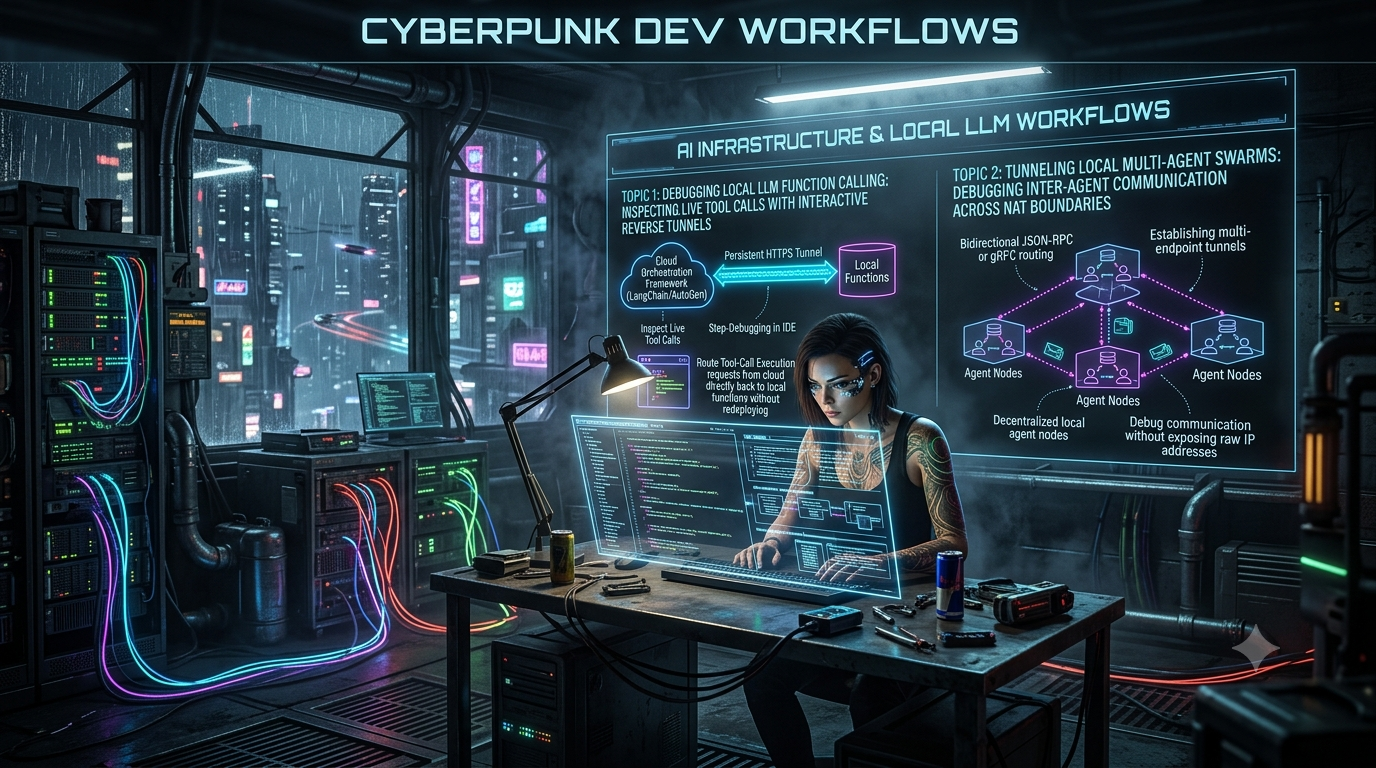
The rapid evolution of LLM orchestrations—from simple single-prompt completions to complex multi-agent swarms—has outpaced traditional debugging and networking patterns. Developing autonomous AI systems locally introduces distinct infrastructure friction: managing closed cloud execution contexts, handling asynchronous state synchronization, and navigating local NAT/firewall boundaries.
This operational guide provides two deep-dive engineering patterns designed to resolve these challenges:
- Interactive Reverse Tunneling for Real-Time LLM Function Calling Debugging
- DeCentralized gRPC / JSON-RPC Multi-Agent Swarm Orchestration Across Network Boundaries
Topic 1: Debugging Local LLM Function Calling: Inspecting Live Tool Calls with Interactive Reverse Tunnels
The Architecture Problem: The Cloud-to-Local Tool Gap
When building agentic applications with cloud-hosted Large Language Models (e.g., OpenAI GPT-4o, Anthropic Claude 3.5 Sonnet, or hosted DeepSeek instances) via orchestration layers like LangChain, LlamaIndex, or AutoGen, tool calls (function calling) execute in a decoupled, two-step loop:
- Inference Phase: The client sends prompt context and JSON Schema tool definitions to the cloud LLM.
- Execution Phase: The cloud LLM emits a structured
tool_callspayload containing function signatures and parsed arguments. The orchestration client receives this payload and must execute the target function before sending the result back to the LLM.
┌─────────────────┐       1. Prompt + Tool Schema       ┌─────────────────┐
│                 │ ──────────────────────────────────> │                 │
│ Cloud LLM API   │                                     │ Local App /     │
│ (Hosted Model)  │ <────────────────────────────────── │ Orchestrator    │
│                 │      2. Output: tool_calls JSON     └────────┬────────┘
└─────────────────┘                                              │
                                                                 │ 3. Local Execution
                                                                 ▼
                                                        ┌─────────────────┐
                                                        │ Local Function  │
                                                        │ (IDE Debugger)  │
                                                        └─────────────────┘
Where Development Friction Occurs
When offloading tool execution to external webhooks, cloud sandboxes, or remote agent nodes, developers face severe friction:
- Silent Schema Mismatches: The LLM generates arguments that fail Pydantic validation locally, aborting without detailed runtime execution logs.
- Opaque Execution: Print-debugging or static console loggers conceal exact parameter mutations, state updates, and network latency during tool execution.
- Redeployment Latency: Code changes to local tools require continuous container builds or serverless deployments just to test a single edge-case parameter.
Reverse Tunneling Architecture for Live Tool Execution
Instead of deploying local code to staging environments to receive incoming webhook executions, developers can expose their local runtime environment to the internet using Persistent TLS Reverse Tunnels (utilizing tools such as ngrok, Cloudflare Tunnels, or devtunnel).
By routing external orchestration execution callbacks through an encrypted tunnel directly into a local development server running on localhost, developers can set breakpoints inside Python or TypeScript IDEs (VS Code / PyCharm) and inspect live stack frames as the LLM triggers tools in real time.
┌────────────────────────────────────────────────────────────────────────┐
│ PUBLIC INTERNET / CLOUD                                                │
│                                                                        │
│   ┌────────────────────────┐            ┌──────────────────────────┐   │
│   │ Cloud Orchestration /  │            │ Reverse Tunnel Gateway   │   │
│   │ Remote Agent Worker    │            │ (e.g., ngrok / Cloudflare)│   │
│   └───────────┬────────────┘            └────────────▲─────────────┘   │
└───────────────│──────────────────────────────────────│─────────────────┘
                │ Webhook HTTP POST                    │
                │ https://agent-dev.ngrok.app/execute  │ Persistent
                └──────────────────────────────────────┼─ TLS Tunnel
                                                       │
┌──────────────────────────────────────────────────────│─────────────────┐
│ LOCAL DEVELOPMENT ENVIRONMENT                        │                 │
│                                                      │                 │
│   ┌────────────────────────┐            ┌────────────┴─────────────┐   │
│   │ Local IDE Debugger     │ ◄───────── │ Tunnel Client daemon     │   │
│   │ (Breakpoints & State)  │ Localhost  │ (localhost:8000)          │   │
│   └────────────────────────┘            └──────────────────────────┘   │
└────────────────────────────────────────────────────────────────────────┘
Step-by-Step Execution Setup
Step 1: Set Up the Persistent TLS Tunnel
Initialize a secure reverse tunnel targeting your local tool server's port (e.g., 8000).
# Using ngrok to open a persistent HTTP tunnel with host header preservation
ngrok http 8000 --domain=agent-dev-environment.ngrok.app

# Alternatively using Microsoft devtunnel CLI
devtunnel host -p 8000 --allow-anonymous
Step 2: Implement the Tool Server with Breakpoint Capabilities
Below is a complete FastAPI implementation exposing an extensible tool interface designed to execute local functions requested by a cloud-orchestrated model.
# tool_server.py
import uvicorn
from fastapi import FastAPI, HTTPException, Request
from pydantic import BaseModel, Field
from typing import Any, Dict

app = FastAPI(title="Local Tool Debugging Bridge")

# Define sample tool payload schema
class ToolExecutionRequest(BaseModel):
    call_id: str
    tool_name: str
    arguments: Dict[str, Any]

class ToolExecutionResponse(BaseModel):
    call_id: str
    status: str
    result: Any

# Sample business logic function to be debugged
def calculate_database_query(query: str, limit: int) -> dict:
    # 🔴 SET IDE BREAKPOINT HERE
    # Inspect 'query' and 'limit' values sent live from the cloud LLM
    processed_query = query.strip().lower()

    if limit > 100:
        # Catch unexpected LLM hallucinated arguments in real-time
        limit = 100

    return {
        "status": "success",
        "rows_returned": limit,
        "executed_query": processed_query
    }

REGISTERED_TOOLS = {
    "calculate_database_query": calculate_database_query
}

@app.post("/execute-tool", response_model=ToolExecutionResponse)
async def handle_tool_call(payload: ToolExecutionRequest):
    """
    Webhook endpoint invoked by cloud orchestrator via Reverse Tunnel.
    """
    print(f"\n[INCOMING TOOL CALL] ID: {payload.call_id} | Tool: {payload.tool_name}")
    print(f"[ARGUMENTS]: {payload.arguments}")

    if payload.tool_name not in REGISTERED_TOOLS:
        raise HTTPException(status_code=404, detail=f"Tool '{payload.tool_name}' not registered locally.")

    # Direct invocation allows live stepping in IDE debuggers
    target_function = REGISTERED_TOOLS[payload.tool_name]

    try:
        # Dynamically unpack LLM-supplied arguments into local function
        execution_result = target_function(**payload.arguments)

        return ToolExecutionResponse(
            call_id=payload.call_id,
            status="completed",
            result=execution_result
        )
    except TypeError as e:
        # Identifies LLM parameter schema violations instantly
        print(f"[SCHEMA ERROR] Invalid arguments passed by LLM: {str(e)}")
        raise HTTPException(status_code=422, detail=f"Argument mismatch: {str(e)}")

if __name__ == "__main__":
    # Launch local server
    uvicorn.run("tool_server:app", host="127.0.0.1", port=8000, reload=True)
Step 3: Configure Cloud Orchestrator Client
Configure the client application to point tool execution callbacks toward the dynamic reverse tunnel URL instead of internal execution.
# orchestrator_client.py
import requests
from langchain_openai import ChatOpenAI
from langchain_core.messages import HumanMessage, ToolMessage

TUNNEL_URL = "https://agent-dev-environment.ngrok.app/execute-tool"

# Initialize model
llm = ChatOpenAI(model="gpt-4o", temperature=0)

# Define tool schema made available to model
tools = [{
    "type": "function",
    "function": {
        "name": "calculate_database_query",
        "description": "Executes a structured query against local database.",
        "parameters": {
            "type": "object",
            "properties": {
                "query": {"type": "string", "description": "SQL query string"},
                "limit": {"type": "integer", "description": "Maximum rows to return"}
            },
            "required": ["query", "limit"]
        }
    }
}]

# Initial model call
messages = [HumanMessage(content="Run a query for active users with limit 50.")]
response = llm.invoke(messages, tools=tools)

# Process function calls returned by the model
if response.tool_calls:
    for tool_call in response.tool_calls:
        print(f"Routing tool call '{tool_call['name']}' through reverse tunnel...")

        # Dispatch execution request across external tunnel to localhost IDE
        webhook_payload = {
            "call_id": tool_call["id"],
            "tool_name": tool_call["name"],
            "arguments": tool_call["args"]
        }

        tunnel_response = requests.post(TUNNEL_URL, json=webhook_payload)
        tool_result = tunnel_response.json()

        print(f"Received Local Result: {tool_result}")
Advanced Inspection Techniques
1. Header and Payload Inspection
Reverse tunnel utilities expose local Web UI dashboards (e.g., [http://127.0.0.1:4040](http://127.0.0.1:4040) for ngrok). Developers can inspect raw HTTP headers, inspect JSON serialization errors, and issue 1-Click Replay actions to re-trigger failed tool executions through local breakpoints without re-running long LLM generation steps.
2. Conditional Breakpoints
Set conditional breakpoints in your IDE based on LLM execution properties:
# Python IDE Conditional Breakpoint Condition
len(payload.arguments.get("query", "")) > 100 or payload.arguments.get("limit") is None
This isolates edge cases where LLMs generate malformed arguments under long context conditions.
3. Enterprise Security & Access Control
When tunneling local endpoints, enforce strict security controls to prevent public access:
- Mutual TLS (mTLS): Enforce client certificate validation at the tunnel client.
- Header Signatures: Verify HMAC headers (
X-Signature-SHA256) sent by orchestration endpoints to ensure requests originate exclusively from authorized cloud services.
Topic 2: Tunneling Local Multi-Agent Swarms: Debugging Inter-Agent Communication Across NAT Boundaries
The Network Bottleneck in Decentralized Agent Architectures
As agentic design moves toward heterogeneous multi-agent swarms (such as AutoGen/AG2, CrewAI, or custom A2A / Model Context Protocol implementations), individual specialized agents are increasingly distributed across disparate environments:
- Agent A (Planner): Runs inside a corporate AWS VPC.
- Agent B (Code Interpreter): Runs inside a local, isolated Docker container on a developer's laptop behind NAT.
- Agent C (Hardware Controller): Runs on an edge device (e.g., Raspberry Pi or NVIDIA Jetson) behind a restricted cellular firewall.
┌─────────────────────────────────────────────────────────────────────────────┐
│ CORPORATE VPC (AWS)                                                         │
│                                                                             │
│   ┌─────────────────────────────────────────────────────────────────────┐   │
│   │ Agent A (Supervisor / Coordinator)                                  │   │
│   └──────────────────────────────────┬──────────────────────────────────┘   │
└──────────────────────────────────────│──────────────────────────────────────┘
                                       │
     ❌ CANNOT DIRECTLY ROUTE OVER PUBLIC INTERNET (NO PUBLIC IP)
                                       │
┌──────────────────────────────────────┴──────────────────────────────────────┐
│ LOCAL OFFICE / WORKSTATION (BEHIND NAT & FIREWALLS)                         │
│                                                                             │
│   ┌────────────────────────────────┐     ┌──────────────────────────────┐   │
│   │ Agent B (Code Sandbox Docker)  │     │ Agent C (Edge Sensor Node)   │   │
│   │ IP: 172.18.0.2 (Private)       │     │ IP: 192.168.1.45 (Private)   │   │
│   └────────────────────────────────┘     └──────────────────────────────┘   │
└─────────────────────────────────────────────────────────────────────────────┘
The Infrastructure Challenge
Standard networking protocols break down in these topologies:
- Symmetric NATs & Strict Firewalls: Block inbound connections to local agent nodes, preventing peer-to-peer invocation.
- Dynamic IP Assignment: Disallows static hardcoding of agent endpoints.
- High Inter-Agent Latency: Traditional HTTP REST polling adds prohibitive latency to complex agent negotiation loops requiring hundreds of back-and-forth messages.
Protocol Selection Matrix: gRPC vs. JSON-RPC over Tunnel Meshes
When selecting a communication layer for decentralized agentic swarms, transport choice heavily dictates throughput, schema strictness, and streaming efficiency.
| Architectural Attribute | JSON-RPC 2.0 over HTTP/2 WebSocket | gRPC over HTTP/2 Tunnel |
|---|---|---|
| Payload Format | Text-based JSON (human-readable) | Binary Protocol Buffers (highly compressed) |
| Schema Enforcement | Dynamic / Runtime (Pydantic / Zod) | Static / Compile-time (.proto files) |
| Streaming Capability | Full-duplex via WebSockets / SSE | Native Bidirectional Streaming |
| Latency Profile | Moderate (Parsing overhead) | Ultra-low (Zero-copy serialization) |
| NAT Traversal Fit | Lightweight, easy web debugging | Exceptional efficiency over multiplexed TCP |
| Ideal Agent Workflows | Ad-hoc text swarms, flexible JSON schemas | High-frequency sensor swarms, multi-modal streaming |
Implementing Multi-Endpoint WireGuard / Tunnel Topology
To enable seamless inter-agent routing across NAT boundaries without assigning public IP addresses, developers can deploy an encrypted overlay network using WireGuard, Tailscale, or P2P Reverse Tunnel Gateways.
                         ┌─────────────────────────┐
                         │   Relay Gateway Node    │
                         │   (Public Overlay Net)  │
                         └────────────▲────────────┘
                                      │
            ┌─────────────────────────┴─────────────────────────┐
            │ WireGuard / Overlay Mesh Tunnel (Encrypted UDP)   │
            └────────────▲─────────────────────────▲────────────┘
                         │                         │
     ┌───────────────────┴──────────┐   ┌──────────┴───────────────────┐
     │ Node 1: Cloud Orchestrator   │   │ Node 2: Local Developer Edge  │
     │ Mesh IP: 10.0.0.1            │   │ Mesh IP: 10.0.0.2             │
     │ (Supervisor Agent)           │   │ (Worker Agent Container)     │
     └──────────────────────────────┘   └──────────────────────────────┘
Production Implementation: Asynchronous JSON-RPC 2.0 Inter-Agent Communication
Below is a complete implementation of a decentralized multi-agent system executing across local container boundaries over a tunneled JSON-RPC mesh.
1. JSON-RPC Protocol Definition & Base Agent (agent_protocol.py)
# agent_protocol.py
import json
from typing import Any, Dict, Optional
from pydantic import BaseModel, Field

class JSONRPCRequest(BaseModel):
    jsonrpc: str = "2.0"
    method: str
    params: Dict[str, Any]
    id: str

class JSONRPCResponse(BaseModel):
    jsonrpc: str = "2.0"
    result: Optional[Any] = None
    error: Optional[Dict[str, Any]] = None
    id: str

class AgentCapability(BaseModel):
    agent_id: str
    description: str
    methods: list[str]
2. Local Worker Agent implementation (local_worker_agent.py)
This agent runs inside a local private network, serving capabilities over an encrypted tunnel.
# local_worker_agent.py
import asyncio
from fastapi import FastAPI, WebSocket, WebSocketDisconnect
from agent_protocol import JSONRPCRequest, JSONRPCResponse
import uvicorn

app = FastAPI(title="Local Worker Agent Node")

async def execute_code_analysis(code: str) -> dict:
    """Simulates local secure code analysis worker task."""
    await asyncio.sleep(0.5) # Simulate processing time
    return {
        "complexity_score": 4,
        "vulnerabilities_found": 0,
        "suggestion": "Optimize loop construct at line 12."
    }

@app.websocket("/ws/rpc")
async def websocket_rpc_endpoint(websocket: WebSocket):
    await websocket.accept()
    print("[MESH] Cloud Agent connected to Local Worker Agent RPC Interface.")

    try:
        while True:
            # Receive raw RPC request frame from overlay network
            raw_data = await websocket.receive_text()
            request_data = JSONRPCRequest.model_validate_json(raw_data)

            print(f"[RPC REQUEST RECEIVED] Method: {request_data.method}")

            # Method Dispatching
            if request_data.method == "analyze_code":
                code_param = request_data.params.get("code", "")
                execution_output = await execute_code_analysis(code_param)

                response = JSONRPCResponse(
                    result=execution_output,
                    id=request_data.id
                )
            else:
                response = JSONRPCResponse(
                    error={"code": -32601, "message": "Method not found"},
                    id=request_data.id
                )

            # Emit RPC response back through WebSocket tunnel
            await websocket.send_text(response.model_dump_json())

    except WebSocketDisconnect:
        print("[MESH] Swarm node disconnected.")

if __name__ == "__main__":
    # Server listens locally; exposed across network mesh via local tunnel client
    uvicorn.run(app, host="0.0.0.0", port=9001)
3. Remote Cloud Supervisor Agent (cloud_supervisor.py)
This agent orchestrates workflow steps by routing RPC commands over the mesh to the local worker agent IP or tunneled alias.
# cloud_supervisor.py
import asyncio
import websockets
import uuid
from agent_protocol import JSONRPCRequest, JSONRPCResponse

# Pointing to the secure overlay IP assigned by tunnel mesh (e.g., Tailscale/WireGuard or Tunnel Proxy)
LOCAL_WORKER_TUNNEL_ENDPOINT = "ws://10.0.0.2:9001/ws/rpc"

async def dispatch_task_to_local_agent(method: str, params: dict):
    request_id = str(uuid.uuid4())

    rpc_payload = JSONRPCRequest(
        method=method,
        params=params,
        id=request_id
    )

    print(f"[SUPERVISOR] Connecting to Local Agent across NAT mesh at {LOCAL_WORKER_TUNNEL_ENDPOINT}...")

    async with websockets.connect(LOCAL_WORKER_TUNNEL_ENDPOINT) as ws:
        # Transmit RPC Call
        await ws.send(rpc_payload.model_dump_json())
        print(f"[SUPERVISOR] Dispatched method '{method}' [ID: {request_id}]")

        # Await Response Frame
        raw_response = await ws.recv()
        response = JSONRPCResponse.model_validate_json(raw_response)

        if response.error:
            print(f"[RPC ERROR] Code {response.error['code']}: {response.error['message']}")
        else:
            print(f"[SUPERVISOR SUCCESS] Execution Result: {response.result}")

if __name__ == "__main__":
    # Execute inter-agent orchestration
    sample_code = "def fibonacci(n):\n    return n if n <= 1 else fibonacci(n-1) + fibonacci(n-2)"
    asyncio.run(dispatch_task_to_local_agent("analyze_code", {"code": sample_code}))
Observability, Tracing, and NAT Keep-Alive Strategies
1. OpenTelemetry Context Propagation Across Agent Swarms
When Agent A invokes Agent B over JSON-RPC, the trace context must survive network boundary transit. Include OpenTelemetry traceparent headers directly inside the RPC parameters payload:
{
  "jsonrpc": "2.0",
  "method": "analyze_code",
  "params": {
    "code": "...",
    "_telemetry_context": {
      "traceparent": "00-4bf92f3577b34da6a3ce929d0e0e4736-00f067aa0ba902b7-01"
    }
  },
  "id": "req-001"
}
This enables distributed tracing tools (like Jaeger, Honeycomb, or LangSmith) to visualize end-to-end execution trees across cloud servers and isolated local laptops.
2. NAT State Table Keep-Alives
Firewalls drop inactive TCP connection states across NAT routers after periods of silence (often 30–120 seconds). To keep bidirectional multi-agent tunnels alive:
- TCP Keepalives: Configure lower-level socket options (
SO_KEEPALIVEwithTCP_KEEPIDLE=30). - Application-Level Pings: Emit ping frames every 15 seconds within WebSocket or gRPC connections:
# Enable WebSocket keepalive ping in Python client
async with websockets.connect(endpoint, ping_interval=15, ping_timeout=10):
    ...
3. Automatic Re-routing & Mesh Topology Failover
In production multi-agent setups, if a local worker agent loses connectivity, the supervisor agent's circuit breaker should instantly divert tasks to a fallback agent node or cloud-hosted queue.
# Conceptual Fallback Circuit Breaker
try:
    await dispatch_task_to_local_agent(...)
except (websockets.exceptions.ConnectionClosedError, TimeoutError):
    print("[CIRCUIT BREAKER] Local agent offline. Rerouting to cloud fallback node...")
    await dispatch_task_to_cloud_fallback(...)
Conclusion & Architecture Checklist
Building resilient local-to-cloud and multi-agent infrastructure requires shifting from static deployment assumptions to modern tunnel-aware architectures:
- [x] For Function Calling: Use reverse TLS tunnels (
ngrok,devtunnel) to bridge cloud model execution back to local breakpoint-enabled servers. - [x] For Inter-Agent Networks: Leverage structured transports (JSON-RPC or gRPC over HTTP/2) layered atop private mesh networks (WireGuard, Tailscale) to bypass NAT constraints.
- [x] For Observability: Propagate trace contexts across network boundaries to preserve end-to-end execution visibility across distributed swarm topologies.
Originally published at https://instatunnel.my/blog/architecting-production-ai-systems-local-llm-tool-debugging-decoupled-swarm-infrastructure


Comments
Post a Comment